SBS NEWS
US Private Equity Fund Lone Star Loses Remand Trial Over W168.2 Billion Tax Refund Claim
Published : Oct 22, 2026 11:47 AM

The 16th Civil Division of the Seoul High Court (Presiding Judges Jeong Jae-o, Kim Sun-hee, and Lee Won-seok) ruled against the plaintiffs today (October 22) in the unjust enrichment return lawsuit filed by nine companies, including Lone Star Funds, against the government and Seoul.
This ruling follows the legal principles set by the Supreme Court in April of last year.
The case began after Lone Star invested in institutions such as Korea Exchange Bank (KEB), Kukdong Engineering & Construction, and Staris between 2002 and 2005, subsequently earning hundreds of billions of won in dividends and trillions of won in capital gains upon selling some of its stakes in 2007.
At the time, under the South Korea-Belgium Tax Treaty, KEB and other entities withheld national taxes when paying dividends to Lone Star, meaning Lone Star did not pay separate taxes directly.
Later, the Seoul Regional Tax Office imposed additional corporate and other taxes amounting to some 800 billion won on Lone Star, arguing that the fund maintained a permanent establishment in South Korea.
The previously withheld taxes were then deducted and appropriated against this tax amount.
Lone Star contested the corporate tax imposition by filing a lawsuit, and in 2017 the Supreme Court ruled that the corporate tax imposition should be cancelled, stating that "investments were made by the headquarters in the U.S., so it cannot be deemed that there was a permanent establishment in South Korea."
Following this, arguing that since the corporate tax was cancelled, the previously deducted and appropriated withholding tax amount of 153.5 billion won should be returned, Lone Star filed a new lawsuit against the South Korean government in December 2017.
Claiming under the same logic that canceled local taxes should also be returned, Lone Star filed an additional lawsuit against Seoul and Gangnam District in January 2018.
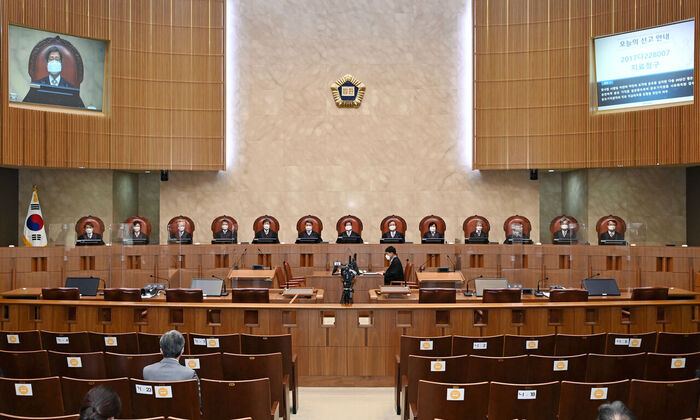
The first and second-instance courts ruled that since the withholding tax had been deducted and appropriated from the corporate tax, and the corporate tax itself was canceled, it should be refunded. They ordered the government to return 153 billion won in corporate taxes and Seoul to return 15.2 billion won in local income taxes to Lone Star.
However, the Supreme Court ruled that "once the disposition imposing corporate taxes is canceled, the effect of deducting and appropriating the withholding tax refund from the corporate taxes also ceases to exist," adding that "consequently, the deducted and appropriated refund must be regarded as belonging to the withholding obligor (such as KEB) who is the nominal taxpayer."
The Supreme Court stated, "The corporate tax imposition disposition in this case was premised on the plaintiffs (Lone Star, etc.) being the actual beneficiaries and taxpayers," and added, "The deduction and appropriation disposition was merely an arbitrary process as if the plaintiffs' corporate taxes were collected by holding a withholding tax refund claim that did not originally belong to them, and there is a high possibility that its effect was invalid from the beginning," thereby ordering a re-trial and fresh judgment.
This means that, barring special circumstances, the refund for taxes withheld and paid by companies including KEB belongs to the withholding entity rather than Lone Star.
During the remand trial, Lone Star argued that there was an agreement between the parties that Lone Star was the substantive entity that actually paid the taxes that were deducted and appropriated, but the court did not accept this argument.
(Photo: Yonhap News)
※ Please note: This article was translated by AI and may contain errors.
Copyright Ⓒ SBS. All rights reserved. Unauthorized reproduction, redistribution, and use for AI training are prohibited.