SBS NEWS
"Missing Rebar and Damaged Steel: Major Sports Facilities Face Collapse Risks, Including Roofs"
Published : Oct 21, 2026 1:28 PM

▲ Board of Audit and Inspection building
A significant number of major domestic sports facilities have been found with severe structural defects left unaddressed or lacking safety inspections.
The Board of Audit and Inspection (BAI) released these interim audit findings regarding the safety management status of multi-use sports facilities.
While stating that these facilities are not at an immediate risk of collapse, the BAI warned that certain risks cannot be ruled out if adverse conditions such as heavy snow and strong winds overlap.
Accordingly, the BAI explained that the Ministry of Culture, Sports and Tourism and respective local governments are formulating corrective measures for the defects with public safety in mind.
The inspections revealed that several local governments had been neglecting defects in multi-use sports facilities.
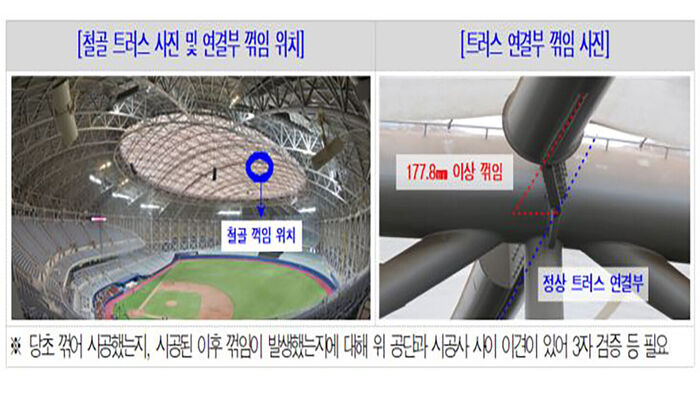
▲ Photo of bent steel truss connection at Gocheok Sky Dome
In 2024, the Seoul Facilities Corporation identified that 23 out of 466 steel truss connections on the roof of the Gocheok Sky Dome were bent, and received a recommendation to reinforce both sides of the trusses following a detailed safety diagnosis.
However, the corporation proceeded with construction based solely on the contractor's opinion that reinforcing only one side would suffice. A safety review conducted during the audit period ultimately showed that the load-bearing capacity of the truss connections was insufficient.
An official from the BAI explained, "While it is not to the extent of immediately closing the stadium, it is true that it becomes dangerous under special circumstances such as heavy snow," adding, "There is a need for prompt reinforcement, and if unexpected heavy snow occurs, we believe halting performances may also be necessary."
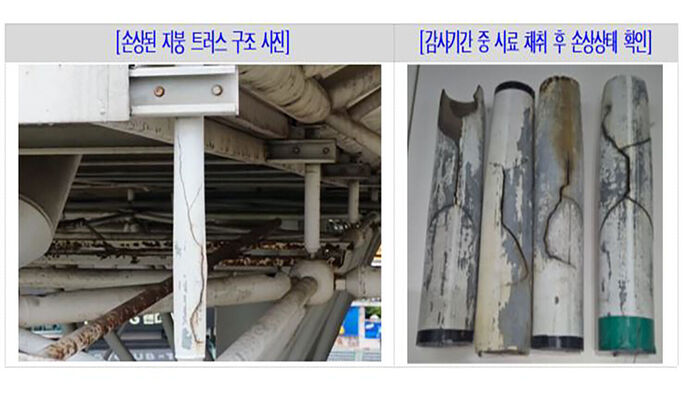
▲ Photo of damaged structure at Incheon Munhak Stadium
Although the city of Incheon also confirmed in 2024 that damage was progressing in 50 steel truss members supporting the roof of Incheon Munhak Stadium, it had practically left them neglected while planning to carry out reinforcement work in 2028.
The Seoul Metropolitan Government pushed forward with the remodeling project for Jamsil Sports Complex without reviewing wind tunnel tests or other evaluations, even though the roof structure was diagnosed as having insufficient load-bearing capacity against wind pressure under open conditions without obstacles.
Jeonju City identified that the cause of cracks in the column brackets—the supporting structures—during a 2016 safety diagnosis of Jeonju World Cup Stadium was the omission of rebar during construction, yet it only reinforced 89 of the 389 brackets where cracks were identified, leaving the remaining 300 neglected.
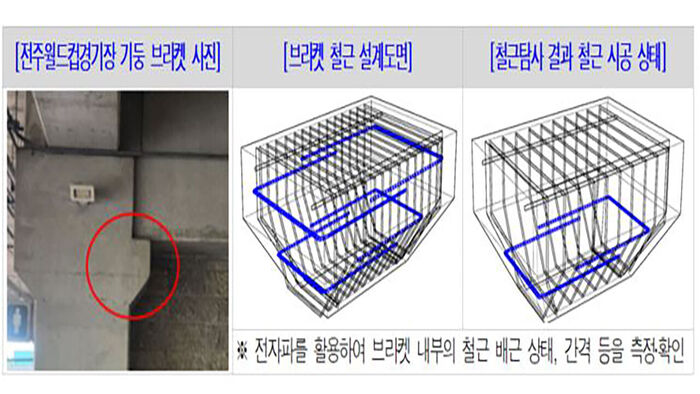
▲ Photo of Jeonju Stadium column brackets
Consequently, a sample inspection of 25 out of the 300 unreinforced brackets revealed rebar omissions in 24 of them, with 13 showing insufficient load-bearing capacity.
The Seoul Facilities Corporation also judged the Seoul World Cup Stadium to be safe during a 2012 diagnosis without reflecting the load of a 120-ton kiln facility.
The BAI diagnosed that for these five stadiums, the possibility of partial structural collapse depending on weather and other conditions cannot be entirely ruled out overall.
The audit also pointed out that safety inspections for workplace sports facilities have not been conducted for a long period.
From 2017 to 2025, the Ministry of Culture, Sports and Tourism failed to include an estimated 2,500 workplace sports facilities nationwide in the scope of inspections during the establishment of safety management plans, leaving many neglected without inspections.
Furthermore, local governments were found to have input "Good" into the Sports Facility Information Management System without conducting safety inspections and left them unattended.
Management of fire-fighting equipment and emergency generators in preparation for contingencies was also found to be inadequate.
Five sports facilities, including the Gocheok Sky Dome, lacked sufficient electrical capacity in their emergency generators, raising concerns that emergency power would fail to be supplied in the event of a fire, rendering fire-fighting systems inoperable and potentially worsening fire damage.
It was also found that a football field in Pohang lacked connected water supply pipe systems in some areas, restricting firefighting operations.
Instances where performance producers and others sold tickets exceeding the expected audience numbers outlined in disaster response plans were also going unchecked.
In fact, for 33 performances held between 2024 and 2025 across seven indoor sports facilities including the Olympic Gymnastics Arena, ticket sales were confirmed to have exceeded the expected audience numbers by more than 10%.
In addition, many facilities lacked proper evacuation time standards or had arbitrarily set times, raising concerns over crowd crush accidents in the event of a fire.
The management of water quality in public swimming pools and indoor air quality in sports facilities was also neglected.
In the case of a swimming pool in Yongin, chlorine was not dispensed due to equipment failure, yet it was left unattended, resulting in levels of coliform bacteria exceeding standard limits in the water.
Substandard water quality, such as failure to meet residual chlorine standards, was identified at nine swimming pools.
Four indoor sports facilities, including the Jangchung Gymnasium, either failed to measure air quality or left fine dust concentrations exceeding standard limits unattended without improvement measures.
Regarding the audit, the BAI stated, "It was conducted to enhance public safety and promote convenience," adding, "According to estimates by the Korea Institute of Civil Engineering and Building Technology, the audit is projected to yield safety accident prevention benefits amounting to 800 billion won."
It further added, "The Ministry of Culture, Sports and Tourism and local governments are formulating preliminary measures for the structural defects in facilities and poor swimming pool water quality management identified through the audit," and "The interim findings will be finalized after deliberation by the Audit Commission."
(Photo provided by BAI, Yonhap News)
※ Please note: This article was translated by AI and may contain errors.
Copyright Ⓒ SBS. All rights reserved. Unauthorized reproduction, redistribution, and use for AI training are prohibited.