SBS NEWS
Corporate Profitability Improved Last Year, but Polarization Widened with Record Share of Firms Failing to Cover Interest
Published : Oct 21, 2026 1:11 PM

▲ Bank of Korea headquarters
While the profitability and financial stability of South Korean corporations improved last year, a clear temperature gap remained between large corporations and small and medium-sized enterprises (SMEs), data showed.
Bolstered by booms in major sectors such as semiconductors and shipbuilding, the operating profit margin for all corporations hit a four-year high, whereas SMEs saw a decline.
Meanwhile, the proportion of companies with an interest coverage ratio below 100% reached a record high since statistics began.
According to the 2025 Corporate Business Analysis results released by the Bank of Korea (BOK) today (October 21), the operating profit margin to sales for 982,767 corporations across all industries (187,804 in manufacturing and 794,963 in non-manufacturing) stood at 5.2% last year, up 0.6 percentage points (p) from the previous year (4.6%).
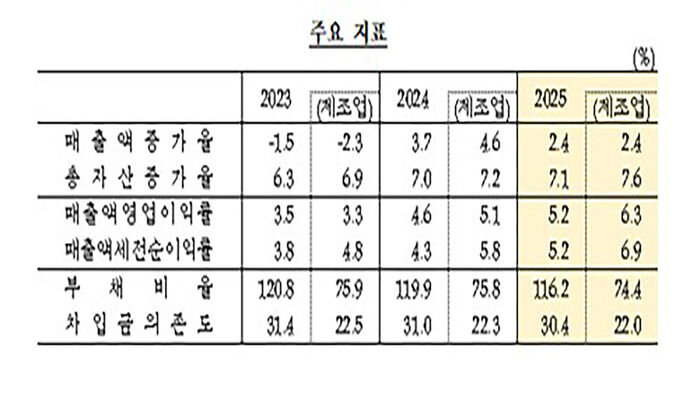
The pre-tax net profit margin (5.2%) also rose by 0.9 percentage points over the course of a year.
The operating profit margin to sales is at its highest level since 2021 (5.6%).
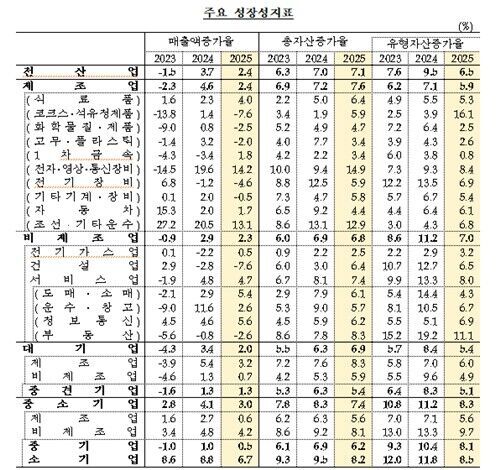
By industry, both manufacturing (rising from 5.1% to 6.3%) and non-manufacturing (from 4.1% to 4.3%) posted increases.
The manufacturing sector was driven primarily by electronic, video, and communication equipment (8.3% to 14.0%), as well as shipbuilding and other transport equipment (6.4% to 11.6%).
This was largely influenced by expanded sales of high-value-added semiconductor products and increased revenue recognition from high-value-added ships.
By corporate size, trends diverged between large enterprises and SMEs.
The operating profit margin for large corporations rose from 5.6% to 6.7%, marking the highest level since 2021 (7.0%), while that for SMEs fell from 3.0% to 2.8%, hitting the lowest level since tracking began in 2009.
Lee Mi-joo, head of the Corporate Statistics Team at the BOK, analyzed, "Industries with sluggish business conditions might be slightly more concentrated among medium-sized or smaller companies, and overall improvements in profitability indicators appear to be more concentrated in large corporations."
However, the BOK explained, "Since the major industries with improved profitability are skewed toward large enterprises, and profitability recovery is spreading even to SMEs this year, we do not view this as an intensification of polarization."
Looking at financial stability indicators, the overall corporate debt-to-equity ratio (116.2%) and dependence on borrowings (30.4%) declined from the previous year (119.9% and 31.0%, respectively).
The debt-to-equity ratio is at its lowest level since 2019 (115.6%).
In contrast, growth indicators slowed down.
Last year's corporate sales growth rate stood at 2.4%, down 1.3 percentage points from the previous year (3.7%).
The sales growth rate in the manufacturing sector dropped from 4.6% to 2.4%.
This was heavily affected by a drop in the sales growth rate of coke and refined petroleum products from 1.4% to -7.6%, driven by falling petroleum product prices due to lower international oil prices.
The non-manufacturing sector (2.9% to 2.3%) declined mainly led by transportation and warehousing (11.6% to 2.6%) and construction (-2.8% to -7.6%).
The BOK explained that growth in transport revenue slowed due to falling container shipping freight rates, while the contraction in sales widened amid sluggish conditions in the construction industry.
By corporate size, both large enterprises (3.4% to 2.0%) and SMEs (4.1% to 3.0%) experienced declines.
However, the BOK explained that rather than judging performance as poor this year, a base effect was at play following a relatively high growth rate in 2024 after negative growth (-1.5%) was recorded in 2023.
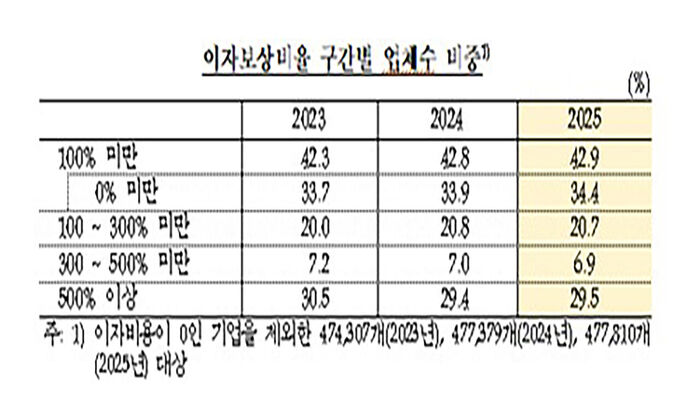
Last year's interest coverage ratio (operating profit to sales divided by financial expense burden rate) rose to 292.7%, up from 244.1% a year earlier.
However, the proportion of companies with an interest coverage ratio of less than 100% edged up from 42.8% to 42.9%.
This is the highest figure since relevant statistics began in 2009.
An interest coverage ratio below 100% means that a company's annual earnings fall short of covering financial expenses such as interest.
Team Head Lee noted, "When calculating the proportion of companies with an interest coverage ratio below 100%, firms with no interest expenses are excluded," adding, "Rather than an overall deterioration in profitability and stability, there was a slight increase in that proportion among companies carrying interest burdens."
She continued, "Looking at the corporate business analysis results for the first and second quarters of this year, profitability indicators for SMEs are also improving alongside large corporations," and analyzed, "Overall, this trend [of an increasing share of companies with an interest coverage ratio below 100%] is unlikely to persist."
The BOK stated that it did not separately calculate the contribution of major semiconductor large corporations to the profitability and growth of all businesses.
It added, "Even when calculating industry-wide indicators excluding Samsung Electronics and SK Hynix, it has no impact on the overall direction of growth, profitability, and stability indicators."
(Photo courtesy of the Bank of Korea, Yonhap News)
※ Please note: This article was translated by AI and may contain errors.
Copyright Ⓒ SBS. All rights reserved. Unauthorized reproduction, redistribution, and use for AI training are prohibited.