SBS NEWS
Are U.S. Midterm Elections Truly a Graveyard for the Ruling Party?
Published : Oct 21, 2026 8:55 AM

The U.S. midterm elections are often called a "graveyard for the ruling party." This means that the president's party frequently loses seats in the election. In South Korean terms, it means the ruling party that produced the president struggles in the election.
Has the ruling party really always lost in U.S. midterm elections? The SBS Fact-Check "Fact Is" team investigated.

Let us first look at how U.S. congressional elections are conducted.
The U.S. Congress is divided into the House of Representatives and the Senate. Members of the House serve two-year terms, so all 435 seats are up for election every two years. In contrast, senators serve six-year terms. Elections are held for about one-third of the total 100 seats at a time. Congressional elections are also held concurrently in presidential election years.
In other words, to understand how many seats the ruling party has lost in midterm elections, it is necessary to examine the House and Senate separately.
First, as of October 22, 2026, the seat distribution in the U.S. Senate and House is as follows.
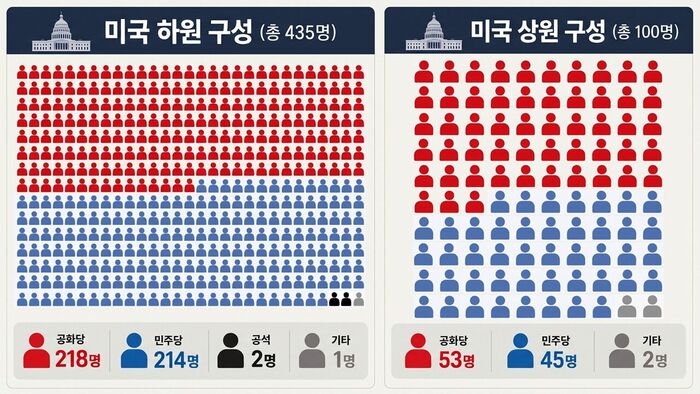
The SBS "Fact Is" team examined how many seats the president's party gained or lost in past midterm elections. The analysis focused on the period since the 1950s, when the American two-party system became firmly established.
Because data compiling election results vary slightly across media reports, and even across foreign news outlets and research papers, the team directly verified the numbers based on the official websites of the U.S. House and Senate. The figures reflect changes in seats immediately following the elections.
The results were as follows.
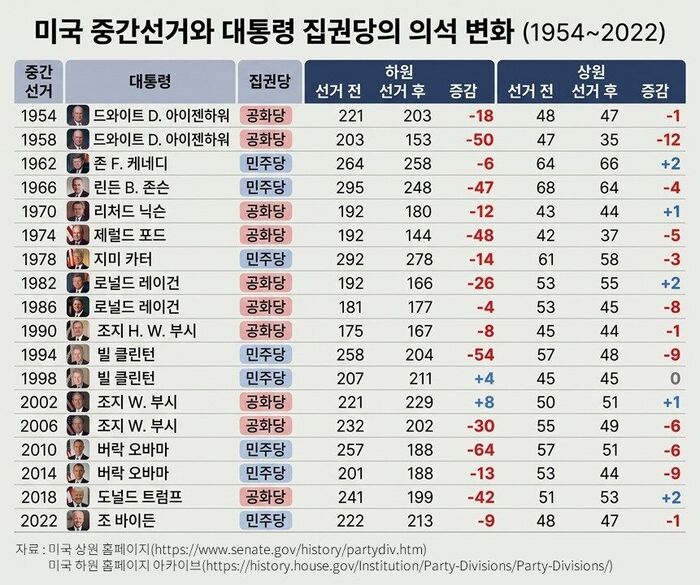
First is the change in House seats.
There were only two occasions when the ruling party gained House seats after a midterm election: in 1998 and 2002. The 1998 midterms took place during the administration of President Bill Clinton (Democrat), and the 2002 midterms during that of President George W. Bush (Republican). Analyses indicated that the 1998 midterm result was driven by an economic boom and backlash against the Republicans' aggressive impeachment push against the Clinton administration, while the 2002 result was attributed to the rally-round-the-flag effect uniting the country behind the president in the immediate aftermath of the September 11 terrorist attacks.
However, these two cases were evaluated as "historic anomalies," and in all other elections, the ruling party lost House seats.
The Senate showed a similar trend. The ruling party lost seats in most cases. However, seat gains occurred five times, which was relatively more frequent than in the House.
The Senate was analyzed to have lower elasticity than the House regarding the "midterm referendum" on the ruling party.
In the House, all 435 seats are up for election. If voters' evaluation of the president deteriorates, ruling party candidates can be affected all at once. In contrast, only about one-third of the Senate's 100 seats are contested. Even if public dissatisfaction with the ruling party surges in a particular election, the extent to which that impact is reflected across the entire chamber can be relatively limited.
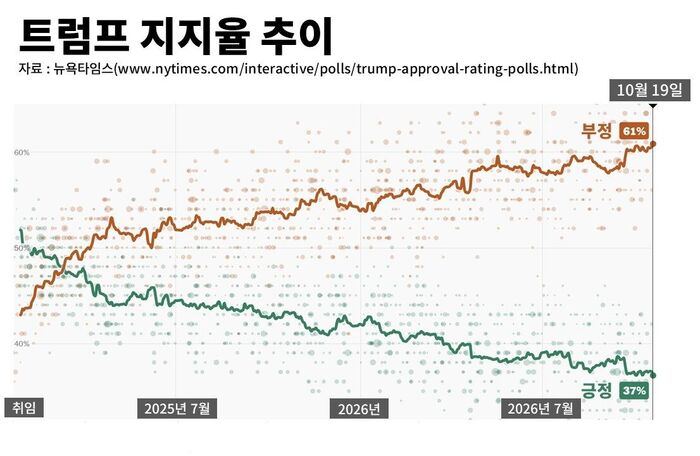
Forecasts continue to emerge that the ruling Republican Party will struggle in this midterm election as well. While results vary by polling organization, a meta-analysis by The New York Times (NYT) that aggregates and statistically averages multiple polls shows that negative evaluations have hovered around the 30% level following the Iran War.
For now, the SBS Fact-Check "Fact Is" team rates the claim that "the ruling party has always suffered crushing defeats in U.S. midterm elections" as "Mostly True."

There is another notable aspect in this midterm election: the issue of President Trump's impeachment.

Recently, Democratic Senator Raphael Warnock appeared on NBC and made remarks to the effect that President Trump is "a con man and needs to step down." This was in response to a question about whether President Trump should be impeached a third time if Democrats win the House majority. Nor is this an isolated remark. Talk of impeachment has surfaced frequently within the Democratic Party.
President Trump was impeached twice by the House during his first term, in 2019 and 2021, but in both cases, the votes required for conviction in the Senate were not secured, and he did not leave office.
If so, how big of a victory do Democrats need in the midterm elections to make impeachment possible?
To understand this, one must first look at the U.S. impeachment process. The U.S. Constitution divides the presidential impeachment process between the House and the Senate.
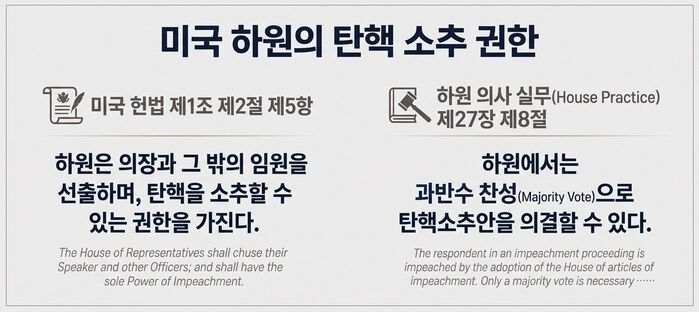
First, the House decides whether to impeach. Article I, Section 2, Clause 5 of the U.S. Constitution provides that the House has the sole power of impeachment. When an impeachment resolution is approved by a simple majority in the House, the president is impeached.
However, this alone does not remove the president from office.
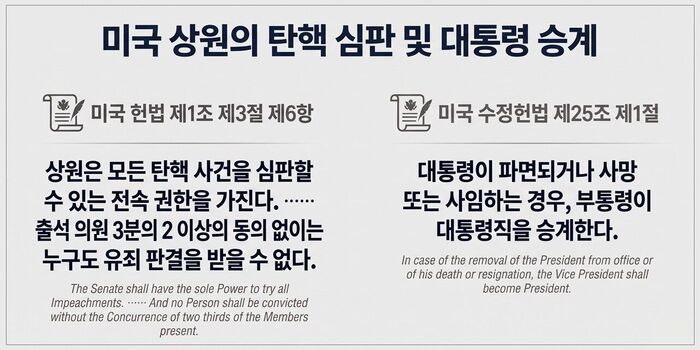
The Senate is where the impeachment is ultimately tried. Under Article I, Section 3, Clause 6 of the U.S. Constitution, a conviction requires the concurrence of two-thirds of the members present in the Senate. If a president is removed through impeachment, the vice president succeeds to the presidency. Unlike in South Korea, where the Constitutional Court adjudicates impeachment after the National Assembly passes an impeachment resolution, in the United States, the House impeaches and the Senate conducts the trial.
Ultimately, whether President Trump is impeached and removed hinges on whether the House can pass an impeachment resolution and whether the Senate can secure the votes needed for a conviction.
Then, under the current balance of seats, how likely is it to secure a two-thirds vote in the Senate?
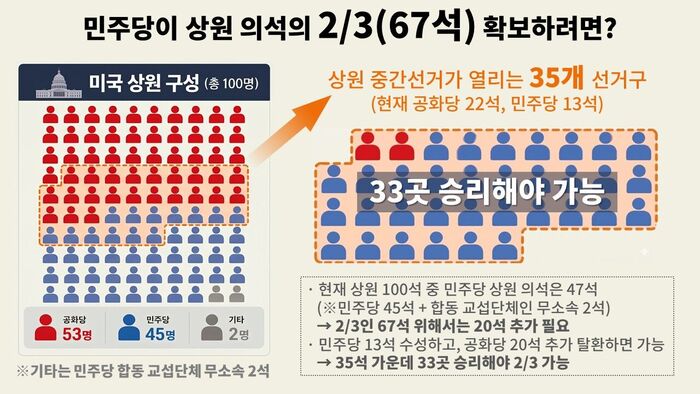
The Senate currently consists of 53 Republicans, 45 Democrats, and 2 independents. Because the two independent senators caucus with the Democrats, the seats aligned with the Democrats can be viewed as 47.
To secure 67 seats, which corresponds to two-thirds of the 100-seat Senate, 20 more senators aligned with the Democrats would be required than at present.
In this midterm election, a total of 35 Senate seats are up for election, combining 33 regular elections and 2 special elections. Even assuming the Democratic side defends all 13 seats it currently holds, calculations show that it would need to flip an additional 20 seats held by Republicans.
In other words, the Democrats would need to win 33 out of the 35 contested seats to reach 67 Senate seats.
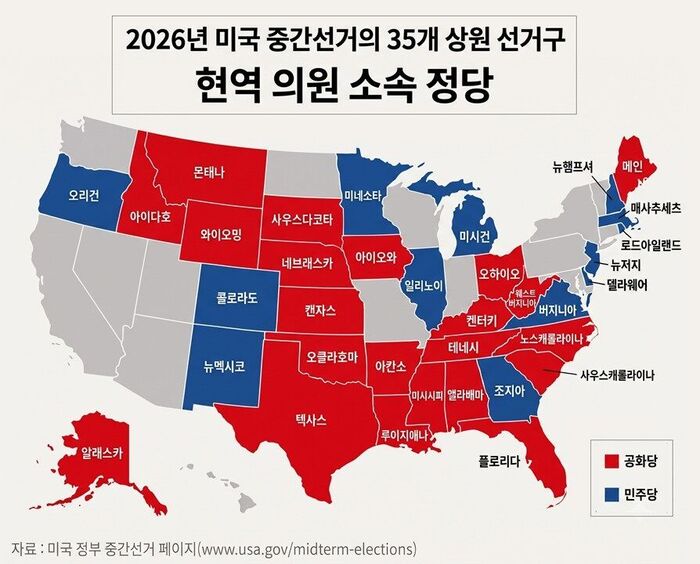
Realistically, this is an extremely difficult target. In particular, the states holding elections this time include many traditionally strong Republican strongholds, such as Idaho, Wyoming, South Dakota, Oklahoma, Alabama, and Louisiana. It is not easy for Democrats to win a large number of seats in these regions.
Moreover, historically, given the structural characteristics of Senate elections, their elasticity as a "midterm referendum" tends to be relatively lower than that of House elections, meaning that even if President Trump's approval ratings are low, the impact may be smaller than in the House.

The outcome of the U.S. midterm elections will impact not only President Trump's governance but also U.S. foreign policy. In particular, congressional checks and political dynamics could serve as key variables in issues involving South Korea's interests, such as the South Korea-U.S. alliance, trade, and security. Beyond changes in U.S. domestic politics, these U.S. midterm elections are expected to be an important turning point that could also influence South Korea's diplomacy, security, and economy.
<References>
· NBC News (Interview with Senator Raphael Warnock, October 18): https://www.nbcnews.com/meet-the-press/video/raphael-warnock-says-dems-are-missing-a-real-opportunity-to-win-in-south-full-interview-271777349832?playlist=mmlsnnd_bestofnbc-nnd
· U.S. House of Representatives seat count (Office of the Clerk): https://clerk.house.gov/
· U.S. Senate seat count (Senate Historical Office): https://www.senate.gov/history/partydiv.htm
· Historical party division in the U.S. Senate (Senate website): https://www.senate.gov/history/partydiv.htm
· Historical party division in the U.S. House of Representatives (House History archive): https://history.house.gov/Institution/Party-Divisions/Party-Divisions/
· The New York Times (NYT) presidential approval rating meta-analysis: https://www.nytimes.com/interactive/polls/trump-approval-rating-polls.html
· U.S. Constitution, Article I, Section 2, Clause 5: https://constitution.congress.gov/browse/article-1/section-2/clause-5/
· House Practice, Chapter 27, Section 8: https://www.govinfo.gov/content/pkg/GPO-HPRACTICE-115/pdf/GPO-HPRACTICE-115-28.pdf
· U.S. Constitution, Article I, Section 3, Clause 6: https://constitution.congress.gov/browse/article-1/section-3/clause-6/
· U.S. Constitution, 25th Amendment, Section 1: https://constitution.congress.gov/browse/amendment-25/
· 35 U.S. Senate races (U.S. government midterm elections webpage): https://www.usa.gov/midterm-elections
(Writer: Kim Hyo-jin, Intern: Kim Jeong-won)
※ Please note: This article was translated by AI and may contain errors.
Copyright Ⓒ SBS. All rights reserved. Unauthorized reproduction, redistribution, and use for AI training are prohibited.