SBS NEWS
Lee Hyoung-il Says 'Exchange Rate Finding Fundamentals... South Korea-US Swap Meaningful and Necessary'
Published : Oct 19, 2026 10:18 AM

▲ Deputy Prime Minister Lee Hyoung-il speaking
Deputy Prime Minister and Minister of Economy and Finance Lee Hyoung-il evaluated the recent decline of the won-dollar exchange rate to around the 1,330 won range, stating, "Currently, the exchange rate is in the process of finding its economic fundamentals."
During a press conference with the accompanying press corps held on the 16th (local time) at the Queen Sirikit National Convention Center (QSNCC) in Bangkok, Thailand—where he was visiting to attend the G20 and G7 Finance Ministers and Central Bank Governors meetings as well as the IMF and World Bank Annual Meetings—Deputy Prime Minister Lee said, "In July, the exchange rate went up to the 1,550 won range, and I think that situation rather deviated from our fundamentals."
The won-dollar exchange rate soared steeply to hit 1,559.2 won in early July, before dropping to 1,328.9 won on the 16th.
This is interpreted to mean that as semiconductor companies and others earn massive amounts of dollars backed by robust exports, the exchange rate is converging in a direction consistent with recent economic conditions.
Regarding the content of the first-ever four-way (2+2) meeting held during the session with Bank of Korea Governor Rhee Chang-yong, US Federal Reserve Chair Kevin Warsh, and US Treasury Secretary Francis Brooke, he refrained from commenting, saying, "As it was decided to discuss it behind closed doors, it is difficult to disclose."
Deputy Prime Minister Lee noted, "While bilateral meetings are held between finance ministries and also between central banks, discussing things together will carry greater significance," adding, "It will be of tremendous help when various situations arise later."
Regarding the necessity of a South Korea-US currency swap, he stated, "It is a meaningful and necessary part in terms of serving as a robust safety net for our foreign exchange market."
Earlier this year, the Ministry of Economy and Finance held the stance that it did not feel it was a situation where a currency swap was needed immediately.
Regarding this, Deputy Prime Minister Lee said, "It is not that we are struggling now due to a lack of foreign currency liquidity and asking for a swap," adding, "I think the intent back then was also not that we didn't need a life jacket because there were no problems with foreign currency liquidity."
He continued with a conventional response, stating, "Now that our economic structure has also grown, we are talking about needing a currency swap at the level of advanced economies," and "(If a South Korea-US currency swap exists) it will serve as a solid defense shield for our economy."
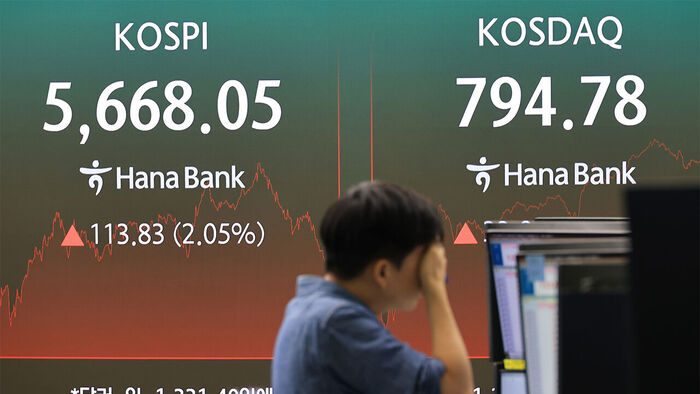
Diagnosing recent volatility in the domestic stock market, he said, "It seems to receive adjustments when there are concerns that global interest rate hikes might occur more frequently than expected, questions over whether investment profitability in artificial intelligence (AI) and semiconductors will last as much as thought, and geopolitical risks such as those in the Middle East."
At the same time, he emphasized, "However, I want to say that the growth pace (of the South Korean economy) is very strong," adding, "Investment is currently leading, but over time that growth momentum will also transition to consumption, and considering large-scale current account surpluses and other factors, I think the fundamental conditions of our economy and stock market remain solid."
To the question of whether measures such as deploying the Stock Market Stabilization Fund or temporarily suspending short selling could be activated if stock market volatility further expands, he replied, "While constantly monitoring market conditions, we are preparing so that we can implement market stabilization measures we possess if necessary," while adding, "What specific measures to take will be handled in accordance with the circumstances."
Regarding the recent appointment of a former Financial Services Commission official as the First Vice Minister of Economy and Finance, and expectations that the Financial Services Commission (FSC) may also relocate to Sejong, and the possibility of expanding cooperation plans with the FSC or additional organizational restructuring, he answered, "Things are already going well, but I think with Vice Minister Kwon Dae-young coming in, they might go even better."
However, regarding the organizational restructuring plan, he withheld comment, saying, "It is a part that is difficult to discuss."
(Photo: Provided by the Ministry of Economy and Finance, Yonhap News)
※ Please note: This article was translated by AI and may contain errors.
Copyright Ⓒ SBS. All rights reserved. Unauthorized reproduction, redistribution, and use for AI training are prohibited.