SBS NEWS
Gov't Achieves 37% of Seoul Capital Area Housing Supply Goal... Expects 80% Range by Year-End
Published : Oct 16, 2026 4:45 PM

▲ Kim Yi-tak, 1st Vice Minister of Land, Infrastructure and Transport, speaks about housing supply progress and future plans during the first regular housing supply briefing held at the Government Complex-Seoul in Jongno-gu, Seoul, on October 16.
The government announced that it has achieved approximately 37% of its annual housing supply target for the Seoul metropolitan area, with construction having started on 99,000 households so far this year.
The government projected that it will be able to reach the 80% range of the target figure by the end of the year.
The Office for Government Policy Coordination and the Ministry of Land, Infrastructure and Transport held their first regular housing supply briefing at the Government Complex-Seoul in Jongno-gu, Seoul, today (October 16) to announce the performance and outlook for housing supply in the metropolitan area, as well as the progress of measures to stabilize the jeonse and monthly rent markets.
Through three supply measures announced last year, including the September 7 measures, the current administration stated its goal to begin construction on more than 1.5 million households in the metropolitan area over a five-year period from this year through 2030.
The construction target for this year is 268,000 households, including 62,000 households in the public sector. The government explained that as of the second week of October, construction had begun on 99,000 households or more, representing about 37% of the annual target.
For public housing, 16,200 households, or about 26% of the target volume, have broken ground so far.
Public land housing starts totaled 14,200 households, including 7,300 households across third-generation new towns such as 2,300 in Goyang Changneung, 2,300 in Incheon Gyeyang, 1,100 in Hanam Gyosan, 1,100 in Namyangju Wangsuk 2, and 600 in Bucheon Daejang.
Urban area volume amounts to approximately 2,000 households, including the complex development of aging office buildings in Seoul (417 households).
For newly built purchase housing, supply was expanded focusing on areas favored by the younger generation such as station areas. Construction started on 13,000 households—including 3,600 in Seoul, 7,000 in Gyeonggi Province, and 2,700 in Incheon—achieving 31% of the 42,000 household target to date.
As of the end of August, private redevelopment and reconstruction project starts stood at 17,000 households, which is 23.6% of this year's target of 72,000 households.
Representative project sites include Heukseok District 11 (1,500 households), Junggye Bon-dong (3,100 households), and Sillim District 2 (1,400 households).
In addition, construction for other housing types such as private housing on public land, regional housing associations, and urban development projects began for 47,000 households, reaching 54.7% of this year's target of 8,600 households.
The government expects to push forward without setbacks with the construction of remaining volumes by the end of the year—including 45,000 public housing households, 28,000 newly built purchase households, and 28,000 private redevelopment households—to break ground on 218,000 to 235,000 households, or 81 to 88% of this year's target.
Regarding the concentration of housing starts toward the end of the year, an official from the Ministry of Land, Infrastructure and Transport explained, "Looking at redevelopment and reconstruction data, there hasn't been a particular tendency to concentrate specifically at year-end, but in the case of public volumes by the Korea Land and Housing Corporation (LH), they have always tended to be concentrated at the end of the year."
The official added, "Because LH lacks currently developed land and fundamentally has a structure where it must develop land and build homes simultaneously on those developed sites, construction starts are bound to appear in the second half of the year."
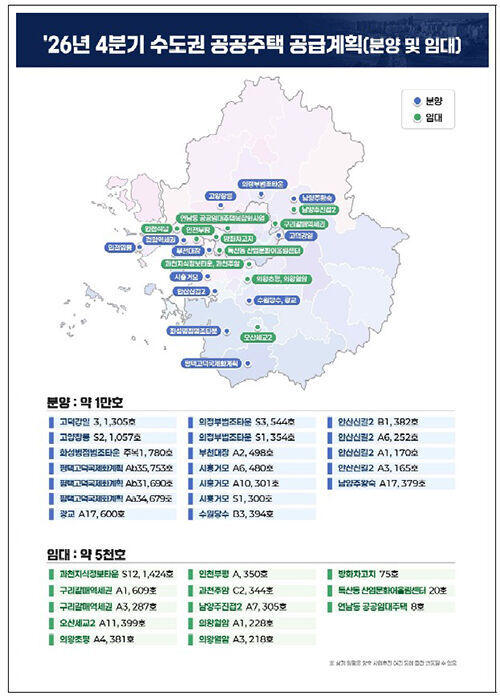
Public pre-sale and rental housing will recruit tenants for a scale of over 15,000 households by the end of the year.
For public pre-sales, 14,800 households have been offered through the third quarter. In the fourth quarter, pre-sale notices will be issued for about 10,000 households, including 1,100 in Goyang Changneung, 500 in Bucheon Daejang, 400 in Namyangju Wangsuk, and 1,300 in Godeok Gangil within third-generation new towns.
Instability in the jeonse and monthly rent markets caused by a decrease in move-in volumes will be addressed by expanding short-term supply and strengthening the housing safety net.
The government will push to move residents into 100,000 public housing units in the metropolitan area by the end of next year, comprising 9,000 public pre-sale units, 29,000 purchased rental units, 45,000 jeonse rental units, and 5,000 publicly supported private rental units.
In addition, an integrated housing supply support center that provides joint support for housing supply approvals and financing will be established within the year to accelerate the prompt supply of general housing (non-apartments), such as urban lifestyle housing.
The government will also continue to supply high-quality rental homes for long-term stable residence through universal public rental housing and long-term private rental housing of 20 years or more, which were announced via the August 13 measures and last month's "Housing Stability Plan."
In connection with this, the government stated that indicators for general housing, which allow for rapid supply, have recently shown signs of improvement.
In Seoul, general housing approvals over the past six months (March to August) reached approximately 5,000 households, up 84% from the same period last year, while construction starts rose 87% to 4,200 households.
The government also explained that the volume of public purchase rental agreements in the metropolitan area received by LH increased by 63%, from a monthly average of 11,000 cases between April and July of this year to 18,000 cases in August.
Kim Yi-tak, 1st Vice Minister of Land, Infrastructure and Transport, said, "What matters most to the public is being able to know specifically 'where and when my home will become available.' Moving forward, we will continuously disclose concrete supply schedules and conditions, and demonstrate through results that we are rapidly supplying quality housing where the public wants it."
(Photo: Yonhap News)
※ Please note: This article was translated by AI and may contain errors.
Copyright Ⓒ SBS. All rights reserved. Unauthorized reproduction, redistribution, and use for AI training are prohibited.