SBS NEWS
President Lee Calls to Enshrine Buma and May 18 Uprisings in Constitution, Urges Assembly to Discuss Revision
Published : Oct 16, 2026 4:17 PM

▲ President Lee Jae-myung delivers a commemorative address at the 47th anniversary ceremony of the Buma Democratic Uprising held at Busan City Hall on October 16.
President Lee Jae-myung requested today (October 16) that "incorporating the Buma Democratic Uprising and the Gwangju Democratization Movement into the preamble of the Constitution is the bare minimum measure to ensure we never forget the bloodstained history that defended the Republic of Korea's democracy and popular sovereignty," urging "the National Assembly to promptly step forward to gather public opinions and hold rational debates for a constitutional amendment."
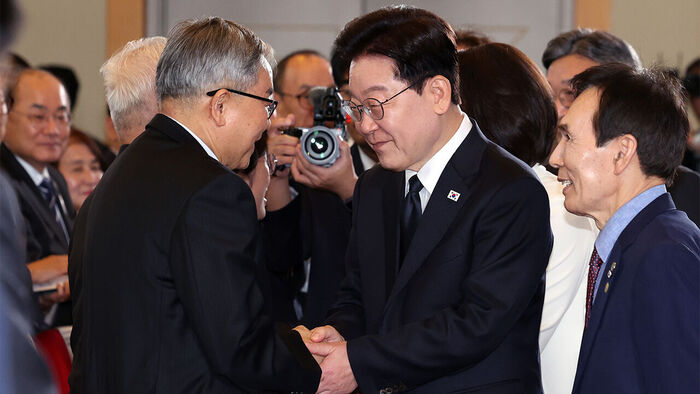
President Lee attended the 47th anniversary commemoration ceremony of the Buma Democratic Uprising held at Busan City Hall on this day.
President Lee said, "Forty-seven years ago today, the roar that began in Busan and Masan pierced through the darkness of a massive dictatorship, became an unquenchable flame, and brightly illuminated the democratic republic that is the Republic of Korea," adding, "I offer my deepest respect and gratitude to the citizens of Busan and Masan who shouted for justice with all their might during that harsh era."
In particular, he explained, "The democracy we take for granted today was never obtained on its own," noting, "It has not been very long since the people have fully enjoyed their rights as sovereign citizens—such as electing representatives directly through elections, and freely criticizing and voicing opinions toward the government or those in power."
President Lee looked back, stating, "Half a century ago, under the shadows of ruthless authoritarianism and the Yushin dictatorship, the fundamental rights of the people were thoroughly oppressed. Voices of political opposition and criticism were brutally suppressed, and the freedom of the press and expression was indiscriminately controlled."
He added, "In the name of emergency decrees, countless innocent citizens were arrested and detained, and it was frequent for people to be punished merely for speaking their minds."
President Lee said, "Yet even in that situation, there were citizens who did not remain silent. The courageous cries of the citizens pushed away the dark night of dictatorship and brightly ushered in the morning of democracy."
He continued, recalling, "The cries to abolish Yushin and overthrow the dictatorship, which began on the campus of Pusan National University, resonated even louder with the solidarity of citizens standing shoulder to shoulder. Ordinary citizens sheltered students chased by police and handed bread and gimbap to the protesters," adding, "The streets of Nampo-dong and Gwangbok-dong, joined by office workers and laborers, were filled with roars yearning for democracy."
President Lee explained, "Ultimately, the government declared martial law and attempted to muzzle citizens with tanks and bayonets, but the roars spread like wildfire beyond Busan to Masan," noting, "The cries on that day 47 years ago, which seemed like striking a rock with an egg, finally cracked the colossal wall of the Yushin dictatorship."
Furthermore, President Lee evaluated, "The Buma Democratic Uprising did not merely end a single dictatorship. By upholding the firm principle that power cannot reign over the people and that the state must exist for the people, it became a solid cornerstone for the development of democracy."
He particularly emphasized, "The roars and spirit of Buma led to May 1980 in Gwangju, then to the June Democratic Uprising of 1987, and on to the Candlelight Revolution and the Revolution of Light."
President Lee highlighted the significance, saying, "Even though the eras and scenes of the streets differed, the burning desire for popular sovereignty was one and the same. Therefore, the Buma Democratic Uprising is an indispensable name in the history of the Republic of Korea and a great milestone of our democracy."
(Photo: Cheong Wa Dae Press Corps, Yonhap News)
※ Please note: This article was translated by AI and may contain errors.
Copyright Ⓒ SBS. All rights reserved. Unauthorized reproduction, redistribution, and use for AI training are prohibited.