SBS NEWS
Protecting Gwijung: The 35-Year Guard for Activist Kim Gwijung on Tails of Tales
Published : Oct 16, 2026 8:44 AM
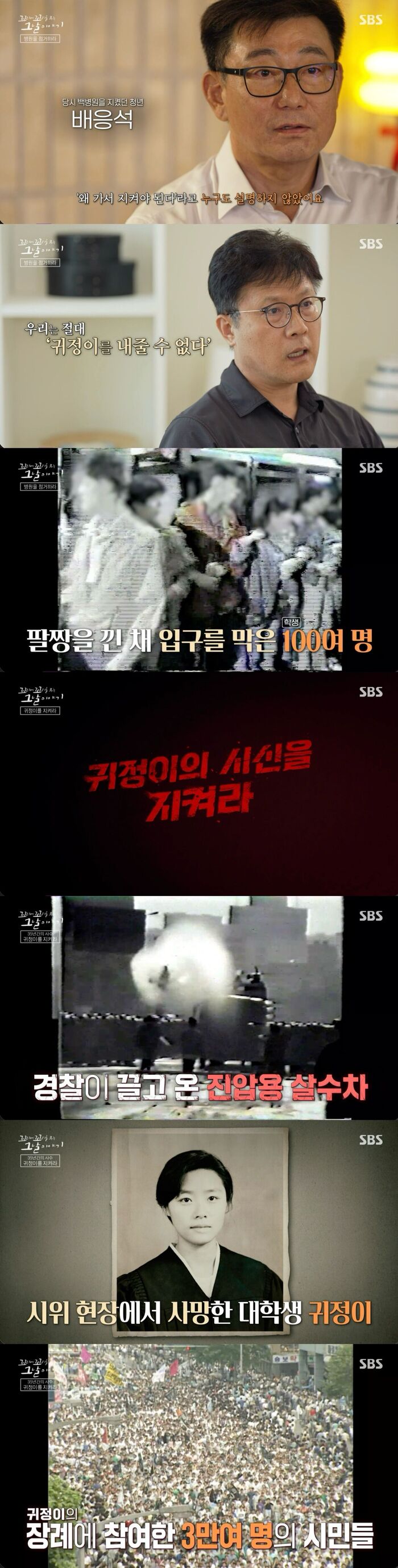 The touching diary of friends who fought to protect the body of their fallen companion has been revealed.
On the October 15 broadcast of SBS's Tails of Tales, the program shed light on the death of student activist Kim Gwijung under the subtitle "Protecting Gwijung - A 35-Year Guard."
In the early hours of a morning in May 1991, hundreds of young people gathered at Baobab Hospital in Myeong-dong, Seoul. They formed a human chain and blocked the entrance to the morgue.
Although no one explained why it had to be done, thousands of students quickly gathered, with about 100 of them guarding the morgue. Raising their voices in unison, they declared, "We can never hand Gwijung over."
Sungkyunkwan University students had united with one heart to protect the body of 26-year-old college student Kim Gwijung, who had passed away just hours earlier.
Faced with Gwijung's sudden death, the police concluded that it was a simple accidental death and urged a swift autopsy and funeral. But her friends thought differently. Suspicious of the circumstances surrounding her death, they demanded a precise investigation into how she died.
However, the prosecution issued a search and seizure warrant for an autopsy just five hours after Gwijung's death. Haunted by the death of a worker whose truth had been obscured by a police snatching of a body that occurred shortly before, the friends had no choice but to step forward and protect Gwijung themselves.
In reality, Gwijung had previously dropped out of school due to high tuition costs, working as a factory assistant by day and a restaurant worker by night to pay for school, finding survival more desperate than democracy. Driven by an unyielding determination to study, she re-enrolled in the French Language and Literature department at Sungkyunkwan University in 1988. Unlike her previous college life, she worked part-time jobs and enjoyed bits of campus life this time around.
Then one day, seeing a friend become a wanted fugitive for participating in student activism, Gwijung reflected on her own life and eventually joined an activist club to take part in the student movement.
Vowing, "I will not live in luxury solely for my own well-being, I will never do that," Gwijung even ran for an executive position in the club union, taking the lead in student activism.
On the day she died, Gwijung had also joined a protest. But after vanishing in an instant, she returned to her friends as a lifeless corpse.
Students flocked to the hospital to protect such a Gwijung. That fateful dawn while guarding the body, the phone inside the morgue rang. Someone said in an urgent voice, "There is going to be a situation tonight, someone might actually die."
That day marked the expiration date of the autopsy search and seizure warrant. At 5:00 AM, about 1,500 armed riot police were mobilized, hurling tear gas and stones at the students. The students, with little more than their bare bodies, blocked them to protect Gwijung's remains.
The police even deployed suppression water cannons, firing tear gas-laced water jets. Yet, the guard unit—ready to face death—defended Gwijung until the very end.
However, warning that they would return, the police re-issued the warrant. A few days later, prosecutors and a forensic doctor arrived to perform an autopsy on Gwijung's body.
Contrary to the guard unit's will, Gwijung's mother agreed to the autopsy. Though she opposed the autopsy more fiercely than anyone else, she ultimately consented out of concern for the safety of the students, stating, "I don't want what happened to my daughter to happen again."
The autopsy began on June 7, 1991, and its results ruled the cause of death as positional asphyxia caused by compression, identical to the claims of the police and prosecution.
Although Gwijung's mother had agreed to the autopsy and requested an investigation into the police suppression tactics, the guard unit could not trust the prosecution. Ultimately, they sought help from alumni to form a truth-commission team—a last resort created by those who trusted neither the state nor public authority.
Determined to uncover the truth behind Gwijung's death, many people who attended the protest with her at the time came forward with tips.
On the rainy day of May 25, 1991, unlike ordinary days, police deployed a rounding-up tactic, firing tear gas at retreating students. Even plainclothes arrest squads, known as the Baekgoldan, appeared to suppress the protesters.
Protesters fled into alleys to escape their violence, but police tear gas chased them there too, and the Baekgoldan pursued them from behind.
Police threw hand-held tear gas grenades, commonly known as apple grenades, directly at the protesters. Student Soojin, who was hit directly by one, testified about everything she experienced to honor Gwijung.
She could not forget the sight of black, round grenade shells piling up like a mountain beside her. A college press photographer who witnessed and captured this scene provided the evidence photos to the truth-commission team, leading them to conclude that death by excessive force was clear.
The deaths of student activists Park Jong-chul and Lee Han-yeol in 1987 served as the fuse for the June Democratic Struggle, reviving the direct presidential election system after 16 years. Yet, South Korea saw Roh Tae-woo—a friend of Chun Doo-hwan—win the election and another military-rooted regime take power.
Drawing a line by claiming, "I am different from Chun Doo-hwan," Roh Tae-woo nevertheless mobilized the National Security Act to imprison college students and numerous citizens while violently suppressing protests. Consequently, in 1991, another college student lost her life to state power.
When public authority drew a line by framing it as the reckless actions of a few police officers, hundreds of thousands of people took to the streets daily to demand the regime's resignation, with many sacrificing their lives through resistance.
And once again, a college student, Gwijung, died at a protest site. This time, students were determined to uncover the truth of the excessive suppression. And public authority tried by all means to block that truth.
Despite the evidence presented by the truth-commission team, the police refused to acknowledge excessive suppression until the end, and the prosecution maintained that Gwijung's death was a mere accident.
Reflecting on this, a member of the historical truth-commission team shared, "The fact that we failed to uncover the preceding factors that led to her compressive asphyxiation still remains a lingering debt, leaving me apologetic and sorrowful."
With Gwijung's death closed as compressive asphyxiation, her funeral was held. Gwijung's friends and family led her bier toward her alma mater, Sungkyunkwan University. However, Confucian scholars clad in traditional Hanbok and Confucian hats blocked the procession, declaring that a corpse could not pass through Sungkyunkwan University, a sanctuary housing the ancestral tablets of Confucian scholars.
Kneeling in the rain, the friends pleaded desperately. Having failed to protect Gwijung while she was alive, they wanted to send her off on her final journey without regrets. Ultimately, the sincerity of the friends moved the Confucian scholars.
With not only Gwijung's friends but some 30,000 mourners in attendance, Gwijung remained in their hearts as activist Kim Gwijung. Two years later, the civilian government of Kim Young-sam was launched.
In response, Gwijung's friends and mother filed a lawsuit against the state, and the government acknowledged that "Kim Gwijung's death occurred due to the negligence of riot police in the performance of their duties," officially recognizing her death as a result of police brutality. The truth was acknowledged four years after her passing.
The members of the guard unit, who still miss Gwijung and cherish her memory, visit her every single year without fail on the anniversary of her departure. And Gwijung's mother continues to cook meals for hundreds of friends.
For Gwijung's friends who survived and live through today, Gwijung's pledge—"I will not live solely for my own well-being"—remains etched in their hearts.
They resolve, "Even if we cannot change the world, let us not wrongfully kill or be killed," striving to live upright and righteous lives.
Bearing in mind that the today they live in was a desperate everyday wish for someone else, they resolved to live lives such that when they finally meet Gwijung in the distant future, they can proudly ask her, "How did I do? Did I live a good life?"
Even now, her friends suffer from guilt and a lingering sense of debt for failing to protect Gwijung. But perhaps simply remembering and longing for her all this time is, in itself, protecting Gwijung.
(SBS Entertainment News, Editor Kim Hyojung)
※ Please note: This article was translated by AI and may contain errors.
Copyright Ⓒ SBS. All rights reserved. Unauthorized reproduction, redistribution, and use for AI training are prohibited.