SBS NEWS
'Tails of Tales' Sheds Light on the Death of Activist Kim Gwi-jeong and the Fight to Guard Her Body
Published : Oct 16, 2026 7:10 AM

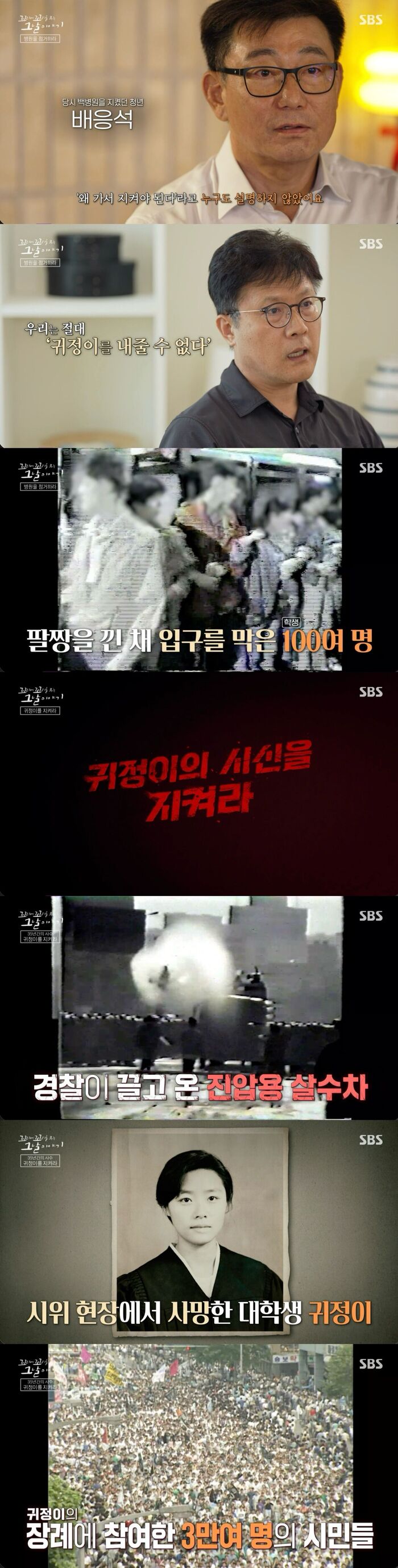 The heartbreaking record of friends striving to protect their fellow classmate's body was revealed.
Broadcast on October 15, SBS's "Tails of Tales" highlighted the death of student activist Kim Gwi-jeong under the subtitle "Protect Gwi-jeong – A 35-Year Defense."
In the early dawn of May 1991, hundreds of young people gathered at Paik Hospital in Myeongdong, Seoul. They locked arms in a scrum and blocked the entrance to the mortuary.
Without anyone having to explain why they had to do so, thousands of students quickly gathered, with about 100 of them standing guard over the mortuary. They spoke in one voice, saying, "We can never surrender Gwi-jeong."
Students from Sungkyunkwan University had come together to protect the body of 26-year-old student Kim Gwi-jeong, who had died just hours earlier.
Gwi-jeong had met an unexpected death. In response, police judged her death to be a simple accidental fatality and pushed to conduct an autopsy quickly and proceed with the funeral. But her friends felt differently. Having doubts about her passing, they demanded that the exact circumstances surrounding her death be properly determined.
However, the prosecution issued a search and seizure warrant just five hours after Gwi-jeong's death. Haunted by the recent death of a laborer whose truth had been obscured after police seized the body, her friends were left with no choice but to step forward and protect Gwi-jeong themselves.
In truth, making a living had once been more urgent than democracy for Gwi-jeong, who worked as a factory assistant by day and at a restaurant by night to pay tuition, eventually having to drop out of university due to high costs. Driven by an unyielding desire to pursue her education, Gwi-jeong re-entered Sungkyunkwan University's French Literature department in 1988. Unlike her earlier college days, this time she balanced part-time work while taking time to enjoy campus life.
Then one day, reflecting on her own life after seeing a friend become a wanted fugitive due to the student movement, Gwi-jeong joined an activist club and began participating in student activism.
Gwi-jeong went on to take the lead in the movement, even running as an executive candidate for the club union with the resolution: "I will not live in comfort only for myself. I will never do so."
On the day she died, Gwi-jeong had also taken part in a protest. But having vanished in an instant, she returned before her friends as a corpse.
Students gathered at the hospital to protect her. At dawn while they guarded the body, the telephone inside the mortuary rang. Someone said in an urgent voice, "There will be a situation tonight. Someone might truly die."
That day marked the expiration date of the search and seizure warrant for the body for an autopsy. At 5:00 a.m., around 1,500 armed riot police were deployed, hurling tear gas canisters and stones at the students, while the students, virtually bare-bodied, stood their ground to defend Gwi-jeong's body.
The police also brought in water cannons to fire tear-gas liquid, but the defense squad, willing to risk death to guard Gwi-jeong's body, held out to protect her until the end.
However, the police warned they would return and had the warrant reissued. A few days later, prosecutors and medical examiners arrived to conduct an autopsy on Gwi-jeong's body.
Contrary to the defense squad's wishes, Gwi-jeong's mother had agreed to the autopsy. Although she had opposed the autopsy more adamantly than anyone, she worried about the safety of her daughter's friends, ultimately consenting as she said, "I do not want what happened to my daughter to ever happen again."
On June 7, 1991, the autopsy began, and the findings matched the claims of the prosecution and police, concluding that she died of suffocation due to simple compression.
Earlier, when consenting to the autopsy, Gwi-jeong's mother had requested an investigation into the police suppression process. However, the defense squad could not trust the prosecution and ultimately formed a fact-finding committee with the help of alumni. Unable to trust the state and state power, they established their final line of defense.
Many who attended the protest Gwi-jeong had participated in came forward with eyewitness accounts to help uncover the truth about her death.
On May 25, 1991, during the rally on that rainy day, the police, unlike on other days, drove the retreating students like cornered rabbits while firing tear gas at them. The "Baekgoldan," a plainclothes arrest squad, also appeared to suppress the protesters.
The protesters fled into alleys to escape the violence. But police tear gas flew into those alleys as well, and the Baekgoldan pursued the demonstrators.
Police hurled handheld tear gas canisters, commonly called "apple bombs," toward the crowd. Student Chae Su-jin, who was struck directly, testified about everything she experienced for Gwi-jeong's sake.
She could never forget the sight of round black heads piling up like a mountain beside her. A campus newspaper reporter from a university, who witnessed and photographed the scene, provided the evidence photos to the fact-finding committee. Based on this, the committee concluded that her death was clearly the result of excessive suppression.
In South Korea, the deaths of student activists Park Jong-cheol and Lee Han-yeol in 1987 had ignited the June Democratic Struggle, leading to the restoration of direct presidential elections after 16 years. However, Chun Doo-hwan's associate Roh Tae-woo was elected, placing another president from the military regime in power.
Roh Tae-woo drew a distinction by claiming, "I am different from Chun Doo-hwan," yet he invoked the National Security Act to arrest numerous citizens, including college students, and violently suppressed demonstrations. In 1991, another university student died at the hands of state power.
State authorities dismissed it as the rogue action of a few officers. In response, hundreds of thousands of people took to the streets every day demanding the regime step down, and many resisted through death, taking their own lives.
And once again, a university student, Gwi-jeong, died at the scene of a protest. The students felt they had to uncover the truth behind the excessive force this time, while the authorities sought to conceal it at all costs.
Despite the evidence presented by the fact-finding committee, the police refused to admit to excessive force until the end, and the prosecution maintained throughout that Gwi-jeong's death was a simple accidental fatality.
A member of the fact-finding committee at the time remarked, "There was a preceding factor that led to her death by compression asphyxiation, and the fact that we failed to uncover it still remains as a sense of debt. I feel deeply apologetic and sorry."
Gwi-jeong's death was closed as compression asphyxiation, and her funeral was held. Her friends and family led the hearse toward her school, Sungkyunkwan University. However, Confucian scholars wearing hanbok and yugeon blocked their way, insisting that a deceased body could not pass through Sungkyunkwan University, a sacred site enshrining the memorial tablets of Confucian sages.
Her friends knelt in the rain and pleaded. Feeling guilty that they could not protect Gwi-jeong, they wanted to see her off on her final journey without regrets. Ultimately, their sincerity moved the Confucian scholars.
Around 30,000 people, in addition to Gwi-jeong's friends, took part in the funeral. In their hearts, she remained as activist Kim Gwi-jeong. Two years later, the civilian government of Kim Young-sam was inaugurated.
Gwi-jeong's friends and mother filed a lawsuit against the state, and the state officially acknowledged that her death resulted from excessive police force, stating, "Kim Gwi-jeong's death occurred due to negligence in the line of duty by riot police." The truth was finally recognized four years after her passing.
The members of the defense squad, who still miss Gwi-jeong and hold her close, visit her on the anniversary of her passing every single year. And Gwi-jeong's mother continues to prepare meals for hundreds of her daughter's friends.
For the friends who survived and live today, Gwi-jeong's resolution — "I will not live only for myself" — remains deeply etched in their hearts.
Pledging, "Even if we cannot change the world, let us not kill or die unjustly," they strive to live righteously and uprightly.
Remembering that the present day they live in was an everyday life so desperately desired by someone else, they resolved to live lives where they can one day confidently ask Gwi-jeong when they meet again far in the future, "How was I? Did I live a decent life?"
Her friends still carry the guilt and sense of debt for not being able to protect Gwi-jeong. Yet perhaps, simply remembering and longing for her all this time has been their way of protecting Gwi-jeong all along.
※ Please note: This article was translated by AI and may contain errors.
Copyright Ⓒ SBS. All rights reserved. Unauthorized reproduction, redistribution, and use for AI training are prohibited.