SBS NEWS
'Questions for the Sake of Questions' and 'Questions for YouTube' Flood Defense Briefings: Has It Gone Too Far?
Published : Oct 15, 2026 9:41 AM

▲ Defense Ministry Spokesperson Jeong Bit-na and Joint Chiefs of Staff Public Affairs Director Jang Do-young listen to questions during a regular Defense Ministry briefing
Lately, various YouTube videos based on regular briefings by the Ministry of National Defense have been racking up high view counts. Most of them capture Defense Ministry and Joint Chiefs of Staff (JCS) spokespersons flustered and struggling to give clear answers to persistent questions from reporters. They are being consumed in a manner that degrades the prestige and honor of the military and the Defense Ministry.
Looking beneath the surface reveals subtle dynamics. The military and the Defense Ministry face constraints in what they can answer regarding military matters such as operational affairs. Under South Korea's civilian control, the relationship between supreme command authority and the military is also complex, leaving the mouths of the military and the Defense Ministry heavily constrained. When political disputes are added to this, spokespersons for the military and the Defense Ministry find themselves completely immobilized. One retired general, recalling his time as Defense Ministry spokesperson long ago, even confessed, "Every time I commuted to the Defense Ministry, I prayed, 'Lord, forgive me for not being able to speak the honest truth once I enter this door.'"
No matter what anyone says, the military is the group that most wants to sharply criticize and deliver a hundredfold retaliation against North Korea for its landmine provocation. The feelings of reporters persistently pressing, "Why can't you call North Korea's planting of landmines a North Korean attack?" must be lukewarm, if not chilly, compared to the boiling hearts of "macho" soldiers whose comrade has been injured. They are not refraining from words and actions by choice; they are simply biting their tongues and holding back due to the various circumstances mentioned above.
Reporters know this, too. Nonetheless, they unleash a barrage of questions while trapping the military and the Defense Ministry inside the ring. It is time to reflect on whether reporters' questions directed at the Defense Ministry and the military are not "questions for news reporting," but rather "questions for the sake of questioning" and "questions for YouTube views."
Why Force Soldiers to Answer with 'Attack'?
After completing its investigation, the military officially defined the landmine incident as a North Korean provocation. During the Defense Ministry's regular briefing on October 12, a reporter asked, "Is the landmine incident a North Korean attack?" to which JCS Public Affairs Director Jang Do-young replied, "We view it as a violation of the Armistice Agreement and a provocation." The reporter pressed with follow-up questions, asking, "Does that mean you do not view it as an attack?" and "What is the difference between an attack and a provocation?" but Director Jang did not deviate from his stance, repeating, "It is a provocation."
A provocation inherently implies an attack on practical and legal levels. In other words, Director Jang's answer of "provocation" already encompasses the meaning of an attack. However, with the word "attack" becoming politically tainted by the dispute between politicians Minister Chung and Rep. Han, it is exceedingly difficult for an active-duty military officer to utter that the landmine incident was an attack. The moment Director Jang, who speaks for the military, mentions "attack," the military gets dragged into politics. This is why the public affairs director cannot utter the word "attack."
No reporter covering the Defense Ministry could be unaware of this. It appears they intentionally asked questions that the public affairs director could not answer, despite knowing full well. A Defense Ministry official stated bluntly, "It is an intentional barrage of questions by reporters aimed at gaining attention on YouTube by staging scenes where soldiers are cornered." An officer pointed out, "When we try to offer explanations after the briefing that could not be said during the briefing, some reporters leave without even listening," adding, "They do not write articles; they only ask questions."
Reporters Exclaiming 'Jackpot' and 'Legendary' After Briefings
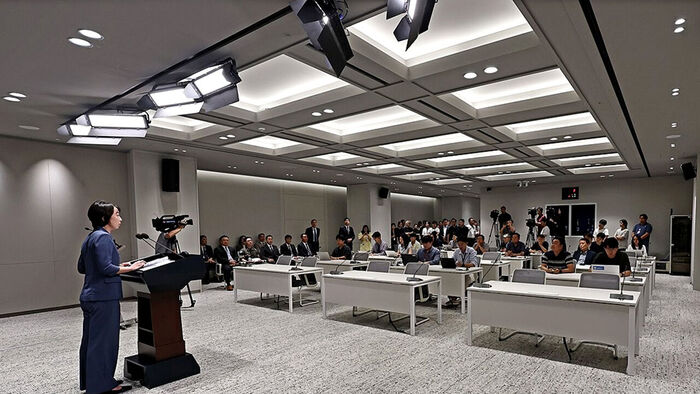
During the regular Defense Ministry briefing on September 29, a reporter asked regarding the timing of the announcement of the on-site investigation into the landmine incident, "Wasn't this timed to match the president's schedule?" It is only natural for the military to consult with the National Security Office in the presidential office to determine the timing of announcements regarding on-site operational situations. This is standard practice between supreme command authority and the military in advanced nations as well, but when reporters insist on linking the military's announcements to politics, the military is rendered speechless. This is because it risks being entangled in politics.
Well before the military defined it as a provocation, one reporter even aggressively badgered, asking, "Isn't the landmine incident a provocation?" Even though a spokesperson or public affairs director cannot arbitrarily define an incident, the reporter's questioning was reckless. While the Defense Ministry and the military are fully aware that the landmine incident is a provocation and an attack, official spokespersons cannot speak out until the government makes its final determination.
One day, when the controversy over the landmine incident was in full swing, several reporters left the briefing room after the Defense Ministry briefing, remarking, "Today's briefing was legendary," and "That was a blockbuster briefing." They looked like returning victorious generals. Watching this, an officer commented, "Reporters who put officials in a bind by throwing questions for the sake of questions were utterly thrilled at the prospect of gaining attention on YouTube."
Hoping for Independent Reporting After Briefings
Lately, regular Defense Ministry briefings seem to have strayed far from serving as a channel through which the ministry and the military convey basic information. Questions attempting to intertwine the military with politics, questions for the sake of questioning, and questions aimed at drawing attention on YouTube are surging. Few questions are asked to dig deeper and serve as the foundation for scoops or in-depth reporting. An atmosphere in which the regular Defense Ministry briefing is treated as the entirety of newsgathering is also palpable.
Since the military itself eroded public trust in the past, service members also bear an original sin. Even so, questions that exploit the military's weaknesses and cleverly set traps to further degrade trust in the military should not be welcomed. The media must help rebuild trust in the armed forces.
※ Please note: This article was translated by AI and may contain errors.
Copyright Ⓒ SBS. All rights reserved. Unauthorized reproduction, redistribution, and use for AI training are prohibited.