SBS NEWS
New Yalu River Bridge Opens After 12 Years: North Korea and China to Hold Official Ceremony Tomorrow
Published : Oct 14, 2026 5:44 PM

▲ A ship passes under the New Yalu River Bridge in Dandong, China's Liaoning Province, on the afternoon of October 5. The opening of the New Yalu River Bridge has been delayed for about 12 years since its completion in 2014.
The New Yalu River Bridge, connecting Dandong in China's Liaoning Province and Sinuiju in North Pyongan Province, North Korea, will officially open on October 15, 12 years after its completion.
During a regular briefing on October 14, Chinese Foreign Ministry Spokesperson Mao Ning stated, "In accordance with agreements between China and North Korea, the China-North Korea New Yalu River Bridge will officially open on October 15, and the two countries will jointly hold an opening ceremony on that day."
Spokesperson Mao emphasized, "China and North Korea are friendly neighbors connected by mountains and rivers," adding that "the New Yalu River Bridge is an important facility for interconnectivity and exchanges between the two countries."
She continued, "Following its opening, it will further promote economic and trade exchanges and people-to-people movement between the two countries, enhancing the well-being of both peoples."
However, regarding the specific schedule of the opening ceremony and attending figures, she remarked, "Relevant news will be announced in a timely manner, so please continue to follow developments."
Earlier in the day, China's state-run Xinhua News Agency also reported that North Korea and China will officially open the New Yalu River Bridge on October 15 and hold a joint opening ceremony.
The New Yalu River Bridge, featuring four round-trip lanes and a total length of 3,026 meters, was completed in 2014, but its opening has been delayed due to reasons such as incomplete connecting roads and customs inspection facilities on the North Korean side.
Until now, overland freight transportation between Dandong and Sinuiju, the largest trade hubs between North Korea and China, has relied on the Sino-Korean Friendship Bridge, which was completed in 1943.
The Sino-Korean Friendship Bridge, structured with a railway on one side and a single-lane road on the other, has long been evaluated as having limitations in handling increasing logistics.
To alleviate the logistics burden on the existing Friendship Bridge and secure a new road transportation route, China invested about 2.2 billion yuan (approx. 440 billion KRW) to construct the New Yalu River Bridge.
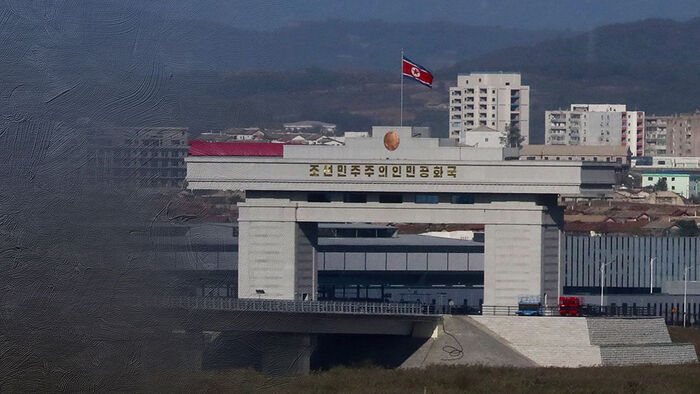
The New Yalu River Bridge had once been cited as a representative example illustrating unusual currents in bilateral relations.
Since 2024, when North Korea strengthened military and economic cooperation with Russia in the wake of the Ukraine war, North Korea-China high-level exchanges became sparse, and a cold atmosphere persisted as both countries dispatched officials of lower ranks than usual to events commemorating the signing of their treaty of friendship.
Then, following North Korean State Affairs Commission Chairman Kim Jong Un's attendance at China's 80th-anniversary V-Day military parade in September of last year, the two countries accelerated exchanges.
In March of this year, North Korea-China international passenger trains resumed operation after six years, and in April, Foreign Minister Wang Yi visited Pyongyang to meet with Chairman Kim and Foreign Minister Choe Son Hui.
In June, bilateral relations entered a rapid recovery phase through a summit between Chairman Kim and Chinese President Xi Jinping, which was realized during Xi's visit to North Korea.
Trade exchanges have also shown a rapid recovery, with total North Korea-China trade volume in the first half of this year (approx. 1.51 billion USD) increasing by 19.6% compared to the previous year, and the annual trade volume for 2025 (approx. 2.736 billion USD) recovering to 98.1% of the level in 2019, before COVID-19.
Around the New Yalu River Bridge, final preparations for opening have recently been captured, including the completion of construction on connecting roads and customs facilities, repainting of traffic lanes at the Chinese customs post, and test runs of trucks and passenger cars.
On October 13, large North Korean and Chinese national flags, which were absent until the previous day, were attached to the pillars on both sides of the northern gateway of the bridge.
However, some analyses suggest that the effects of this opening of the New Yalu River Bridge will initially be focused on certain freight transportation sectors, as people-to-people exchanges such as North Korean group tours for Chinese tourists and the issuance of visas and tourist passes have not yet normalized.
Chinese citizens holding ordinary passports still need a North Korean visa or tourist pass to travel to North Korea.
Prior to this, North Korea and Russia opened their first automotive-only cross-border bridge—connecting Rason, North Korea and Khasan, Russia, with a length of about 1 km and two round-trip lanes—on October 7 of last year, strengthening bases for vehicular freight and passenger movement.
(Photo: Yonhap News)
※ Please note: This article was translated by AI and may contain errors.
Copyright Ⓒ SBS. All rights reserved. Unauthorized reproduction, redistribution, and use for AI training are prohibited.