SBS NEWS
Ambassador to US Cites Hurdles in Consultations with Washington Amid Pending Issues and Intelligence Friction
Published : Oct 13, 2026 1:17 PM

▲ South Korean Ambassador to the U.S. Kang Kyung-wha speaks during a parliamentary audit by the Foreign Affairs and Unification Committee held at the Korean Embassy in Washington, D.C., on the 12th (local time).
Concerns are rising that warning lights are flashing for the blood-alliance relations between South Korea and the United States, amid a series of signs that communication between the two countries is not running smoothly and that mutual trust is weakening.
While the transactional nature typical of the U.S. Donald Trump administration may be partly responsible, voices are also emerging that Seoul must read Washington's global strategy and shape bilateral relations accordingly.
According to diplomatic circles on the 13th, the U.S. side recently expressed various grievances regarding intelligence cooperation between South Korea and the U.S., and while discussions have continued between the intelligence authorities of both countries, differences have yet to be resolved.
Minister of Foreign Affairs Cho Hyun stated during a parliamentary audit on the 6th, "I was briefed on what issues exist in the intelligence sector during the South Korea-U.S. foreign ministers' meeting." His remarks drew attention for publicly disclosing sensitive communication between diplomatic channels.
Although detailed explanations did not follow, it was interpreted that considerable friction lurks between the two countries in the intelligence sector, and that the issue remained unresolved even after mobilizing the highest levels.
South Korean Ambassador to the U.S. Kang Kyung-wha also stated during the parliamentary audit of the embassy by the National Assembly's Foreign Affairs and Unification Committee held in Washington, D.C., on the 12th (local time) that the controversy over restrictions on intelligence sharing between South Korea and the U.S. is the most difficult pending issue in bilateral diplomacy, adding that consultations with the U.S. side are not easy.
She went as far as to use the expression, "I admit that there are limitations" in communicating with the White House, saying, "As for high-level consultations to the extent I would like, they are currently not taking place to the degree I wish, to the point of being frustrating."
This is interpreted to mean that while working-level communications at various levels, such as minister-counselors or counselors, continue, direct communication with officials at the assistant secretary level or higher—who could pave the way for a breakthrough—is largely blocked.
While opinions are divided over the cause, it could be that the U.S. side, dissatisfied with the contents of South Korea's communications with Washington, sees no need for additional consultations.
From the U.S. perspective, it may have judged that there has been no change in the approach of South Korean authorities, starting with the Coupang issue, which has remained unresolved for nearly a year, to the recently surfaced differences in the intelligence sector.
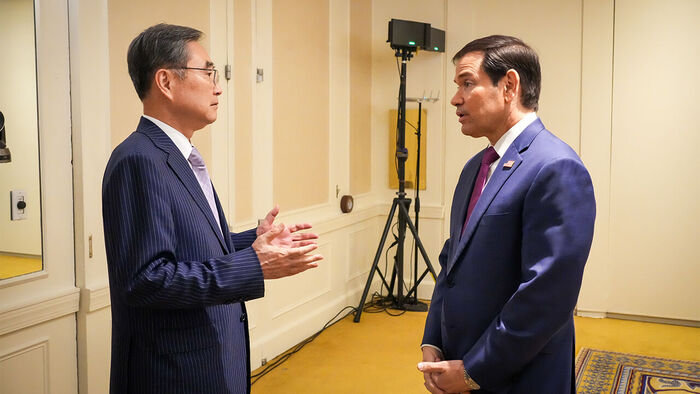
The U.S. has reportedly conveyed its opinions on South Korea's diplomacy and security line to the South Korean side through various channels.
Although it is not at the level of raising direct personnel demands or complaints as some speculate, some high-ranking officials are known to have consistently mentioned the impact on South Korea-U.S. relations.
Diplomatic observers view this closer to a sense of critical awareness that goes beyond simply North Korea policy, questioning whether the primary focus of South Korea's overall diplomatic stance remains aligned with South Korea-U.S. relations as before.
This sense of awareness appears to have surfaced partly even in corporate and economic fields where actual funds are moving.
Independent lawmaker Han Dong-hoon remarked during the embassy audit that the U.S. side had raised an issue where a major South Korean conglomerate suspended transaction negotiations with a U.S. company out of concern over potential Chinese sanctions.
While avoiding specific confirmation, Ambassador Kang noted that South Korean companies face difficulties caught between the regulatory frameworks of the U.S. and China.
If the U.S. actually raised this issue, it could be interpreted as going beyond the level of demanding "cost-sharing," such as investment in the U.S. or contributions to the alliance, and effectively asking South Korea, "Whose side are you on?"
Consequently, voices are emerging that the U.S.'s persistent grievances should be taken as a "crisis signal" for South Korea-U.S. relations and should not be dismissed merely as a "clash of interests."
Concerns are also being raised together that if such a situation persists, South Korea's aspirations—such as securing nuclear-powered submarines and the authority for nuclear fuel enrichment and reprocessing—could become a distant reality, meaning these warning signs must be taken seriously.
(Photo provided by Embassy of the Republic of Korea in the USA, Ministry of Foreign Affairs, Yonhap News)
※ Please note: This article was translated by AI and may contain errors.
Copyright Ⓒ SBS. All rights reserved. Unauthorized reproduction, redistribution, and use for AI training are prohibited.