SBS NEWS
Kospi Plunges Below 6,000 in "Black Tuesday" Rout, Shedding Over 1,000 Points in Five Days
Published : Oct 13, 2026 12:15 PM
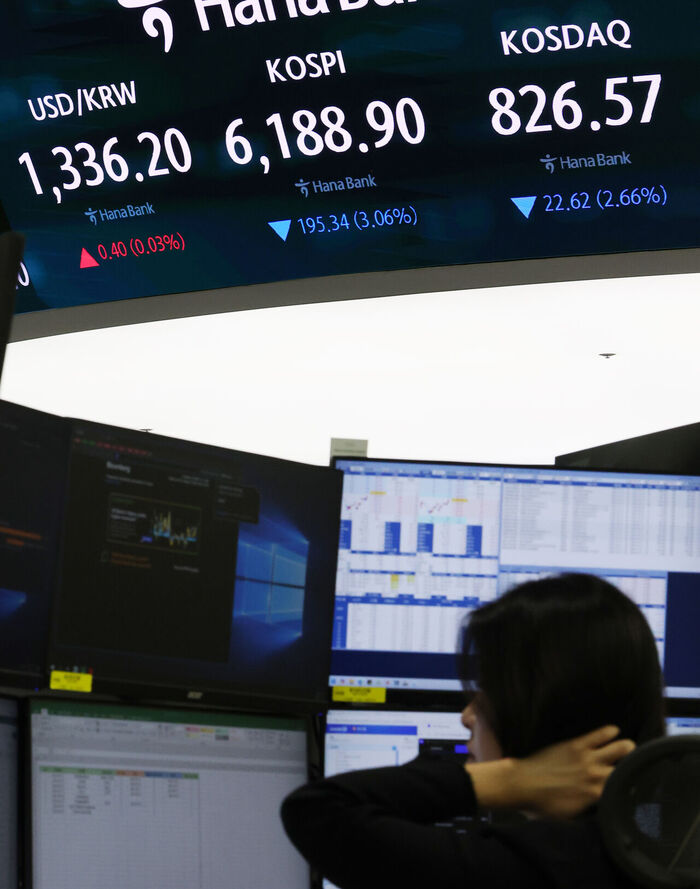
▲ The electronic signboard at the dealing room of the Hana Bank headquarters in Jung-gu, Seoul, displays the won-dollar exchange rate, Kospi, and Kosdaq indices on the 13th. On this day, the Kospi dropped by 2 to 3 percent in early trading, extending its losing streak to five consecutive sessions.
Amid renewed concerns over a slowdown in artificial intelligence infrastructure investments, the Kospi is experiencing a relentless free fall, plunging more than 1,000 points in just five trading sessions.
According to the Korea Exchange and financial information service provider Yonhap Infomax on the 13th, the Kospi was down 6.19% at 5,989.18 as of 11:08 a.m. today.
Opening down 3.10% at 6,186.08, the index at one point sank as low as 5,950.00, down 6.80%.
The sharp drop triggered a sell-sidecar on the main bourse, temporarily suspending program buy orders for five minutes.
After closing at 7,003.74 on October 2 to reclaim the 7,000-point threshold on a closing basis for the first time since late September, the Kospi has declined for five consecutive sessions through today.
During this period, the cumulative loss reached 1,014.56 points, or 14.49%.
As the index plummeted from the 7,000 range to below the 6,000 mark in one sweep, the total market capitalization of the Kospi shrank by more than 800 trillion won, dropping below the 5,000 trillion won mark.
Even during past market slumps—such as Liberation Day on April 2, 2025, when U.S. President Donald Trump imposed high universal tariffs worldwide, the outbreak of the U.S.-Iran war in March of this year, or the supply-demand shock in July this year triggered by a global semiconductor correction and the launch of single-stock leverage products for Samsung Electronics and SK Hynix—there was no five-day consecutive losing streak.
Notably, the index decline has been widening progressively, dropping 0.89% on the 6th, 1.98% on the 7th, 2.62% on the 8th, and 3.65% on the 12th.
After surging to an intraday high of 9,385.59 on June 19 and plummeting to an intraday low of 5,262.77 on July 29 before staging a rebound as the global semiconductor correction ended, the Kospi had been moving sideways within a box range centered around the 7,000 level.
However, momentum in the domestic stock market sharply cooled following the National Foundation Day long weekend from October 3 to 5.
The Kospi index has now retreated to the levels seen during the market plunges in July and August.
The Kosdaq is also suffering a steep decline of over 5% as of this time.
Key factors cited for the downturn include burdens from rising U.S. Treasury yields and a strong won, alongside profit-taking (sell-on-news) following Samsung Electronics' third-quarter earnings release.
According to a filing on the 8th, Samsung Electronics posted a third-quarter operating profit of 107.4 trillion won, marking a 782.5% increase from the same period last year and setting an all-time quarterly record.
This is the first time a South Korean company has exceeded 100 trillion won in quarterly operating profit, and its operating profit margin also reached a record high of 55.1%.
Despite these figures, Samsung Electronics has undergone a sharp correction, plunging 2.42% on the day of its earnings announcement, followed by drops of 4.39% on the 12th and 7.49% on the 13th.
Other semiconductor-related shares, including SK Hynix, are following a similar trajectory.
The trigger was a foreign media report early this month stating that OpenAI's annualized revenue as of late September stood at $50 billion, falling short of market expectations ranging between $68 billion and $70 billion.
Although it turned out to be merely a difference in accounting revenue recognition methods rather than an actual drop in sales, dispelling fears of a sharp contraction in AI demand, the incident revived concerns over a peak in the memory market cycle and stimulated profit-taking desires, which had subsided for a while.
Over the weekend, ChangXin Memory Technologies (CXMT) of China announced new progress in DRAM memory technology and revealed plans to introduce next-generation server products utilizing it within the year, acting as another negative factor for the share prices of the three major memory makers: Samsung Electronics, SK Hynix, and Micron.
A warning from Broadcom CEO Hock Tan that capital raising, rather than a shortage of semiconductors or power, could become the biggest constraint on the AI boom was also cited as a contributing factor.
Speaking at an event in Singapore the previous day, he said, "We've had bottlenecks several times over the last two years and we've navigated through them. The memory shortage today could look different a year from now. My view is that the primary constraint may actually be capital."
Such remarks fueled concerns that a global high-interest-rate environment, driven by rising bond yields, could dampen infrastructure investments such as AI data centers.
Seo Sang-young, a managing director at Mirae Asset Securities, stated, "The sharp drop in Asian stock markets like South Korea and Japan today, alongside falling U.S. index futures, appears to be the combined result of worries over the profitability of AI investments and a reduction in global risk asset weightings."
He analyzed, "Comments from the CEOs of Broadcom and Intel regarding capital-raising burdens and the cancellation of an IPO by Australian AI data center firm Firmus stimulated doubts over the sustainability of AI investments. Black록's downgrade of its U.S. stock investment stance from overweight to neutral, citing high Treasury yields, also added to the burden."
At the same time, the fact that Samsung Electronics' share buybacks for employee stock compensation have effectively ended, and SK Hynix's buyback and cancellation programs are nearing completion, is cited as a factor that significantly lowered the domestic stock market's defense capability.
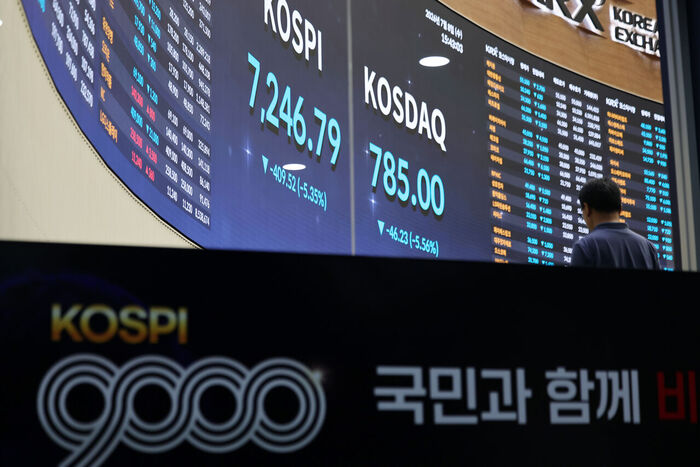
In the aftermath of the July market slump, a significant number of retail investors remain in the loss zone, and institutional investors, including pension funds, have had limited buying capacity, leaving the domestic stock market suffering from a supply-demand vacuum.
Large-scale net purchases by other corporate entities, driven by the share buybacks of Samsung Electronics and SK Hynix, had previously supported the bottom of the Kospi, but the intensity of this buying has weakened markedly this month.
Heo Jae-hwan, an analyst at Eugene Investment & Securities, pointed out, "Comparing the market capitalizations of Taiwan and South Korea, the intensity of foreign selling pressure on the domestic market is more than three times that of Taiwan."
He noted that given Taiwan's Weighted Index gain exceeding 70% this year—outperforming the Kospi (at 51% based on the previous day's close)—it is excessive to view the adjustment merely as asset reallocation prompted by high stock prices.
Heo emphasized, "The key issue is not foreign selling itself, but whether there is a domestic stock demand base to offset it. For instance, unlike South Korea, where the Bank of Korea raised interest rates twice this year, Taiwan did not raise rates. With an economic growth rate reaching 11.5% and inflation hovering in the low 2% range, it is easier for Taiwanese households to sustain their interest in the stock market."
Ultimately, due to vulnerable supply and demand dynamics, the domestic stock market is experiencing severe volatility whenever selling pressure emerges centered around foreign investors.
However, Heo remarked, "Foreign investors' ownership stake in domestic semiconductor shares stands at 47.2%, approaching the minus-one standard deviation level (47%) since 2000, and the upward trend in U.S. interest rates has also been stalling since last week. Given the high volatility inherent in the domestic market, it is difficult to completely avoid foreign selling, but a point is likely to arrive soon where the pressure stops escalating."
(Photo: Yonhap News)
※ Please note: This article was translated by AI and may contain errors.
Copyright Ⓒ SBS. All rights reserved. Unauthorized reproduction, redistribution, and use for AI training are prohibited.