SBS NEWS
South Korea's Treasury Bonds Hold Firm Despite Global Rate Surge as Foreigners Post Second-Largest Futures Buying Spree
Published : Oct 13, 2026 10:48 AM

▲ New York Stock Exchange (NYSE)
South Korea's Treasury bond yields, which experienced sharp fluctuations earlier this year in sensitive response to rising U.S. Treasury yields and international oil prices, have recently shown a relatively resilient trend despite the global upward pressure on interest rates.
The financial investment industry believes that South Korea's superior fiscal conditions and export competitiveness compared to major economies could serve as factors attracting foreign investors to South Korean government bonds.
According to the Seoul bond market today (the 13th), the final quote yield for 3-year Treasury bonds closed down 6.2 bps from the previous trading day at 3.921%.
The 10-year yield also fell 8.9 bps to 4.306%.
While the stabilization of U.S. long-term yields while the domestic bond market was closed for holidays played a part, foreign net buying of Treasury futures strongly underpinned investor sentiment.
Foreigners net-purchased 34,789 contracts of 3-year Treasury futures yesterday.
This marks the second-largest single-day net buying volume on record, following the 42,353 contracts recorded on April 4, 2025.
Foreigners also net-purchased 12,126 contracts of 10-year Treasury futures, marking their largest acquisition in about four months since last June.
This net buying may have included purchases to unwind existing short (selling) positions.
However, if preemptive futures buying continues, there is a possibility that buying pressure could spill over into the cash (spot) market.
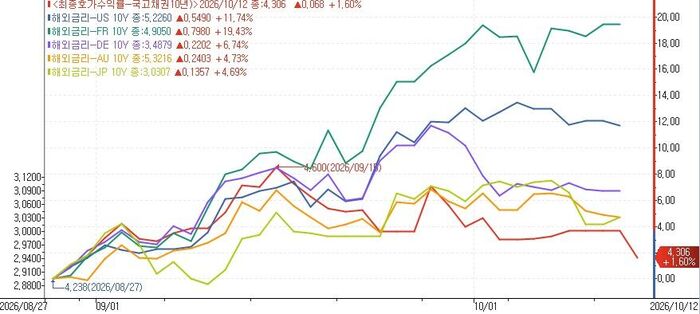
Treasury yields have largely recovered to levels seen before the global rate spike that began in late August.
Global government bond yields have risen steeply since September as expectations grew regarding a potential U.S. policy rate hike.
In addition, concerns over a resurgence in international oil prices and fiscal soundness across various countries have placed upward pressure on yields.
Since late August, the U.S. 10-year Treasury yield has surged by approximately 59 bps.
The 10-year yields for Germany and Australia each rose 35 bps before paring their gains, while France, hit by overlapping fiscal concerns, saw its 10-year yield skyrocket by 79 bps.
Japan, which typically experiences relatively minor yield fluctuations, also saw an 18 bp increase before retracing slightly.
South Korea's 10-year yield also climbed by up to around 32 bps during the same period, but has since retraced most of those gains, returning to late August levels.
The bond market interprets this as a result of the highlighted relative appeal of South Korean bonds.
A bond trader at a foreign securities firm explained, "South Korea is now viewed as a country with a much stronger fiscal position compared to the U.S. or Japan," adding, "When betting on a decline in global interest rates, South Korea is a preferred market."
Regarding the concentration of foreign purchases in Treasury futures, the trader noted that futures are a relatively easier trading vehicle given the lower liquidity of cash bonds, while adding that this could potentially lead to lagging spot purchases.
Solid export forecasts also lend weight to the positive outlook on South Korean bonds.
A bond broker from another securities firm raised the hypothesis that capital could shift from European advanced nation bonds to South Korean government bonds, citing that there are not many countries with strong domestic exports and investment-grade Treasury yields.
"If exchange inflows from export companies increase due to solid exports, the won could strengthen, and foreign capital may flow into the domestic bond market," the broker said.
However, given that the starting point for this rate rise and fall was volatility in U.S. Treasury yields, it is difficult to view South Korea's bond strength as entirely independent of external interest rate environments.
Even so, the concentration of foreign buying in South Korean bonds—which were sensitive to global rate and oil price surges earlier this year—highlights investors' focus on South Korea's relative fiscal and export conditions.
(Photo: Provided by Yonhap Infomax, Yonhap News)
※ Please note: This article was translated by AI and may contain errors.
Copyright Ⓒ SBS. All rights reserved. Unauthorized reproduction, redistribution, and use for AI training are prohibited.