SBS NEWS
Microsoft Unveils In-House AI Chip 'Maia 300'... Plans to Deploy Over 1 Million Next Year
Published : Oct 13, 2026 9:29 AM

▲ Microsoft CEO Satya Nadella
Microsoft (MS) has unveiled its third-generation in-house artificial intelligence (AI) chip, the "Maia 300," and announced plans to deploy it on a large scale starting next year to reduce its reliance on Nvidia.
MS announced through its official blog on the 12th (local time) that it will expand the Azure Maia chips to a scale of several gigawatts (GW) starting next year, making them the primary AI inference system for its products and services.
According to Reuters, Microsoft stated that it could deploy more than 1 million Maia 300 chips next year.
Scott Guthrie, Executive Vice President of Microsoft's Cloud and AI Group, said, "With the advent of the superintelligence (SI) era, Microsoft is entering a new infrastructure phase," adding, "The Maia 300 will process 40% more tokens per megawatt than major graphics processing unit (GPU)-based systems."
Microsoft did not disclose the system used for comparison.
Unlike Nvidia GPUs, which are surrounded by memory around a single massive computing chip, the Maia 300 adopts a "multi-chiplet" architecture that connects multiple specialized chips.
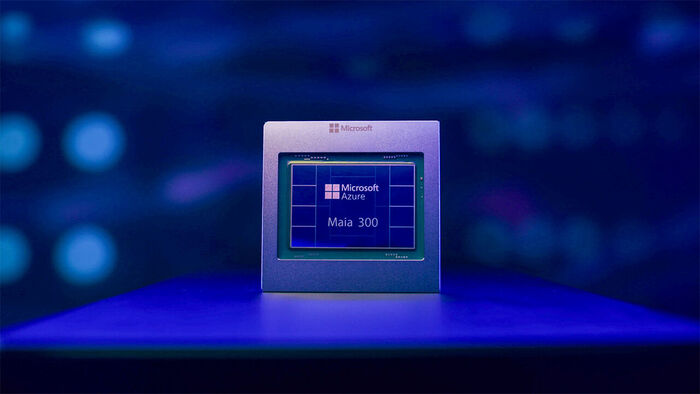
Taiwan's TSMC 2-nanometer process was applied to the core computing chiplet, while the 3-nanometer process was used for chiplets handling data movement and other tasks.
Equipped with eight sixth-generation high-bandwidth memory (HBM4) modules on a single chip, it delivers a memory bandwidth of 18 terabytes (TB) per second, with a thermal design power (TDP) of 950 watts.
A single rack containing 96 accelerators consumes about 167 kilowatts (kW) of power, and the rack-level throughput reaches up to 7 times that of its predecessor, the Maia 200.
Nvidia's latest GB300 rack consumes 142 kW with 72 GPUs.
The Maia 200, unveiled in January, is currently used in MS Copilot and other services, and its usage will expand to GitHub Copilot and others by the end of the year.
Cloud competitors such as Google and Amazon, as well as AI companies like OpenAI, are also accelerating their own chip development efforts to reduce dependence on Nvidia.
Microsoft expects its capital expenditures this year to exceed $175 billion (approx. 237.7 trillion won).
Microsoft plans to unveil additional related strategies at its annual developer conference, "Ignite 2026," to be held in San Francisco next month.
(Photo: Getty Images, Provided by MS blog, Yonhap News)
※ Please note: This article was translated by AI and may contain errors.
Copyright Ⓒ SBS. All rights reserved. Unauthorized reproduction, redistribution, and use for AI training are prohibited.