SBS NEWS
"No Compensation Even if 'Squid Game' Becomes a Mega-Hit": Creators' Coalition Urges Legislation for Fair Compensation Rights
Published : Oct 13, 2026 3:44 PM


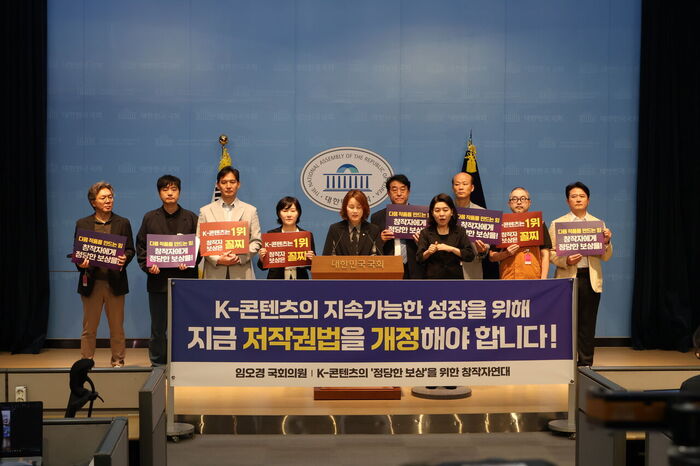
Representative Lim O-kyeong of the National Assembly's Culture, Sports and Tourism Committee hosted a press conference on October 12 at the National Assembly Communication Building to urge the passage of a Copyright Act amendment for the fair compensation of K-content creators.
The proposed amendment introduces a new "right to claim fair compensation," which allows creators to demand reasonable compensation for profits generated from the use of their works, even after transferring the rights required for exploitation.
Explaining the legislative intent, Representative Lim O-kyeong stated, "Even when works like 'Squid Game' achieve worldwide success, creators who cannot secure special agreements receive nothing in return, and the current structure makes it extremely difficult to enter into such special terms in the first place," adding that the bill was proposed to establish a clear legal basis.
The Creators' Coalition for Fair Compensation in K-Content (abbreviated as the "Creators' Coalition"), composed of six organizations including the Writers Guild of Korea and the Directors Guild of Korea, joined the press conference to state that buyout contract practices by global streaming platforms such as Netflix leave writers, directors, producers, and actors excluded from sharing in the profits of their works' success.
Screenwriter Park Hae-young, who penned dramas such as "My Mister" and "My Liberation Notes", pointed out that global streaming services like Netflix and Disney Plus demand contracts requiring the transfer of all copyrights, sharing the reality that creators are unfairly stripped of their intellectual property rights.
Song Young-woong, president of the Korea Broadcasting Performers Rights Association, shared that the organization requested negotiations with Netflix but received no response, highlighting the lack of a legal basis to bring global streaming platforms to the negotiating table as a serious issue. Regarding this, Moon Hyun-sung, copyright committee chair of the Directors Guild of Korea, noted that in the United States, Europe, and Latin America, fair compensation for the use of works is guaranteed through laws or collective bargaining agreements, emphasizing, "Fair compensation is the international standard."
Kang Ho-jun, president of the Association of Korean Independent Television Producers, pointed out the disparity between compensation systems in music and video, noting that while composers and lyricists receive royalties whenever music is streamed, video creators receive no compensation for the continued exploitation of their works.
Actor Lim Ho highlighted the difficult living conditions of creators, revealing that the average annual appearance fee for broadcast performers is 7.58 million won. Baek Jae-ho, president of the Association of Korean Independent Film & Video, stressed that fair compensation is essential for creators to continue making quality content, emphasizing that this Copyright Act amendment is a livelihood bill supporting the survival of creators.
Representative Lim O-kyeong expressed her commitment to advancing the bill, stating, "I will stand with them until the day a legal foundation is established to protect the rights of K-content creators, who are the core pillar of a sustainable K-culture ecosystem." The Creators' Coalition urged the National Assembly to swiftly pass the amendment and called on the government to lend its support so that the K-video industry can grow while ensuring creators receive fair compensation.
(SBS Entertainment News | Kim Ji-hye)
Copyright Ⓒ SBS. All rights reserved. Unauthorized reproduction, redistribution, and use for AI training are prohibited.