SBS NEWS
'Unanswered Questions' Explores Paju Freezer Murder: What Ties 50 Billion Won in Counterfeit Vouchers to Organized Crime?
Published : Oct 11, 2026 6:35 AM

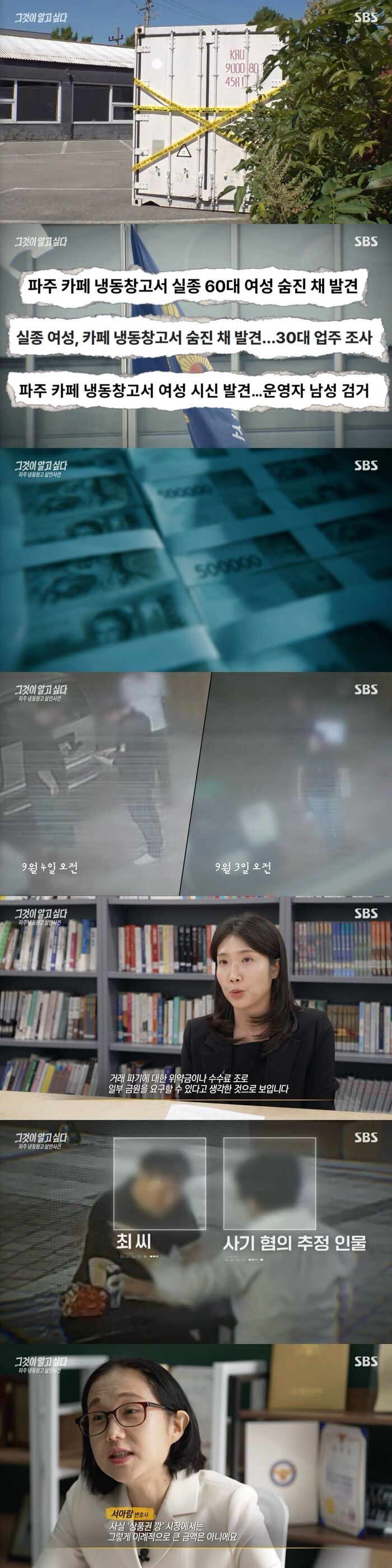 The freezer warehouse murder case—what is the real story behind the incident?
On the October 10 broadcast of SBS's "Unanswered Questions," the program tracked the horrific case of a woman in her 60s who died after being trapped inside a freezer warehouse set to minus 25 degrees Celsius, under the subtitle "Frozen False Scenario: The Paju Freezer Warehouse Murder."
On September 4, a body was discovered in a refrigerated container located in a corner of a large café parking lot in Paju, Gyeonggi Province. Found inside the container set to minus 25 degrees Celsius, the body was that of a woman in her 60s, surnamed Lee, who had been reported missing the previous day.
It came as a major shock that the victim died after being confined in the freezer warehouse for 27 hours. Soon after, 39-year-old Shin, the owner of the café where the freezer was located, was urgently arrested.
Shin, who had met the victim for the first time on the day of the incident, locked her in the freezer warehouse less than an hour after meeting and left her there. Shin claimed that it was an accidental crime and that he did not know it would lead to her death.
However, along with the victim's body, 10 boxes were discovered in the freezer warehouse, containing counterfeit department store gift certificates with a face value of 50 billion won.
The cause of death for the body, which showed no external trauma from assault or a weapon, was hypothermia. Shin claimed that when the counterfeits were discovered, he panicked and confined the victim.
The victim had worked in an area unrelated to gift certificates. Yet, the place where Shin was apprehended the next day was the location of the deceased's office.
Furthermore, on the day of his arrest, three men were with Shin, and one of them, surnamed Choi, was the person who had brought the victim to Paju on the day of the incident and connected her with Shin.
The victim's family filed a missing person report on the night of the incident. Immediately following the report, the police tracked the victim's movements via her cell phone location, but it was difficult to identify Shin's café.
This was because Shin, after confining the victim, drove around the Paju area while repeatedly turning her cell phone off and on to manipulate its location.
In addition, the prosecutor handling the case explained, "Even though Shin knew the victim's location, he told other investigative agencies and related persons that he didn't know well or that she had gone elsewhere in order to confuse the investigation. In particular, he also told specific lies claiming that they had already parted ways in the morning."
The prosecutor analyzed, "He seems to have thought he could demand money from Choi as a penalty or fee for the broken transaction, claiming that the victim had disappeared with the gift certificates," adding, "He demanded a penalty from Choi, asking how he would take responsibility and what he planned to do, and this appears to be because he had a criminal plan to that effect in his head."
In response, prosecutors revealed they have obtained search records showing Shin looked up criminal plans in advance, as well as phone recording files in which he explained details of the crime to a third party.
Before the incident, Choi and his party were seen traveling with the victim, and another person from their group was also arrested.
An expert commented on the case, saying, "In the discounted voucher exchange market, that is not an unusually large sum. There are cases where up to 230 billion won has been laundered," and added, "The goal could be bringing funds into the open from investment chatroom scams, romance scam organizations, or even the illegal gambling market."
A criminal psychology professor analyzed Shin's actions, stating, "He seems to have thought she was an intermediary who might not be able to report to the police," adding, "He appears to have obtained information or calmly formulated a plan believing that even if he scammed people trying to purchase gift certificates, the victims would not easily report it or seek help from those around them."
Ahead of the gift certificate transaction with Shin, Choi said he wanted to verify the certificates, and Shin requested that an elderly woman be sent to verify them. Choi then asked the victim to act as a proxy verifier for the certificates.
It was also revealed that Shin told the victim to leave her cell phone in his car, saying he would show the certificates via video call with Choi on his own phone. Was Choi also deceived by Shin?
When asked who Choi is and what his relationship with Shin was, investigative authorities refrained from answering, stating that it remains under investigation, though they drew a line by clarifying that Choi did not put the victim in danger while knowing Shin's criminal plan.
Shin, who carried substantial business loan debt compared to his assets, had continuously looked for ways to resolve it all at once.
Shin, who had a desire to show off, often believed he could fix problems in a single move. While devising dramatic ways to overcome his difficulties, he is presumed not to have considered human life in that plan.
An expert commented, "By abandoning the victim in the freezer warehouse, he caused her death without getting blood on his own hands. He likely viewed the victim not as a human being, but as a mere tool or procedure to achieve his objective," adding that targeting an elderly woman may have been a choice to pick someone easily overpowered.
The expert continued, "I don't think the buyer Choi's side bore any risk. The buyer did not show up at the scene and left no room for himself to be cracked down on or arrested. He merely put the victim forward, and it seems very likely that the victim went to the scene without knowing how illegal or dangerous what she was doing was," pointing out that putting a victim forward as a surrogate resembles the methods of criminal organizations.
Furthermore, the prosecution stated that through this case, they judged the fact that high-denomination gift certificates circulate without passing through official issuers and that there are people wanting to buy them indicates there is supply and demand to launder money via untraceable methods, whether from voice phishing or illegal gambling, raising expectations that the full truth behind the incident will be clearly revealed.
※ Please note: This article was translated by AI and may contain errors.
Copyright Ⓒ SBS. All rights reserved. Unauthorized reproduction, redistribution, and use for AI training are prohibited.