SBS NEWS
Analysis of Financial Sector Hacking Tool 'ARTEX' Reveals Integration with DeepSeek
Published : Oct 7, 2026 2:56 PM

▲ DeepSeek
It has been confirmed that ARTEX, an artificial intelligence penetration tool known to have been utilized in recent hacking incidents targeting the financial sector, is equipped with a feature that allows it to integrate with China's AI model DeepSeek.
ARTEX is structured to connect various large language models (LLMs), including not only DeepSeek but also OpenAI and Anthropic, as its "brain," enabling multiple AI agents to analyze attack targets, plan penetration paths, and proceed with security inspection tasks such as executing commands and handling HTTP communication.
Consequently, experts point out that the financial sector must manage the origins of AI models alongside their system access and execution privileges.
According to the ARTEX GitHub repository on Tuesday (Oct. 7), the development team introduces ARTEX as an AI-based autonomous penetration testing system.
The system is structured so that by connecting large language models (LLMs), multiple AI agents analyze attack targets, plan penetration routes, and execute security inspection tools.
In the version 0.3.10 update released on September 13, the development team explicitly stated that they added the official DeepSeek source to the network reconnaissance feature.
According to the description posted by ARTEX, this feature utilizes the currently active LLM settings as they are, calling DeepSeek's server-side web search tool using the official DeepSeek endpoint and the Anthropic protocol.
However, ARTEX itself is not a program designed exclusively for DeepSeek.
The official documentation notes that when using ARTEX, users can configure Anthropic or OpenAI API keys or designate a separate AI model in the "LLM Settings" menu of the user interface (UI).
ARTEX is closer to a type of AI-based security automation platform that utilizes the user-selected LLM to act as its brain.
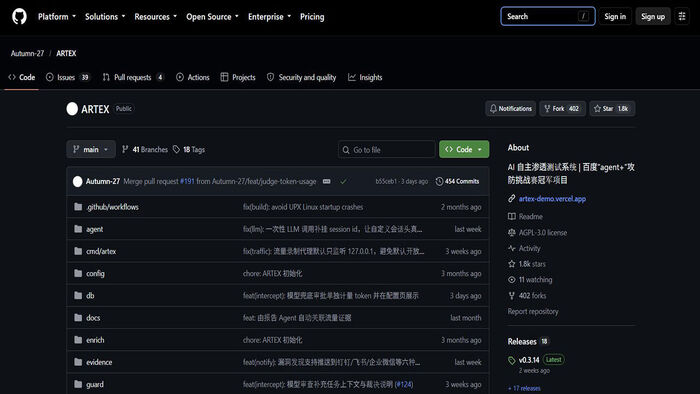
▲ ARTEX GitHub
Examining the technical structure of ARTEX, the LLM goes beyond simply answering questions and directly intervenes in the security inspection process.
The development team describes ARTEX as an "LLM multi-agent-based autonomous penetration system."
Inside the system, there is a "planner" that determines the direction of the attack and multiple "workers" that perform actual tasks, and they decide the next course of action based on target assets and information already secured.
Workers can perform actual security inspection tasks such as executing commands or HTTP communication (protocols), and through this, they accumulate information on discovered assets and vulnerabilities back into the system.
The structure allows AI to continue multi-stage attack processes even without a human inputting attack procedures one by one.
An official from the security industry said, "In the financial sector, it is necessary to control not only the origin of the AI model but also what systems it is connected to and what commands it is capable of executing."
(Photo: AP, Captured from GitHub, Yonhap News)
※ Please note: This article was translated by AI and may contain errors.
Copyright Ⓒ SBS. All rights reserved. Unauthorized reproduction, redistribution, and use for AI training are prohibited.