SBS NEWS
Iran Admits to 'Hardest Period in History' Amid Worsening Economic Crisis
Published : Oct 5, 2026 1:21 PM

▲ Mohsen Rezaei, Secretary of Iran's Supreme National Security Council (SNSC)
Iran's top security official has unusually admitted that the Iranian economy is going through the most difficult period in its history due to the fallout from the war with the United States, which has lasted for more than seven months.
The New York Times reported on October 4 that Mohsen Rezaei, Secretary of Iran's Supreme National Security Council (SNSC), made remarks to this effect during a high-level government meeting held on October 3 (local time).
According to Iranian state media, Iranian President Masoud Pezeshkian and other senior ministers attended the meeting, though state media did not directly quote Rezaei's remarks.
However, Iran's state-run news agency IRNA reported that he described the current situation as "one of the most difficult periods Iran has faced."
It also reported that he stated at the meeting that the Supreme National Security Council would provide all possible support.
President Pezeshkian also acknowledged the worsening economic situation in a social media statement on the same day, stating that the government has "adopted a new response posture to manage these special circumstances."
However, he did not elaborate on what that meant.
The Iranian economy has deteriorated rapidly since the outbreak of the war following a surprise attack by the U.S. and Israel in February.
The value of Iran's currency, the rial, has plummeted since the start of the war, and the downward trend accelerated in recent weeks as the U.S. tightened sanctions and enforced a maritime blockade.
According to Bonbast, a website tracking exchange rates in Iran's currency market, the rial surged to a record high of 2.567 million riials per dollar as of September 30.
Compared to February before the war, when the rial traded at 1.5 million to 1.6 million per dollar, the value of the currency has plunged to about one-third over the six months of war.
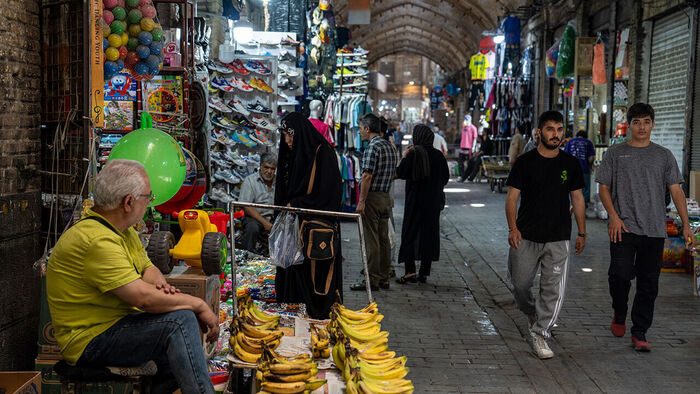
As the value of the currency fell, import prices rose, increasing the inflation burden on ordinary citizens.
In recent days, employees in both the public and private sectors, including nurses and teachers, took to social media to announce they were quitting their jobs, stating they could no longer make a living on their salaries alone.
Iranian local media also reported that retired public officials took to the streets in protests over the past few weeks after failing to receive their full pensions.
Analysts point out that the U.S. maritime blockade has virtually cut off Iran's crude oil exports, causing Iran to lose its main source of revenue and triggering a fuel crisis.
Seemingly feeling the impact of this, Iranian Oil Minister Mohsen Paknejad, who had previously stated that Iran would continue oil exports despite the U.S. maritime blockade and strengthened economic sanctions, recently resigned.
According to Reuters, a presidential office public relations official stated through state TV that Minister Paknejad had resigned "some time ago" for personal reasons, and that President Pezeshkian accepted the resignation at his strong request.
The presidential office announced that Hamid Bord, CEO of the National Iranian Oil Company, has been appointed as acting oil minister.
Economic pressure on Iran is intensifying further as negotiations between the U.S. and Iran remain deadlocked.
U.S. President Donald Trump and President Pezeshkian signed a Memorandum of Understanding containing a roadmap to end the war in July, mediated by Pakistan.
This tentative agreement fizzled out amid recurring military clashes as differences over control of the Strait of Hormuz were reaffirmed, leaving negotiations stalled.
To advance negotiations, Iran proposed a "7-day confidence-building plan" to the U.S. on the occasion of the UN General Assembly last month and recently received a response from the U.S. side.
According to foreign media, Iran proposed that it would reopen the Strait of Hormuz within seven days if the U.S. fulfills conditions including lifting the U.S. maritime blockade, immediately returning frozen funds, exempting Iranian crude oil exports from sanctions, and halting combat on all fronts.
However, many forecast that a conclusion will not be easily reached as both sides are still engaged in a war of nerves over the implementation sequence of lifting sanctions on Iran and reopening the Strait of Hormuz.
(Photo: Captured from IRNA's Telegram channel, Yonhap News)
※ Please note: This article was translated by AI and may contain errors.
Copyright Ⓒ SBS. All rights reserved. Unauthorized reproduction, redistribution, and use for AI training are prohibited.