SBS NEWS
Seoul Apartment Prices Set Record for Longest Bull Run, Gains Slow for 5th Week
Published : Oct 1, 2026 2:31 PM

▲ Seoul Apartments
Apartment selling prices in Seoul have broken the record for the longest consecutive upward streak in history.
However, as the downward trend originating from the Gangnam 3-district (Seocho, Gangnam, and Songpa districts) spreads to the Han River belt, the upward momentum itself has slowed for the fifth consecutive week.
A majority of regions in the mid-to-lower tier categories also showed a wait-and-see pattern.
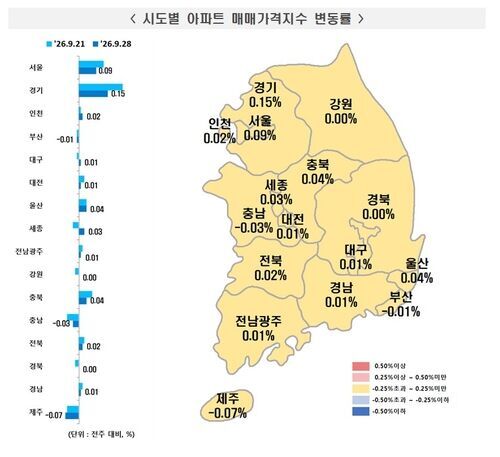
According to the weekly apartment price trends for the fourth week of September (as of September 28) released by the Korea Real Estate Board today (the 1st), apartment selling prices in Seoul rose by an average of 0.09% compared to the previous week.
This marks the 86th consecutive week of increases since the first week of February last year, surpassing the previous record of the longest rising period from the second week of June 2020 to the third week of January 2022 (85 weeks).
The Korea Real Estate Board stated, "While Seoul as a whole showed an upward trend with mixed movements across regions—such as upward contracts being signed mainly in large-scale complexes, station areas, and small-to-medium-sized units with steady demand, alongside downward adjustment transactions in some areas—prices overall went up."
The magnitude of the increase has shrunk for five consecutive weeks starting from the fifth week of August (0.29% to 0.22%).
In the fourth week of September, the increase decreased by 0.04 percentage points compared to the previous week (0.13%), gradually approaching the flat range.
While the Gangnam 3 districts continue to show weakness—where the potential burden of increased holding taxes and capital gains taxes due to tax code revisions acts as selling pressure—even Yongsan District has turned downward, showing signs that the Han River belt is entering the sphere of price adjustment influences.
Gangnam District (-0.42% to -0.56%), centered around Apgujeong and Daechi-dong, and Songpa District (-0.14% to -0.19%), centered around Jamsil and Bangi-dong, widened their declines, while Seocho District (-0.37% to -0.33%) maintained a weak trend although its decline narrowed slightly.
In addition, Yongsan District (-0.01%), a core area of the Han River belt, turned downward for the first time in 22 weeks since recording -0.03% in the last week of April this year, bringing the total number of price-declining districts in Seoul to four.
Seongdong District (0.12% to 0.07%), one of the representative regions of the Han River belt, saw its growth rate shrink, while Mapo District (0.08%) grew by 0.02 percentage points compared to the previous week, but its actual rate of increase remained at a low level.
This indicates that the weakness originating from the Gangnam 3 districts is showing signs of spreading to the so-called "Mayongseong" areas (Mapo, Yongsan, and Seongdong).
Regions in the mid-tier and below, which had previously maintained high upward trends, also experienced a slowdown in growth across multiple areas, including Seongbuk District (0.39% to 0.36%), Dongdaemun District (0.39% to 0.36%), Eunpyeong District (0.22% to 0.07%), Gangseo District (0.33% to 0.23%), Jungnang District (0.36% to 0.25%), Dobong District (0.35% to 0.23%), and Gwanak District (0.30% to 0.21%).
However, since the upward trend in the mid-to-lower tiers continues to drive overall prices in Seoul, attention is focused on whether future environmental changes, such as interest rates, will affect the persistence of Seoul's upward trajectory.
In Gyeonggi Province (0.23% to 0.15%), the overall magnitude of increases also narrowed, while areas such as Dongtan-gu in Hwaseong (0.47%) and Jungwon-gu in Seongnam (0.39%) showed relatively high rates of increase.
In Suwon's Yeongtong District, which rose 1.09% the previous week due to factors like Samsung Electronics' internal housing loans, the rate of increase shrank significantly to 0.37%, while Giheung-gu in Yongin (0.48% to 0.23%) and Hanam (0.38% to 0.25%) also saw large slowdowns.
Incheon rose 0.02%, and the Seoul metropolitan area as a whole rose 0.12%.
Non-metropolitan areas (0.00%) remained flat for the third consecutive week, while Sejong (0.03%) and Jeonnam-Gwangju (0.01%) saw increases, and the four major metropolitan cities and seven provinces remained flat.
Nationwide selling prices rose by an average of 0.06%.
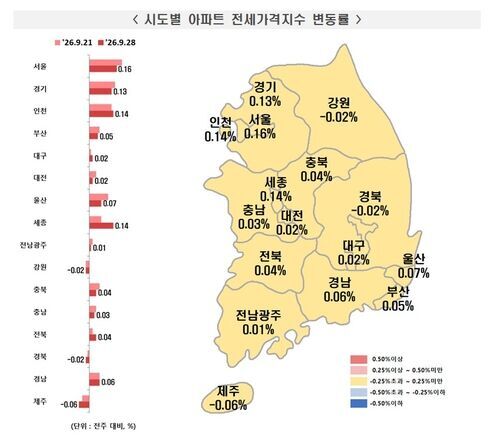
Jeonse (lump-sum lease) prices nationwide rose by an average of 0.09% compared to the previous week.
In Seoul (0.19%), Seocho District (-0.23%), affected by large-scale complex move-in supplies, fell for the seventh consecutive week, while Gangnam District showed a flat trend after four weeks of declines.
On the other hand, mid-to-lower tier areas such as Seongbuk District (0.36%), Gangbuk District (0.36%), Nowon District (0.36%), Dobong District (0.30%), Dongdaemun District (0.28%), and Geumcheon District (0.27%) rose, driven by large complexes and small-to-medium-sized units.
In Gyeonggi Province (0.13%), areas with relatively high growth rates included Yeongtong-gu in Suwon (0.30%), Guri (0.29%), Dongtan-gu in Hwaseong (0.29%), and Hanam (0.27%).
Incheon rose 0.14%, and the metropolitan area average increase rate was 0.14%.
In non-metropolitan areas (0.03%), the four major metropolitan cities rose 0.04%, Sejong rose 0.14%, Jeonnam-Gwangju rose 0.01%, and the seven provinces rose 0.02%.
(Photo: Provided by Korea Real Estate Board, Yonhap News)
※ Please note: This article was translated by AI and may contain errors.
Copyright Ⓒ SBS. All rights reserved. Unauthorized reproduction, redistribution, and use for AI training are prohibited.