SBS NEWS
Administrative Procedures for Converting Internal Combustion to EV Plants Accelerated; Semiconductor Fab Expansion Speeds Up
Published : Oct 1, 2026 9:55 AM

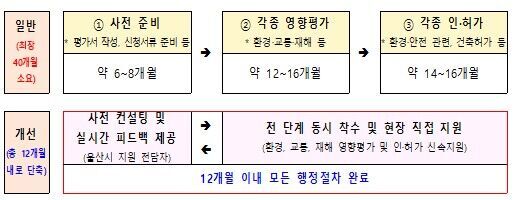
▲ One-stop licensing support to accelerate investment in converting internal combustion engine plants to electric vehicle facilities
The government plans to shorten various administrative procedures, such as licensing and impact assessments, from more than three years to within one year, centered around Hyundai Motor, to support the transition of internal combustion engine plants to electric vehicle facilities.
Reflecting feedback from major semiconductor companies like SK Hynix, the government will also allow the integrated commissioning of electrical and communication construction works for semiconductor fabs (fabrication plants) to accelerate expansion speeds.
The government announced these measures as part of the joint-ministry "2nd Field-Centered Corporate Investment and Innovation Support Package" during the Emergency Economic Headquarters Meeting and Economic Ministers' Meeting held today (1st) and presided over by Deputy Prime Minister and Minister of Economy and Finance Lee Hyung-il.
This package focuses on accelerating stalled projects totaling 7.9 trillion KRW in cutting-edge industries such as green industries, secondary batteries, and advanced sensors, while establishing investment-friendly systems in advanced and new industries.
Licensing support will be provided for investment to convert internal combustion engine plants into electric vehicle facilities.
Hyundai Motor plans to completely rebuild its internal combustion engine production lines in Ulsan into a plant centered on autonomous electric vehicles.
The investment scale is approximately 4 trillion KRW.
However, there were concerns that impact assessments on environment, traffic, and disasters, as well as licensing for environment, safety, and construction, would take more than three years.
In response, the government plans to shorten administrative procedures, including licensing and impact assessments, to within one year through a memorandum of understanding (MOU) between Ulsan City and Hyundai Motor within the second half of this year.
A dedicated project manager (PM) for one-stop support from local governments will also be designated.
Investment in clean hydrogen production and power generation facilities will also be supported.
The government plans to reopen the bidding market this month for companies that faced difficulties in investment decisions due to the cancellation of the clean hydrogen power generation market competitive bidding notice last year.
The bidding volume is 500 GWh annually, utilizing a 15-year long-term fixed-price contract system.
The evaluation process will expand the allocation of points for contribution to the domestic clean hydrogen ecosystem.
Through this, investments amounting to approximately 3 trillion KRW will be supported.
Regarding the new technology of mixing LNG into byproduct combined cycle power generation facilities, the period for consulting on environmental impact assessment revisions will be reduced from more than three months to within one month.
The government estimates that approximately 69.7 billion KRW in fuel costs will be saved.
The designation process for the Muan National Industrial Complex, promoted as a follow-up measure to the relocation of Gwangju Military Airport to Muan, will also apply a fast track to shorten it by more than a year.
The investment scale related to the Muan National Industrial Complex is approximately 761.5 billion KRW.
The application target of special provisions for hazardous material safety management related to secondary batteries will be expanded to related materials, parts, and equipment companies.
Through this, the government plans to promote new investments worth approximately 70.2 billion KRW.
For Ible Photonics, a specialized underwater acoustic sensor (sonar) company, the government will support its entry into the nearby bio-convergence industrial technology complex to back a manufacturing facility expansion investment of approximately 40 billion KRW.
In the semiconductor sector, regulatory improvements will be pursued to accelerate fab expansions.
Under the current system, electrical and communication construction works had to be commissioned separately, making it difficult for general contractors to oversee related works.
Accordingly, the government has decided to permit the integrated commissioning of electrical and communication works for semiconductor fabs.
To ensure fab expansions can proceed swiftly, the government will push for system improvements next year.
SK Hynix reportedly raised difficulties such as increased risks of serious disasters due to the separate execution of electrical and communication works, construction delays caused by schedule coordination, and delayed maintenance due to disputes over responsibility among contractors.
Regulations concerning cylinder cabinets, which protect containers supplying gases used in the semiconductor manufacturing process, will also be eased.
Currently, every time a small number of cylinder cabinets are added, technical reviews and change permit procedures must be undergone, taking at least one week per case.
Due to the characteristics of semiconductor processes, changes in the number of cylinder cabinets are frequent, causing problems that delayed the use of production equipment.
The government plans to enact a special semiconductor notification under the High-Pressure Gas Safety Control Act next year so that technical reviews and change permits can be processed collectively when multiple cylinder cabinets are installed.
In addition, the government will rationalize the criteria for small-scale environmental impact assessment targets for agriculture-integrated photovoltaics and pursue the rapid designation of a regulatory sandbox to allow the installation of standalone reformers inside buildings on the condition that safety devices are introduced.
A standalone reformer is a facility that extracts hydrogen by reacting hydrocarbons with steam at high temperatures.
For next-generation power semiconductors, 12 billion KRW will be supported through next year's budget bill to secure core technologies for 8-inch and larger large-diameter wafer process equipment and build demonstration infrastructure.
A total of 13.3 billion KRW will be injected into secondary battery technology development for humanoids.
The government explained that a dedicated research and development (R&D) project to develop three vulnerable robot parts—actuators, sensors, and robot hands—will receive 100 billion KRW in national funds from 2027 to 2029, with 30 billion KRW reflected in next year's budget bill.
(Photo: Excerpted from Ministry of Economy and Finance data, Yonhap News)
※ Please note: This article was translated by AI and may contain errors.
Copyright Ⓒ SBS. All rights reserved. Unauthorized reproduction, redistribution, and use for AI training are prohibited.