SBS NEWS
Westinghouse Obstacle Cleared… Path Opens for South Korean-Designed Nuclear Reactors in the U.S.
Published : Oct 1, 2026 9:35 AM

▲ A panoramic view of Unit 4 of the Barakah Nuclear Power Plant, featuring the APR1400 reactor model.
A path has opened to pursue the construction of South Korean-style large-scale nuclear reactors in the United States, the birthplace of the nuclear industry.
An agreement has been reached to revise the existing settlement agreement with the U.S. nuclear company Westinghouse, which has acted as a stumbling block to South Korea's nuclear power exports.
South Korea and the United States have agreed on a "South Korea-U.S. Nuclear Framework" to invest up to $120 billion out of the $200 billion U.S. investment fund to build eight large-scale nuclear reactors in the United States.
The framework is scheduled to be signed by the governments of South Korea and the United States, Westinghouse, Korea Electric Power Corporation (KEPCO), and Korea Hydro & Nuclear Power (KHNP).
The construction targets a total of eight large-scale nuclear reactors, including two South Korean-designed APR1400 reactors and six Westinghouse AP1000 reactors.
The project will proceed sequentially, starting with the first stage of construction for two AP1000 reactors, followed by the second stage for two APR1400 and two AP1000 reactors, and the third stage for an additional two AP1000 reactors.
Due to the settlement agreement signed between Westinghouse, KEPCO, and KHNP in January of last year, South Korea had to shoulder technology royalties exceeding 1 trillion won for every single nuclear reactor exported.
The domestic construction of the APR1400 within the United States was also impossible.
Westinghouse had opposed the revision of the settlement agreement out of concern over competition with its own reactor models, but a breakthrough was reached as the U.S. government, judging South Korea's construction capabilities to be essential for expanding nuclear power, demanded the revision.
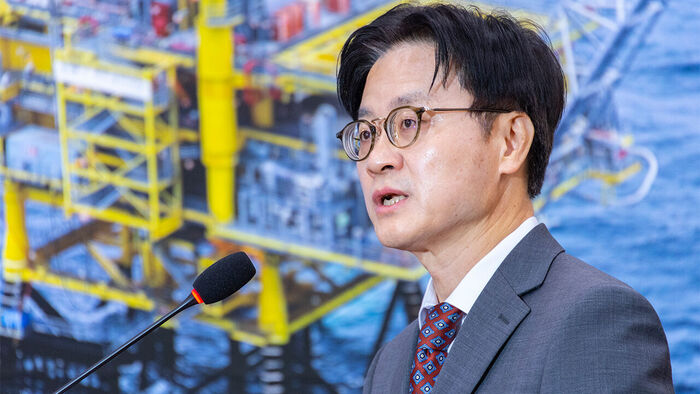
Minister of Trade, Industry and Energy Kim Jeong-kwan stated, "The framework includes the content that the settlement agreement will be revised to build two APR1400 reactors in the U.S.," adding, "Having signed it, we will not fail to revise it."
The entry of the two APR1400 reactors into the U.S. market is expected to serve as a stepping stone to increase the winning prospects for South Korean reactor models in third-country market bidding wars.
South Korean constructors and equipment suppliers will also participate in the construction of the six Westinghouse AP1000 reactors.
About 50 years after South Korea's first nuclear power plant, Kori Unit 1, was built in 1978 using Westinghouse technology, South Korean companies are now building nuclear reactors in the U.S. as partners of Westinghouse.
The government is also pushing to acquire equity stakes to improve the unequal contract terms with Westinghouse.
Minister Kim stated, "We are coordinating the equity stake at the 5% to 10% level," and added, "Considering financial burdens, KEPCO and KHNP will participate at a symbolic level, and domestic private companies will join together."
He explained, "The reason for adjusting the equity stake to under 10% is because Westinghouse is burdened by South Korea's entry into the board of directors," and noted, "Domestic companies are proactive from a strategic investment perspective, keeping in mind entry not only into the U.S. but also into third-country markets such as Western Europe, which are held by Westinghouse."
Westinghouse shares are 51% owned by Canadian private equity firm Brookfield and 49% by Canadian uranium mining company Cameco.
The observation is emerging that even if South Korea does not directly participate in the board of directors, given the current governance structure, it can secure considerable voting power in major management decisions with a voting stake of less than 10%.
To prevent business risks regarding large-scale nuclear reactors, the government has allocated $20 billion out of the total project cost of $120 billion as a separate contingency reserve.
The policy is to assign responsibility and share costs in the event of construction cost overruns.
Minister Kim diagnosed, "U.S. nuclear power plant construction is always accompanied by cost overrun issues, so we have designated $20 billion out of $120 billion for contingency purposes." He added, "However, the risk of licensing delays is remarkably small right now because the U.S. administration has issued guidelines to complete nuclear plant licensing within 18 months, making nuclear construction urgent."
He added, "Our goal is for our companies to successfully complete the construction and completely save and recover the $20 billion."
However, the final implementation will be decided with caution.
Minister Kim stated, "While we agreed on the general outline, project costs and commercial rationality vary depending on specific project conditions such as ground conditions, cooling water accessibility, and connection to demand sources and power grids," adding, "We will go through a meticulous verification process in the fourth quarter regarding the detailed projects to be presented by the U.S. side."
(Photo provided by KEPCO, Yonhap News)
※ Please note: This article was translated by AI and may contain errors.
Copyright Ⓒ SBS. All rights reserved. Unauthorized reproduction, redistribution, and use for AI training are prohibited.