SBS NEWS
Semiconductor Boom Drives Record Tax Revenue... Up to 56 Trillion Won Available for Future Fund
Published : Sep 30, 2026 12:26 PM

▲ Ministry of Economy and Finance
Fueled by a semiconductor boom, this year's national tax revenue is projected to reach a record high of 478.6 trillion won, according to a government re-estimation.
Total tax revenue is estimated to increase by roughly 63 trillion won compared to the projection made during the supplementary budget compilation in March.
Among this, "excess tax revenue" that can be used as financial resources for the Future Response Fund (hereinafter referred to as the Future Fund) is projected to reach 56 trillion won, raising the possibility that the total size of the Future Fund could exceed 200 trillion won.
According to the Ministry of Economy and Finance today (September 30), the government recently held a tax revenue re-estimation committee meeting presided over by Cho Man-hee, head of the Tax Office at the ministry, to discuss the tax revenue outlook for 2026.
As a result of the re-estimation, the government forecast that this year's total national tax revenue will reach 478.6 trillion won, an increase of 104.7 trillion won compared to last year's performance (373.9 trillion won).
This surpasses the previous record high of 395.9 trillion won set in 2022, four years ago.
It is 88.4 trillion won larger than the main budget for 2026.
The increase compared to the supplementary budget compilation in March is 63.2 trillion won.
The tax revenue error rate against the final budget stood at 15.2%, the 5th highest on record.
Years with higher error rates than this year include 1950 (21.5%), 1988 (17.6%), 2000 (16.6%), and 1989 (15.3%).
Despite efforts to enhance the reliability of tax revenue estimation, such as strengthening cooperation with experts and upgrading the tax revenue estimation committee to a government deliberation body, corporate tax revenue significantly exceeded initial forecasts.
The government explained that even though an artificial intelligence (AI) forecasting model was introduced to estimate corporate taxes, the sharp fluctuations in corporate operating profit input variables—which must be fed into the model—due to the booming semiconductor industry were the main cause of the error.
Kim Byung-chul, Director General for Tax Policy at the Ministry of Economy and Finance, explained, "(Tax revenue) increased far more than projected due to an unpredictable semiconductor boom and a vibrant stock market," adding, "Operating profits in the semiconductor sector are 70 to 80 percent higher than initial forecasts."
He added, "The tax revenue estimation model uses a method of estimating past performance values with regression coefficients, but it cannot explain unexpected situations. We have no choice but to rely on market forecasts for operating profits, and these forecasts turned out to be wrong."
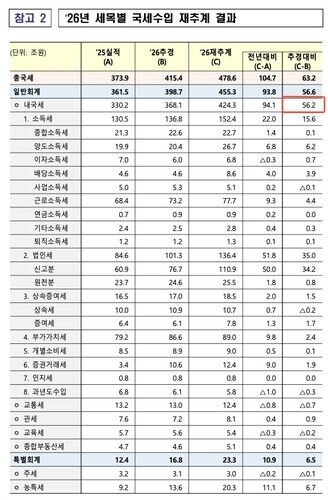
The government predicted that this year's corporate tax revenue would reach 136.4 trillion won, an increase of 51.8 trillion won from last year.
This is 35 trillion won higher than the February supplementary budget forecast of 101.3 trillion won.
Market consensus forecasts for the operating profits of Samsung Electronics and SK Hynix grew from 81 trillion won in July of last year to 339 trillion won during the February supplementary budget compilation this year.
Current market forecasts stand at 638 trillion won, double the figure from the supplementary budget period.
The government explained that looking at the first-half operating profits of Samsung Electronics and SK Hynix, market forecasts in February stood at 79 trillion won and 67.6 trillion won, respectively, but actual performances surged to 146.7 trillion won and 98.1 trillion won.
The government re-estimated that this year's income tax collection will reach 152.4 trillion won.
This is also an increase compared to both the main budget (132 trillion won) and this year's supplementary budget (136.8 trillion won).
It explained that tax revenue centered on earned income, dividends, and capital gains showed strength, driven by increases in performance-based bonuses and wage growth rates in the semiconductor and financial sectors, special dividends from semiconductor companies, and expanded housing transactions.
Value-added tax revenue was also recalculated to reach 89 trillion won, up 2.4 trillion won each from the main budget and supplementary budget, supported by a recovery in private consumption and an increase in import values.
Reflecting the robust stock market in the first half, securities transaction taxes and special rural development taxes were re-estimated to bring in 12.4 trillion won and 20.3 trillion won, respectively.
Compared to this year's main budget compilation (5.4 trillion won and 8.5 trillion won), both tax items increased more than twofold.
The government re-estimated that comprehensive real estate holding tax revenue will reach 5.1 trillion won, an increase of 400 billion won compared to the supplementary budget.
Looking at the tax revenue re-estimation results, forecasts suggest that the total size of the Future Fund the government can operate next year will exceed 200조 won.
Based on this re-estimation, "excess tax revenue" that can serve as financial resources for the Future Fund amounts to approximately 56.2 trillion won.
Simply adding this to "additional tax revenue" of 162.3 trillion won, which is the basic funding source, theoretically allows up to approximately 218 trillion won to be accumulated as fund resources.
The "Bill on the Establishment and Operation of the Future Response Fund" (Future Response Fund Act) submitted by the government early this month specifies additional tax revenue, excess tax revenue, transfers from general surplus funds, and fund operation earnings as financial resources for the Future Fund.
Excess tax revenue is defined as the amount exceeding the initial internal tax revenue budget among internal tax revenue budgets (or based on the supplementary budget if compiled).
It is essentially limited to the internal tax portion among the tax revenues that increased beyond expectations.
Director General Kim Byung-chul stated, "The bill related to the Future Fund currently submitted to the National Assembly only stipulates that excess tax revenue can be transferred to the Future Fund," adding, "How to utilize this is currently under discussion among related ministries."
(Photo provided by the Ministry of Economy and Finance, Yonhap News)
※ Please note: This article was translated by AI and may contain errors.
Copyright Ⓒ SBS. All rights reserved. Unauthorized reproduction, redistribution, and use for AI training are prohibited.