SBS NEWS
Cigarette Smoking Rates Down 29% Over Decade, While E-Cigarette Use Doubles
Published : Sep 30, 2026 8:30 AM

▲ No-smoking zone sign
While conventional cigarette smoking rates have decreased by nearly 30% over the past decade, tobacco consumption patterns have shifted, with liquid e-cigarette usage doubling, data showed.
In addition, while overall drinking indicators are improving, physical activities such as aerobic exercise, strength training, and walking have decreased, and obesity continues to be on the rise.
With 1 out of every 2 men being obese, the obesity rate for women also approached 30%.
These findings are from the 2025 Korea National Health and Nutrition Examination Survey conducted by the Korea Disease Control and Prevention Agency (KDCA), which surveyed approximately 10,000 household members aged 1 and older across 4,800 households in 192 regions nationwide through medical examinations, interviews, and self-administered questionnaires.
Last year, the overall tobacco product usage rate was recorded at 36.3% for men and 8.6% for women.
Compared to the previous year in 2024, the rate increased by 0.3 percentage points for men and 1.7 percentage points for women.
Broken down by type, conventional cigarette smoking rates stood at 28.0% for men and 5.5% for women, with only women showing a 1.3 percentage point increase compared to the previous year.
E-cigarette usage rates were 4.8% for liquid types and 7.3% for heated tobacco products, similar to the previous year. However, looking at the 10-year trend from 2016 to last year, conventional cigarette smoking rates dropped 29% from 23.9% to 17.0%, while liquid e-cigarette usage surged 109% from 2.3% to 4.8%.
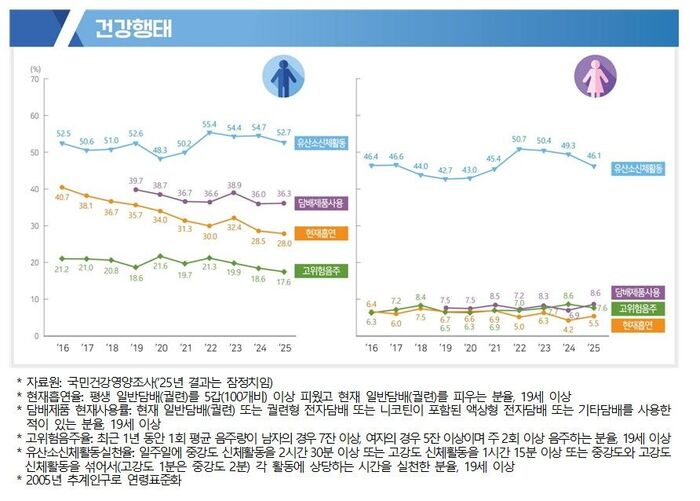
The high-risk drinking rate (defined as consuming an average of 7 or more drinks for men and 5 or more drinks for women per occasion, two or more times a week over the past year) stood at 12.6%, a slight decrease from 13.6% the previous year.
Notably, the high-risk drinking rate among men in their 40s dropped significantly over the year, falling from 30.3% to 23.3%.
The monthly heavy drinking rate was 35.1%, which decreased for both men and women compared to 2024, with the drop being most prominent among younger age groups.
Significant decreases were observed among men in their 20s (down 8.0 percentage points), women in their 20s (down 6.2 percentage points), and women in their 30s (down 7.3 percentage points).
The proportion of people exercising regularly declined.
The aerobic physical activity practice rate dropped to 49.5% from 52.1% in the previous year.
It decreased by 2.0 percentage points for men and 3.2 percentage points for women.
The strength training practice rate (down from 28.4% to 26.4%) and the walking practice rate (down from 44.2% to 41.7%) also fell.
Starting with this survey, the KDCA newly introduced and analyzed questions regarding social determinants of health, such as social support, life satisfaction, and loneliness.
As a result, the social support rate—the proportion of people who have someone to lean on or receive help from in times of difficulty—was recorded at 94.5%.
However, both men and women showed a tendency for this social support rate to decline as they grew older.
While it reached 98.6% for those in their 20s, it dropped to 87.8% for those aged 70 and older.
Subjective life satisfaction averaged 6.9 out of 10 points.
The proportion of individuals with low life satisfaction scores of 4 or below exceeded 10% among those in their 20s, 30s, and those aged 70 and older, which was higher compared to other age groups.
The prevalence of loneliness, measured by feeling "always or often lonely" in daily life, stood at 6.4%.
It was higher among women (7.5%) than men (5.3%), peaking at 9.7% particularly among women in their 30s.
The trend of decreasing carbohydrate intake and increasing fat intake continued.
For both men and women in their 20s and 30s, the proportion of energy intake derived from fat exceeded the optimal upper limit of 30%.
The prevalence of obesity stood at 49.1% for men and 28.7% for women.
For men, more than half of those in their 30s to 50s were obese.
The obesity rate for men was recorded at 59.0% for those in their 30s, 53.3% for those in their 40s, and 54.0% for those in their 50s.
The prevalence of underweight was 2.4% for men and 9.5% for women.
The prevalence of underweight among women in their 20s reached 19.9%, the highest across all groups.
(Photo provided by the Korea Disease Control and Prevention Agency, Yonhap News)
※ Please note: This article was translated by AI and may contain errors.
Copyright Ⓒ SBS. All rights reserved. Unauthorized reproduction, redistribution, and use for AI training are prohibited.