SBS NEWS
Korean Track and Field Concludes Asian Games Without a Silver Medal for the First Time
Published : Sep 29, 2026 10:03 PM

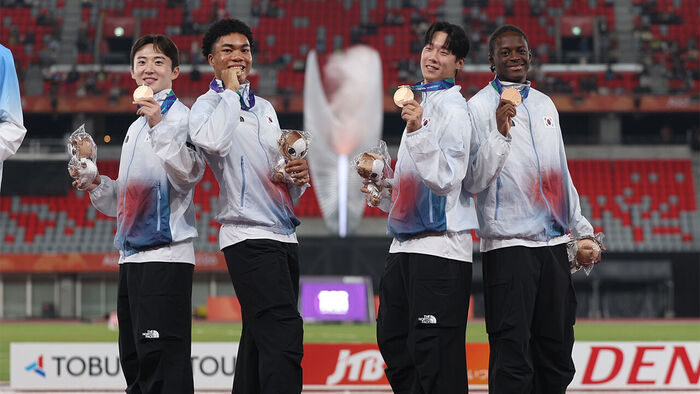
▲ South Korean athletes Seo Min-jun (from left), Namadi Joel Jin, Lee Jae-sung, and Bewsa Daniel Kasama celebrate with their bronze medals during the medal ceremony for the men's 400m relay at the athletics venue of the 2026 Aichi-Nagoya Asian Games at Mizuho Park Stadium in Nagoya, Aichi Prefecture, Japan, on the 29th. (Photo: Yonhap News)
South Korean track and field has wrapped up its schedule at the 2026 Aichi-Nagoya Asian Games, failing to win even a single silver medal for the first time in Asian Games history.
South Korea managed to secure only three bronze medals across the 50 track and field events contested at this tournament.
Choi Byung-kwang (Samsung Electronics), a leading South Korean race walker, won a bronze medal in the men's half marathon race walk on the 23rd with a time of 1 hour, 28 minutes, and 35 seconds. Meanwhile, South Korea's high jump star Woo Sang-hyeok (Yongin City Hall) cleared 2.22 meters in the men's high jump final on the 27th to take home the bronze, landing on the podium for the third consecutive Games.
The men's relay team—consisting of Seo Min-jun (Seocheon County Office), Namadi Joel Jin (Yecheon County Office), Lee Jae-sung (Gwangju City Hall, South Jeolla Province), Bewsa Daniel Kasama (Ansan City Hall), and Kim Si-on (Korea Armed Forces Athletic Corps)—grabbed a bronze medal in the men's 400m relay final on the 28th with a national record time of 38.43 seconds.
This marks the third time the track and field national team has failed to produce at least one silver medal at the Asian Games, following the 1st New Delhi Games in 1951, where the entire delegation did not participate, and the 4th Jakarta Games in 1962, where the track and field team did not attend.
The Jakarta Games were disrupted by political reasons, leading the South Korean delegation to dispatch athletes only to select events, with no entries in track and field.
Therefore, this is the first time South Korea has sent a track and field delegation to the Asian Games and failed to achieve a result of a silver medal or better.
The previous lowest performance came at the 1978 Bangkok Games (one silver, one bronze).
South Korea won four golds, three silvers, and three bronzes at the 2010 Guangzhou Games, followed by a sluggish performance of four silvers and six bronzes at the 2014 Incheon Games, and one gold, one silver, and four bronzes at the 2018 Jakarta-Palembang Games.
After settling for one silver and two bronzes at the 2022 Hangzhou Games, the team failed to win even a silver medal at this year's event.
While the results are disappointing, signs of hope were also discovered.
In particular, the remarkable growth of men's sprint twin pillars Namadi Joel Jin and Bewsa illuminated the future of South Korean track and field.
The two athletes finished fourth and fifth in the men's 100m final, which determines Asia's top sprinter, stepping up to the top tier of Asian competition.
The pair also led the national team in the men's 400m relay.
Although the medal tally was low, the stories embedded within the three bronze medals were moving.
World-class jumper Woo Sang-hyeok was favored as a strong contender for the gold medal at this competition, but prepared for the event while carrying a left instep injury, ultimately producing results despite not being at 100 percent physical condition.
The men's 400m relay team was disqualified during the preliminaries due to a questionable ruling, but quick responses from the Korea Association of Athletics Federations and the coaching staff overturned the decision, allowing them to compete in the final and ultimately win a medal.
Even after winning the bronze medal, the national team faced temporary confusion when the organizing committee incorrectly announced Thailand, which crossed the finish line with the fourth-place record, as the bronze medal team, but corrected the error following protests.
South Korea also suffered setbacks in the mixed 400m relay preliminaries.
The national team was disqualified due to a misjudgment, but ran a lone re-race following an appeal.
China achieved the best performance by sweeping 17 gold medals solely in track and field events at this tournament.
Japan claimed 10 gold medals and Bahrain took 9, while Thailand—led by Asia's top sprinter Puripol Boonson—and Uzbekistan secured 3 gold medals each.
South Korea finished 16th in the track and field events.
(Photo: Yonhap News)
※ Please note: This article was translated by AI and may contain errors.
Copyright Ⓒ SBS. All rights reserved. Unauthorized reproduction, redistribution, and use for AI training are prohibited.