SBS NEWS
On the Question: "Why Bother Treating Autistic Children?"
Published : Sep 29, 2026 11:21 AM
The Reality of 'Autism Private Education' in South Korea: A Country Where Therapy Has Become Shadow Education ①

Raising a Son on the Autism Spectrum
Now, roughly two years later, daily life for my child and me has become very busy, but fortunately, it is not as chaotic and bleak as the future I had imagined at that moment. My child remains my beloved son, just as he was before the diagnosis, and he is growing well at his own pace. Since that day, having visited two more university hospitals, I came to accept the diagnosis. Rather than dwelling on the diagnostic label itself, I spend each day thinking about what kind of support I can provide for him and navigating various trials and errors along the way.

Handed Only a Diagnosis with No System in Place Afterward
On September 12, an episode titled 〈The Reality of 'Autism Private Education' in South Korea: A Country Where Therapy Has Become Shadow Education〉 aired on the SBS current affairs program "SBS Newstory." Working on the SBS Newstory team producing 30-minute documentary-style programs rather than daily news, I wanted to use this opportunity to share the "reality of therapy" faced by families raising children with autism. Planning began early this year, and after being selected for the Korea Press Foundation's investigative reporting grant program, I was able to conduct on-site reporting on overseas cases in the United States, Japan, and elsewhere. As both a mother raising an autistic child and a journalist, I pursued this coverage for two reasons. First, is the current reality of "post-diagnosis therapy," which relies entirely on parents' financial capacity, a sustainable system? Second, is it acceptable for a child's future to diverge simply because of differing family circumstances and national systems, despite receiving the exact same autism diagnosis?
As of last year, the number of registered children under 19 with autism spectrum disorder in South Korea stood at 33,506, roughly a threefold increase from 2010 (11,918). Furthermore, among students eligible for special education this year, those with autism numbered 28,798, up about 70% from 2022 (17,024). Looking merely at the surface reality revealed by these statistics, this was clearly not an issue felt by me alone. In fact, far more viewers watched the broadcast and resonated with the concerns than anticipated. I extend my sincere gratitude.
On the Question: "Why Spend Big Money to Treat Autistic Children?"

Autism spectrum disorder is a type of developmental disability characterized primarily by deficits in social interaction and communication, as well as restricted and repetitive patterns of behavior. The term "spectrum" is used because the individual manifestations of the disability vary widely. While research into why autism occurs and which genetic mutations play a role is actively underway, an explanation applicable to all cases has yet to be found, remaining an unresolved question for humanity.
The word "treatment (치료)" that we commonly use carries the connotation of curing an illness or wound to make someone well. However, in modern medicine, aiming for a so-called "complete cure" that makes autism spectrum disorder symptoms disappear is unrealistic. Comparing English terms makes this distinction clearer: "therapy" for autism is closer to "Therapy," which refers to regimens aimed at symptom alleviation or functional recovery, rather than "Treatment," which refers to medical cures or procedures. In academic contexts, the term "Intervention" is more frequently used in the sense of supporting the life of an autistic child. While we in South Korea collectively refer to professionals carrying out these interventions as "therapists," in the English-speaking world they are distinguished under various titles, such as speech-language pathologist, occupational therapist, and behavior analyst.
These explanations hold the answer to the question, "Why bother treating autism?" The therapies received by children diagnosed with autism spectrum disorder are not intended to turn a child with autism into a child without autism. Rather, autism therapy means that specialists across various disciplines provide tailored support based on an individual's circumstances and characteristics—filling in gaps and minimizing hindering factors so that children can learn, or be equipped to learn, skills that are difficult for them to acquire naturally due to their disability, yet essential for participating in school and community life. Rather than a short-term medical cure, it is closer to "lifelong education across life stages" and "independence training" that helps them learn how to live independently step-by-step as they grow. (Medication, which falls under medical treatment, may be utilized when necessary during this process, but it also does not cause autism to disappear.)
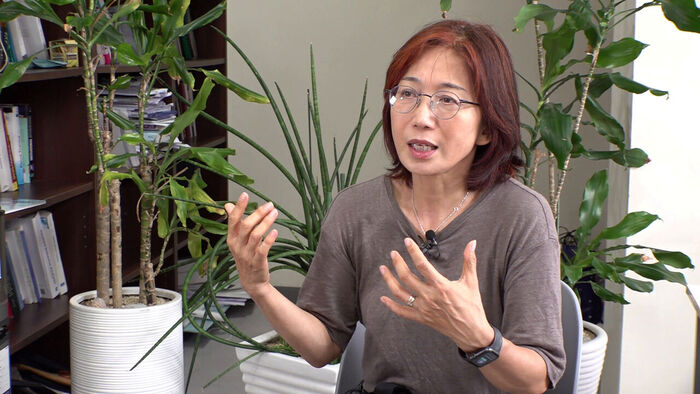
The follow-up question might be, "So what and how do you teach them?" A concrete example from an expert I interviewed went as follows. While approaches may vary depending on the discipline, Chung Kyung-mi, a professor in the Department of Psychology at Yonsei University, explained "autism therapy" from the perspective of applied behavior analysis (ABA) as follows:
| "In short, it means teaching every single thing one by one. Typically developing children learn by observing social cues from birth without anyone specifically teaching them, right? They are good at imitation. When imitation works well, learning occurs smoothly. But children on the autism spectrum struggle with imitation. Learning does not happen easily. It means teaching each thing individually—clapping hands, dressing oneself, putting on a hat, eating independently, putting on shoes—things they simply won't learn on their own because they lack inherent interest. It is so the child can live independently in society. The earlier you teach them, the more their ability to learn and acquire these skills develops, eventually enabling them to absorb things on their own without major assistance, just like typically developing peers. It is a bottom-up approach. If you teach them one by one to reach a state where they can learn, once they pass a certain threshold, they can reach a state where they learn on their own." (Chung Kyung-mi, Professor of Psychology at Yonsei University) |
Through this process, Professor Chung defined therapy and intervention as ultimately "enabling individuals to perform their roles in society, live functional lives, and lead happy lives while retaining their autistic traits."
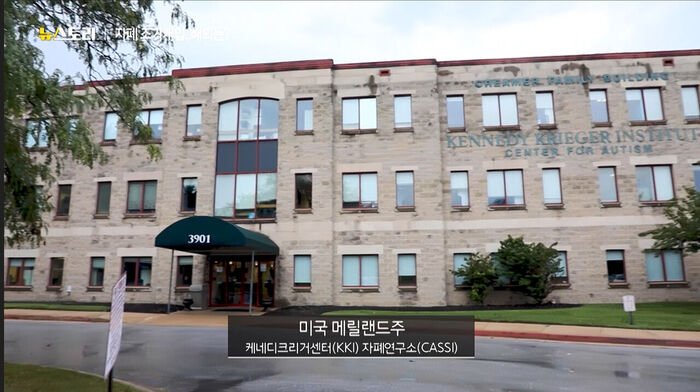
A 'Different Perspective' on 'Therapy' for Autistic Children in the United States
| "We teach what another person's facial expressions mean. If someone reaches their hand toward an object, we help them learn to anticipate that person's actions by realizing, 'Oh, they are thinking about that object and are about to grab it.' It is about building 'anticipatory ability.' We help them establish daily routines, enhance language comprehension, and understand and use gestures themselves. Rather than mechanically imitating others, we guide them to engage in play with peers within social contexts and participate in shared activities. Through this, along with learning ways to express their emotions, we lead them away from 'undirected play behaviors'—such as aimlessly banging objects or putting them in their mouths—toward meaningful play stages, like placing a small doll on a toy bus or pretending to feed the doll." (Rebecca Landa, Executive Director of the Center for Autism Services, Science and Innovation at Kennedy Krieger Institute) |
While reading another person's mind and understanding their behavior may come naturally and effortlessly to some, it is extraordinarily difficult for children on the autism spectrum. Domestic and international experts alike emphasized that when such early intervention takes place from a young age, children can internalize the social skills needed to live alongside others.
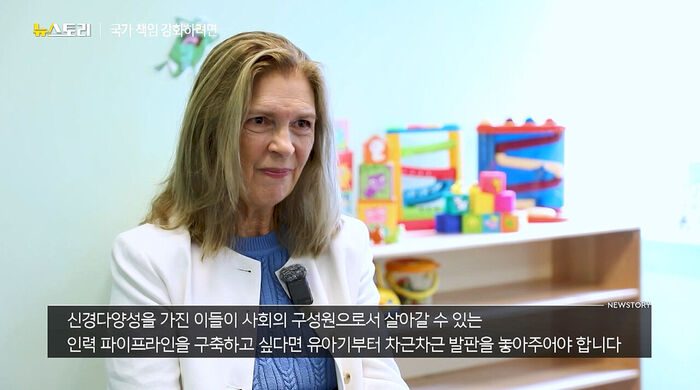
Beyond the benefits of enhancing an autistic child's individual happiness and quality of life, I also encountered an even broader perspective in the United States: the argument that early intervention ultimately reduces the financial burden on society and the state over the long term, laying the foundation for autistic individuals to work and live as contributing members of society.
| "Currently, autism spectrum disorder occurs in roughly one in every 31 children. That means every pediatrician is seeing autistic children, and an autistic child lives right in our neighborhoods. The United States has also realized that autism is a critical issue requiring state intervention from a public health standpoint. This issue directly connects to the country's bottom line. It brings immense financial ramifications in both the short and long term. If we want to build a workforce pipeline where neurodivergent individuals can live as members of society, we must lay the stepping stones step-by-step starting in early childhood." (Rebecca Landa, Executive Director of the Center for Autism Services, Science and Innovation at Kennedy Krieger Institute) |
I would like to conclude by returning to the comments. Amid the numerous comments asking "Why bother treating an autistic child?", there was also a voice left by one parent: "My heart aches reading comments questioning whether autism can even be cured. Parents here know full well there is no cure or complete fix. We are just trying to ensure that even after we die and are gone, they can live independently, not cause harm to others in society, and do at least the basics that ordinary children do... (omitted)" That earnest longing to equip their child with basic abilities for independence—perhaps that parent's voice had already answered the question of "What is this therapy for?"
In the second part of Reporter's Notebook, we will explore 〈Autism Private Education Where Centers Name Their Price: A Government Lacking Even 'Statistics' on Private Therapy Centers〉.
■ Sources
- Ministry of Health and Welfare, Registered Persons with Disabilities by Age, Disability Type, and Gender Nationwide, 2025
- Ministry of Education, 2026 Special Education Statistics
- Shaw KA, Williams S, Patrick ME, et al. Prevalence and Early Identification of Autism Spectrum Disorder Among Children Aged 4 and 8 Years — Autism and Developmental Disabilities Monitoring Network, 16 Sites, United States, 2022. MMWR Surveill Summ 2025;74(No. SS-2):1–22.
※ You can watch the SBS Newstory broadcast from September 12 via the link below.
▶ [SBS Newstory] The Reality of 'Autism Private Education' in South Korea: A Country Where Therapy Has Become Shadow Education
※ Please note: This article was translated by AI and may contain errors.
Copyright Ⓒ SBS. All rights reserved. Unauthorized reproduction, redistribution, and use for AI training are prohibited.