SBS NEWS
"North Korea's Drone and Missile Swarm Attacks Increase Success Rate of Follow-up Tactical Nuclear Strikes"
Published : Sep 28, 2026 4:33 AM
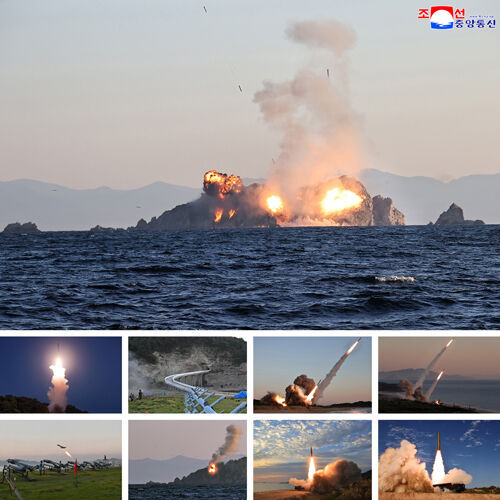
▲ North Korean People's Army combined unit joint firepower strike drill
Assessments have emerged that North Korea's recent commencement of full-scale testing for tactics combining drones and missiles could pose a threatening strategy that alters the military balance on the Korean Peninsula.
North Korea announced that it conducted a joint strike drill involving long-range artillery and missile units on September 12, simultaneously firing four types of weapons: cruise and ballistic missiles, multiple rocket launchers, and unmanned aerial vehicles.
This reflects a trend of accelerating the integration of weapon systems by adopting the "swarm tactic," whose effectiveness has been proven on the battlefields of Ukraine and the Middle East.
The U.S. daily The Wall Street Journal (WSJ) reported on the 27th (local time) that "North Korea has adopted tactics used in the wars in Iran and Ukraine, beginning practice for swarm attacks that combine conventional weapons with unmanned weapon systems." It conveyed assessments by Western experts that such multidimensional attacks could overwhelm air defense networks that rely on high-cost interceptor missiles.
Rami Kim, Korea chair at the International Institute for Strategic Studies (IISS) in the U.K., analyzed that "the strengthening of North Korea's drone capabilities, when combined with its nuclear and missile capabilities, could alter the military balance on the Korean Peninsula."
She explained that in the event of a conflict on the Korean Peninsula, North Korea could weaken South Korea's air defense network by adding drones to missile firepower, thereby increasing the likelihood of success for subsequent attacks using much more powerful weapons such as tactical nuclear weapons.
The Center for Strategic and International Studies (CSIS), a U.S. think tank, warned that compared to wars in Europe and the Middle East, a conflict involving North Korea or China would place a much greater burden on the stockpiles of weapons held by the U.S. and its allies.
In a recent report, CSIS pointed out that "massive salvoes of missiles and drones define modern warfare," and that future armed conflicts will be decided by whether one side can produce the missiles required for multidimensional attacks faster than the other.
Ankit Panda, a senior fellow at the Carnegie Endowment for International Peace, stated regarding this swarm tactic—referred to as salvoes, saturation, or precision mass attacks—that "it will significantly change the calculus of air defense."
He explained that large-scale attacks pouring in missiles and drones rapidly deplete the adversary's defensive assets and expose vulnerabilities in existing defense networks.
Military expert Fabian Hinz also analyzed that "the aim is to create numerous potential targets in the form of small warheads and then simultaneously launch conventional ballistic missiles to overwhelm the enemy's air defense or missile defense system."
(Photo: Korean Central News Agency, Yonhap News)
※ Please note: This article was translated by AI and may contain errors.
Copyright Ⓒ SBS. All rights reserved. Unauthorized reproduction, redistribution, and use for AI training are prohibited.