SBS NEWS
Lee Byung-hoon: Skilled Technology is Competitive in the AI Era, Striving to Host International Competition in Korea
Published : Sep 27, 2026 12:16 PM

▲ The national team for the WorldSkills competition
While the Asian Games were in full swing in Nagoya, Japan, an international competition was also held in Shanghai, China.
The 48th WorldSkills Shanghai was held for six days from September 22 to today (September 27).
WorldSkills is a biennial competition where young skilled technical national representatives aged 25 or younger gather to compete in their technical capabilities.
An interview was conducted with Lee Byung-hoon, chairman of the Human Resources Development Service of Korea and head of the South Korean national delegation, on-site in Shanghai where WorldSkills is taking place.
▲South Korea has ranked first overall 19 times since the 1970s at WorldSkills. However, after the Brazil competition in 2015, it has yielded the top spot to countries like China for 10 years. What are your thoughts on this?
"I think skilled technology is even more important in this era, but compared to that, it feels like it has taken a back seat over time. China participated in all 64 events, and Japan and Taiwan also participated in more events than South Korea. South Korea participated in 50 events, failing to field athletes in 14 events. I think this reflects our reality of failing to discover and nurture young talent in those respective fields. I believe the government and businesses must work together to garner social interest for fostering various skilled technologies, and isn't that our competitiveness for the future?"
South Korea previously hosted WorldSkills in Busan in 1978 and Seoul in 2001. Chairman Lee Byung-hoon stated that it is now time for Korea to host the competition again.
"South Korea hosted WorldSkills in 2001. About 25 years have already passed, and I think it is time for us to host it once more. Just as hosting the Olympics creates a nationwide boom, I came to think that efforts through various investments and support for skilled technology are needed via hosting WorldSkills."
Chairman Lee is an expert in the fields of labor sociology and industrial relations. After receiving a Ph.D. in Industrial and Labor Relations from Cornell University, he served as a professor in the Department of Sociology at Chung-Ang University. While serving as a professor, he took on roles mediating labor-management conflicts, such as serving as chair of the Social Dialogue Forum for Platform Labor in 2020 during the COVID-19 pandemic to mediate between delivery apps and labor unions, and serving as a public sector committee chair at the Economic, Social and Labor Council. Lee was asked about labor in the AI era.
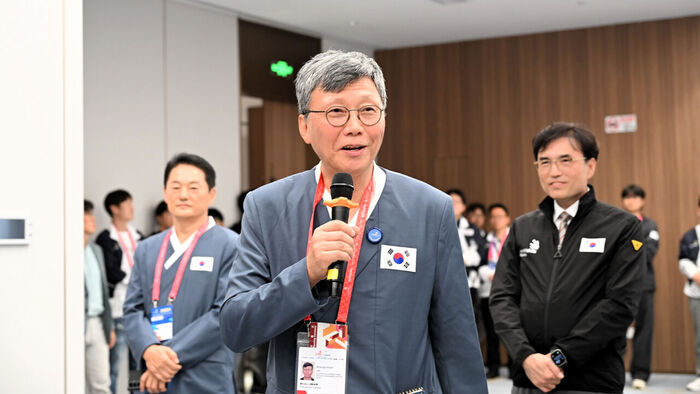
▲ Lee Byung-hoon, Chairman of the Human Resources Development Service of Korea
"As AI develops fearsomely, fields that rely on brainpower have reached a point where it is hard for humans to win against it. Accountants and professionals are like that, and journalists and professors are also being affected by AI. Even artistic fields like writers are utilizing AI. However, relatively speaking, physical skills are taking longer to be replaced by AI. You could call it the 'mystery of the human body.' In a way, that can be said to be another opportunity for the skilled technology field in the AI era. Since it takes a considerable amount of time for AI technology to catch up to the tacit knowledge of the human body for industrial workforce use, that can become industrial competitiveness."
▲There must be areas where human labor and AI collide.
"Recently, there was a controversy when the government attempted to have AI learn the tacit knowledge of technical masters to create data. The tacit knowledge of skilled technical masters is actually intellectual property, isn't it? Standards for sharing profits when they are generated by utilizing AI need to be agreed upon, so a lot of discussion seems necessary. Hopefully, social consensus can be reached where AI increases productivity, humans work less, and profits generated by AI are shared, but if such a structure cannot be built, it will be difficult for working people."
▲The impact of AI seems to be gradually becoming a reality in WorldSkills as well.
"Regarding DX (Digital Transformation), it is already entering many events such as mechatronics. Regarding AX (AI Transformation), I expect that AI will be utilized during the competition preparation process. I think athletes might use it in forms such as receiving various advice from AI to solve tasks. Whether AI itself becomes a single event and a method where humans and AI collaborate will be discussed going forward."
▲What is your role as the Chairman of the Human Resources Development Service of Korea in the AI era?
"As I took office as the Chairman of the Human Resources Development Service of Korea, I think our agency needs to play a good role regarding youth employment issues in the AI era. We plan to introduce the 'Youth AI First Career Support Project' as a pilot project next year. It is a project to support 750 youths in building careers in the AI field for up to two years so they can grow in that sector."
Shanghai / Reported by Jeon Hyeong-u
※ Please note: This article was translated by AI and may contain errors.
Copyright Ⓒ SBS. All rights reserved. Unauthorized reproduction, redistribution, and use for AI training are prohibited.