SBS NEWS
Fact Check: Comparing President Lee's Approval Rating with Predecessors
Published : Sep 24, 2026 10:13 PM

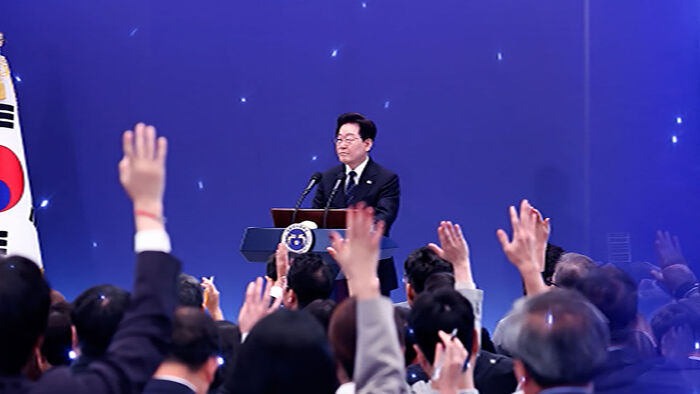
In recent polls, President Lee Jae-myung's job approval ratings have frequently been seen dropping. At the beginning of his term, when state administration should be gaining full momentum, talk of a crisis has emerged within the ruling camp. During a press conference last week, President Lee struck a humble tone, saying, "It is all due to my own shortcomings."
Marking the Chuseok holiday, the SBS Fact-Check Team examined the president's approval rating in detail. The team looked into how it compares with the early months of past presidents' terms, and how approval ratings have shifted across age groups, regions, occupations, and political orientations.

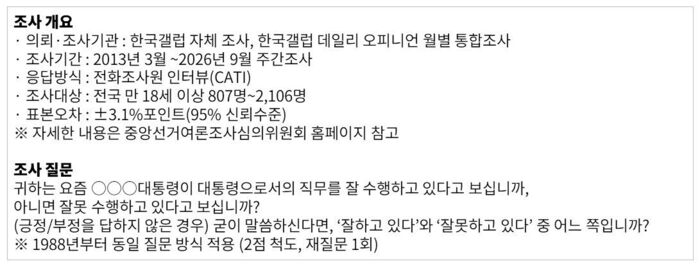
The Fact-Check Team used Gallup Korea's "Daily Opinion Monthly Integrated Survey" as the basis for analysis. Gallup Korea regularized its weekly public opinion polls in January 2012 during the term of former President Lee Myung-bak. Because it also releases monthly average integrated indicators based on these weekly surveys, monthly approval rating trends could be easily tracked. Given that it has been conducted repeatedly using identical methodology, it is also regarded as a useful tool for observing comprehensive trends in public opinion.
President Lee Jae-myung, who took office in June of last year, is currently in his 15th month in office this month. As last Friday marked the release of the final survey for September, the average approval rating for September was also announced. Aligning the timeframe to the first 15 months of each term, the team compared the job approval rating trends with those of former presidents. The subjects of comparison are former Presidents Park Geun-hye, Moon Jae-in, and Yoon Suk Yeol, who served after Gallup's weekly polls were regularized.
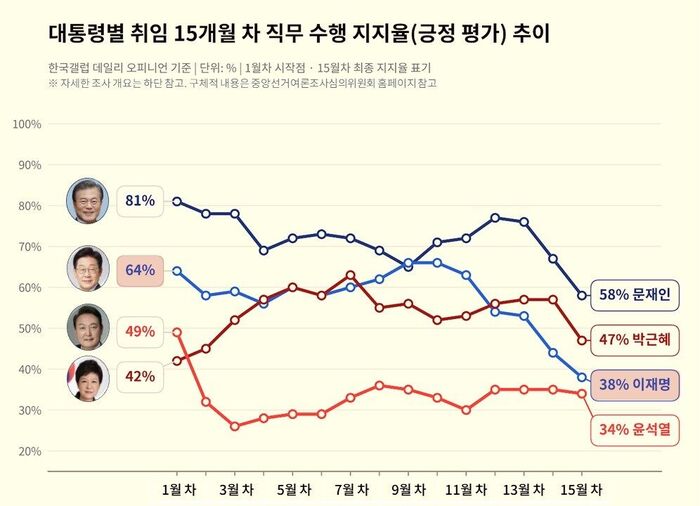
In the case of former President Park Geun-hye, her approval rating rose to 63% in September 2013, early in her term. It was analyzed that her approval rating gained momentum right after a series of diplomatic events, including a visit to China and the G20 summit in Russia. Former President Park continued to maintain relatively high approval ratings afterward, even coining the term "concrete support," but she also holds the record for the lowest rating in history, dropping to 4% during the Choi Soon-sil scandal.
Former President Moon Jae-in also saw his approval rating rise significantly around the time of the inter-Korean summit in April 2018, early in his presidency. The following month, in May 2018, his approval rating reached 77%. However, his rating subsequently declined relatively quickly. At the time, Gallup analyzed that this phenomenon seemed to stem from intensifying controversies surrounding issues such as the minimum wage, nuclear power policy, and refugee issues.
On the other hand, former President Yoon Suk Yeol, who took office in May 2022, saw his approval rating drop relatively quickly beginning in the presidential transition period. Controversies surrounding cabinet nominations and the relocation of the presidential office persisted, and his approval rating fell to the 20% range just three months into his term.
What about President Lee Jae-myung? During a period when economic indicators were favorable, including a rally in the stock market, his job approval rating also showed an upward trend, peaking at 66% in March. However, after the local elections in June, the atmosphere shifted relatively abruptly, leading to a sustained downward trend. Analysts pointed out that adverse factors included a shortage of ballots during the local elections, controversies over real estate and single-stock leveraged exchange-traded funds (ETFs), intra-party conflict that erupted during the national convention, and recent controversies surrounding personnel appointments in a second cabinet reshuffle. The average approval rating for September was 38%.
Compared with similar periods in the early terms of former presidents, at least according to Gallup Korea surveys, it is notable that the downward trajectory of President Lee Jae-myung's approval rating has been relatively steep.
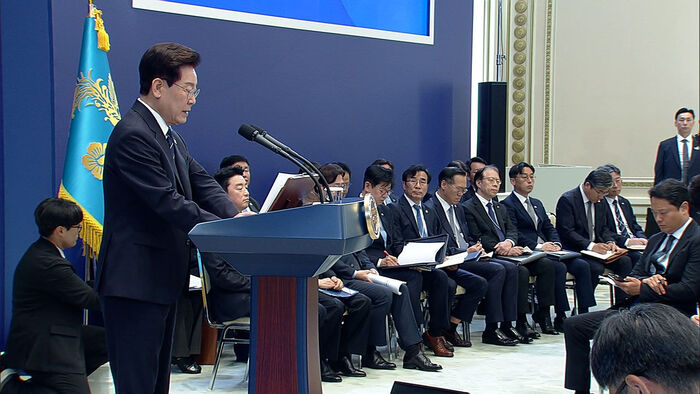
In which demographic groups, then, has this decline appeared relatively pronounced?
To examine this, the 1,000 total respondents to the poll must be broken down and analyzed by region, generation, and other categories. These are generally referred to as "subsamples," but subsample analysis comes with caveats. When respondents are segmented into smaller groups, the sample size becomes much smaller, which naturally widens the margin of error. As uncertainty increases, caution is required when interpreting differences between groups based on absolute figures. However, experts consulted noted that if subsample results measured repeatedly under an identical survey design move consistently in a certain direction, they can be utilized as data to "exploratorily" observe shifts in public opinion.
The SBS Fact-Check Team analyzed the subsamples based on this premise.
First is the job approval rating trend by age group.
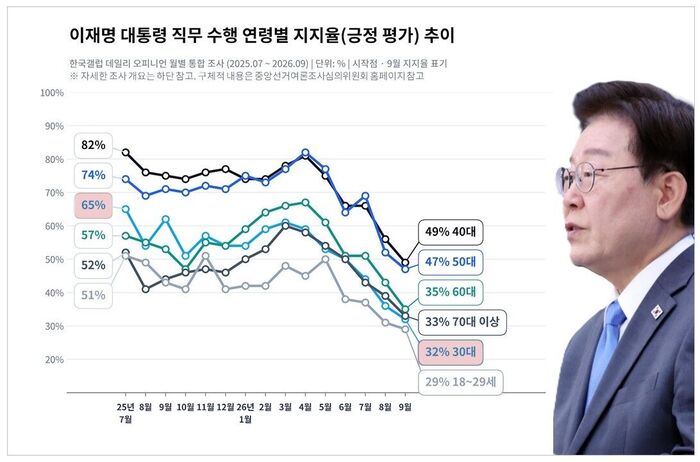
Overall, approval ratings have been declining across most age groups. However, although the decline among those in their 40s to 50s was significant, the fact that they remain President Lee Jae-myung's core support base has not changed.
In the age-specific analysis, the SBS Fact-Check Team took note of people in their 30s. When the Lee Jae-myung administration was launched, those in their 30s showed a moderate level of approval compared to other age brackets. Over time, however, their approval rating dropped, and it has now fallen to the lower tier among the age groups.
People in their 30s are a generation that can react sensitively to economic conditions and wealth accumulation issues.
Kim Hyung-jun | Chair Professor at Pai Chai University
"Individual investor losses in single-stock leveraged exchange-traded funds (ETFs) are estimated at 54 trillion won, with losses among those in their 30s said to be overwhelming. This is a life stage where people need to lay the foundation for asset building, even to secure housing, so the shock can be substantial. This could be a signal that economic anxiety is translating into an erosion of support for the current government."
The team reanalyzed the age-specific results by breaking them down by gender.
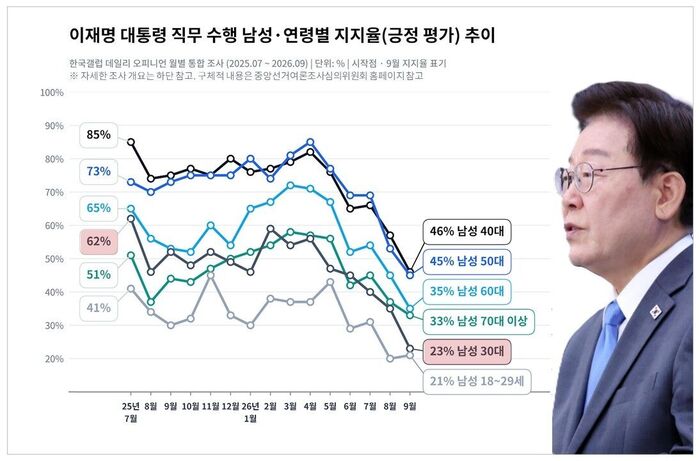
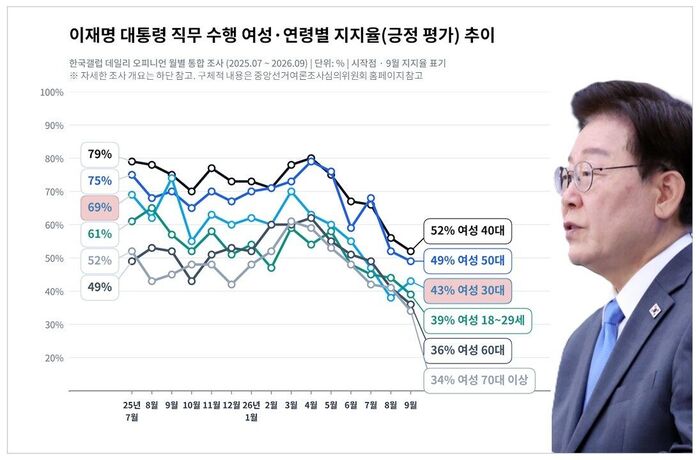
The younger the demographic, the wider the gender gap was. While women in their 20s can be seen as a core support base of the Lee Jae-myung administration, men in their 20s have shown weak support since early in his term. In recent surveys, their approval was in the low 20% range.
Among people in their 30s as well, a subtle shift in sentiment was detected, with the gender gap widening somewhat further. Earlier, we highlighted the drop in approval among people in their 30s; more precisely, it could be assessed that men in their 30s have driven this trend.
Next, we examine the job approval rating trends by region.
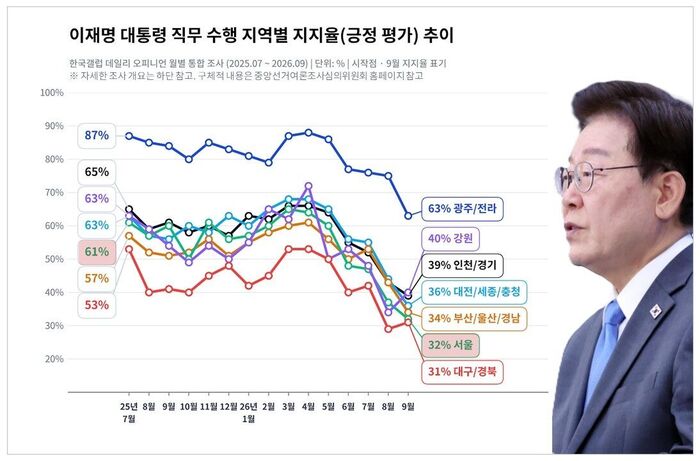
A downward trend was pronounced across most regions as well, with the Seoul area standing out in particular. Early in his presidency, Seoul stood in the mid-range with an approval rating of 61%, but it has since dropped by nearly 30 percentage points, marking a relatively steep decline. In September, it reached a level similar to that of Daegu and North Gyeongsang Province.
Viewed in conjunction with the preceding age breakdown, it appears plausible to interpret that the departure of support was prominent among young adults in the capital region. Over the span of a year, they have become a demographic group with a relatively large exodus of support.
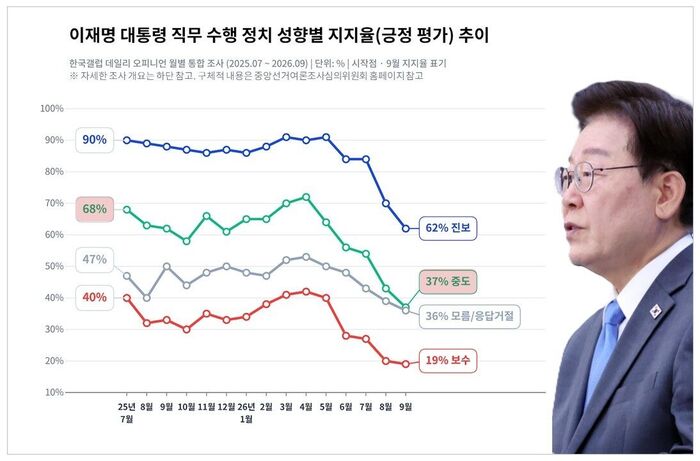
By political orientation, the drop in approval among respondents who identified as "moderates" was noticeable. Some interpret this as a weakening of support among the so-called "New Lee Jae-myung" cohort.
Jang Hyeong-cheol | Vice President of the Korea Society Opinion Institute
This clearly shows the characteristics of the so-called "New Lee Jae-myung" group centered on moderates, who supported the administration believing in government policy and competence. They can be drawn in quickly depending on policy responses, but they can also drift away just as rapidly.
Ideological factors cannot be ignored either. Finally, we look at the job approval rating trends by party support.
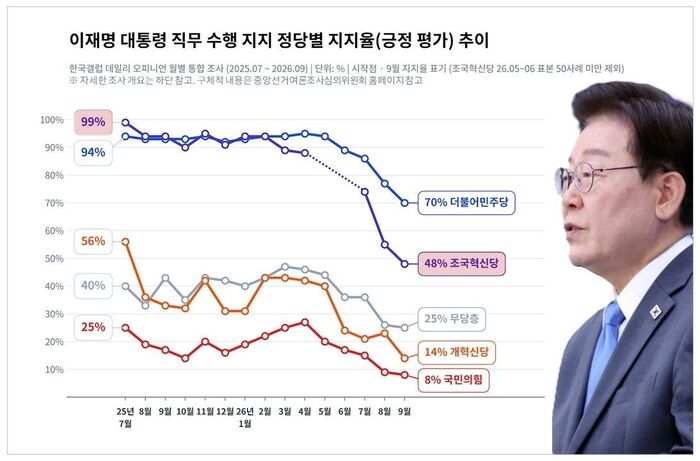
The decline in approval among supporters of the Rebuilding Korea Party was especially sharp. To be sure, the sample size for Rebuilding Korea Party supporters is relatively small, and Gallup does not present figures when a sample size is 50 or fewer, leaving no approval rating data for certain periods. One should be cautious of hasty generalization.
However, considering the recent fissures within the ruling bloc, room for interpretation certainly exists.
Yoon Hee-woong | CEO of Opinionz
Supporters of the Rebuilding Korea Party are a strongly ideological group among progressives, demanding high-intensity reforms from the current government. They already viewed the Lee Jae-myung administration's pragmatic and moderate reform path with discomfort, and there is an aspect where antipathy was amplified amid the clash between the pro-Lee and pro-Chung factions during last month's national convention.
Putting together the findings examined so far, it is true that President Lee Jae-myung's approval rating has shown an overall downward trend after hitting a peak early in his term. A distinctive feature confirmed by this analysis is that the decline in approval ratings was relatively large among demographics whose initial support at the launch of the government was not particularly low, such as those in their 30s, moderates, and the Seoul region. Assessments have also emerged that internal strife within the ruling camp became intertwined with these factors, amplifying the downturn.
The Chuseok holiday has begun. It has long been a fixture of Korean politics for the ruling and opposition parties to wage fierce messaging battles to capture public sentiment around the holiday dining table. Holiday gatherings have historically served as turning points for public opinion. This is because views shared among family members and acquaintances can easily exert a tangible influence on shaping political attitudes.
How will the landscape of public opinion evolve after Chuseok? The annual parliamentary audit of state affairs begins next month. Amid fierce competition between the ruling and opposition parties, presidential job approval ratings also carry the potential for sharper volatility than ever before.
Kim Hyung-jun | Chair Professor at Pai Chai University
The recent drop in approval ratings should be seen as an early warning regarding the administration's governance approach. Withdrawing support does not mean voters immediately switch to the opposition party. This is also why the People Power Party's approval ratings have not seen a dramatic surge. Defection is not synonymous with conversion. However, if this early warning is overlooked, the situation could easily change. That is why it is essential to look carefully at who is leaving and why they are leaving.
(Writer: Kim Hyo-jin, Intern: Kim Jeong-won)
※ Please note: This article was translated by AI and may contain errors.
Copyright Ⓒ SBS. All rights reserved. Unauthorized reproduction, redistribution, and use for AI training are prohibited.