SBS NEWS
"Deluded into Thinking I Was Studying by Using AI": The Decision Made by the 'World's Top School District'
Published : Sep 21, 2026 10:27 AM
"No Watching YouTube!"
 This is a story that parents, particularly those with young children, might find of interest. New York City is pushing forward with plans to ban students from watching YouTube in schools. My own child attended kindergarten here in New York—equivalent to pre-elementary in Korea—which was housed in the same building as an elementary school. One day, my child came home with an iPad provided by the school. I was quite surprised and thought, "Is the U.S. really different?" But from a certain point on, whenever I visited the school, I saw children gathered together playing games on them, and after classes ended, teachers were even playing YouTube videos inside the classrooms. One parent whose child attended the same school felt completely devastated, saying they had never let their child watch TV or turn on YouTube at home, only to see all that effort crumble upon entering an American school.
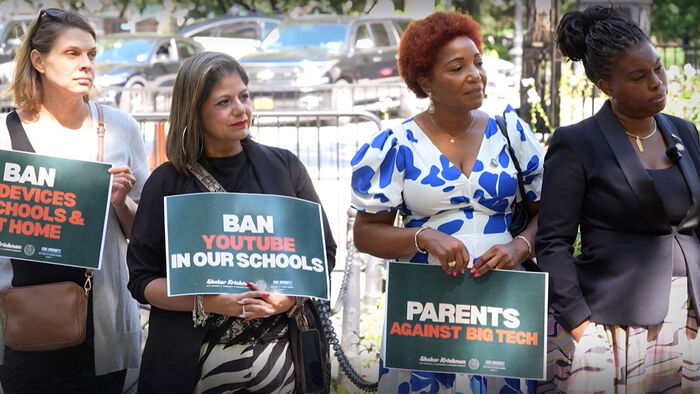
During our reporting, we met with a parent and examined a digital device distributed by a New York public elementary school, and found that all kinds of searches were possible on YouTube. There were no search-blocking filters for firearms, adult material, or inappropriate content, and games were even pre-installed on the learning devices, playable as soon as the children agreed to the terms. Raising these concerns, parents spoke out, prompting related civic groups and the New York City Council to begin looking into the issue.
When Did Digital Devices Become Ubiquitous?
However, another problem arose. Arguments were made that in underserved areas or low-income households without computers or digital devices, a learning gap would widen between them and students who had access. Triggered by this, digital devices were introduced into schools on an explosive scale, and classes began to be taught through them.
While this was an unavoidable choice during the unpredictable days of the pandemic, now, years after COVID-19 subsided, many argue that the devices brought in to aid students' learning are now eroding their academic capabilities instead.
[Eric Dinowitz / New York City Council Member: Even after children returned to in-person classes, the screens remained. So instead of looking at each other across their desks, children ended up looking down at screens.]
[Julie Menin / New York City Council Speaker: Screen misuse and overuse not only hinder children's social development, but are also directly linked to declining academic performance. This year, reading scores for grades 3 to 8 dropped by 6 percent compared to last year, and third-grade proficiency plummeted by nearly 14 percent.]
Why Is New York Taking Decisive Action?
 As dissatisfaction grew among parents and teachers, New York City—the largest school district in the United States with approximately 1 million students—took decisive action. It began earlier this month with an announcement by New York City Mayor Mamdani: a measure banning the use of generative AI, such as ChatGPT and Gemini, in elementary and middle school classrooms for at least one year.
[Zohran Mamdani / Mayor of New York City (September 2): "AI will never, in any form, replace the relationship between teachers and students."]
That was not the end; the New York City Council demanded even stronger measures. While AI has been temporarily blocked, platforms like YouTube and game-based educational apps remain accessible, prompting the council to pressure the Department of Education to issue a strict administrative order prohibiting their use. Furthermore, they argued that taking exams on computers should be banned to return to paper, and that schools should stop distributing digital learning devices to young students altogether.
[Shekar Krishnan / New York City Council Member: "Corporations tell us children will be left behind without technology, selling their latest upgrades and reaping profits for multi-billion dollar edtech companies. This is precisely why government regulation is needed."]
New York City Council Member Shekar Krishnan is the chair of the City Council's Committee on Oversight and Investigations and a key figure aggressively pushing for this policy. He is the first Indian American elected to the New York City Council in the city's history. A father of two young children, he has been appearing in local media quite frequently lately.
The position of Chair of the City Council Oversight and Investigations Committee carries considerable influence. It is a standing committee under the City Council that monitors whether the Department of Education is implementing policies properly and identifies issues. While it corresponds to a local government or municipal council in Korea, the weight of the position carries a different gravity given that it is in New York. The New York City education budget alone is roughly comparable to the entire municipal budget of Seoul.
However, because this committee cannot legislate or directly issue executive orders, it held a hearing this time to rally public opinion instead. Council members summoned Department of Education officials to the hearing and pressured them to issue a strong internal administrative order applied across all schools citywide. The hearing was livestreamed online, starting on Tuesday afternoon local time and continuing late into the evening.
Can't We Just Stop Using Digital Devices?
This is how the discussion has unfolded so far, and the issue remains an ongoing debate. How the landscape of New York classrooms will evolve is being closely watched across the United States. An MIT report was recently released stating that because students rely heavily on artificial intelligence, they turn to AI at the slightest difficulty, giving up on their own critical thinking while falling into the illusion that "I am studying" and "I am learning." These days, one cannot help but frequently reflect that technology created to enrich human life is increasingly turning into something that threatens it instead.
 Video
Video※ Please note: This article was translated by AI and may contain errors.
Copyright Ⓒ SBS. All rights reserved. Unauthorized reproduction, redistribution, and use for AI training are prohibited.