SBS NEWS
Exemption for Inherited and Elderly Farmland... Conditional Disposition Suspension for Conventional Rural Leasing
Published : Sep 21, 2026 9:47 AM

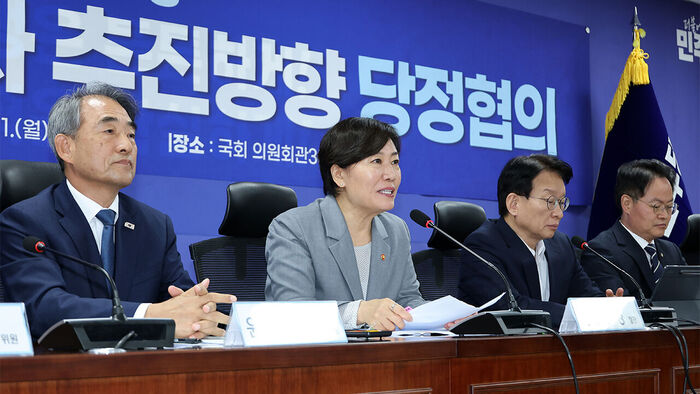
▲ Minister of Agriculture, Food and Rural Affairs Song Mi-ryung (second from left) speaks during a party-government consultation meeting on the direction of the comprehensive farmland survey held at the National Assembly Members' Office Building on the 21st.
The government and the ruling party have decided not to collectively dispose of farmland law violations that are not for speculative purposes in connection with the comprehensive farmland survey.
Specific relief and guidance procedures for the comprehensive farmland survey have been established so that farmland that is difficult to farm directly due to inheritance or aging, as well as leases conventionally practiced in rural areas, can be normalized through voluntary reorganization and consignment to the Farmland Bank.
The Ministry of Agriculture, Food and Rural Affairs explained that this measure does not change the government's existing stance, but rather clearly clarifies the principle of "distinguishing speculation from general violations" that it has maintained so far.
Since the beginning of the comprehensive survey, the government has stated that it will take strict action against speculation aimed at market margins or development gains without actual intent to farm, while preparing alternative measures for minor violations conventionally occurring in rural areas, taking field circumstances into consideration.
However, as the survey got underway, concerns were raised that farmers unable to farm due to old age or inheritance, tenant farmers borrowing farmland to cultivate, and owners who left farmland neglected because they could not find buyers could all become subject to disposition.
Some pointed out that rather than reflecting rural realities, the comprehensive farmland survey could become a means of uniformly applying only the principle that "those who farm should own farmland."
Amid growing controversy and misunderstanding, the Ministry of Agriculture, Food and Rural Affairs and the Democratic Party of Korea held a party-government consultation meeting on the morning of the 21st and announced follow-up measures to dispose of farmland with clear speculative intent according to law and principles, while normalizing and legalizing rural farmland ownership and utilization by reflecting rural realities.
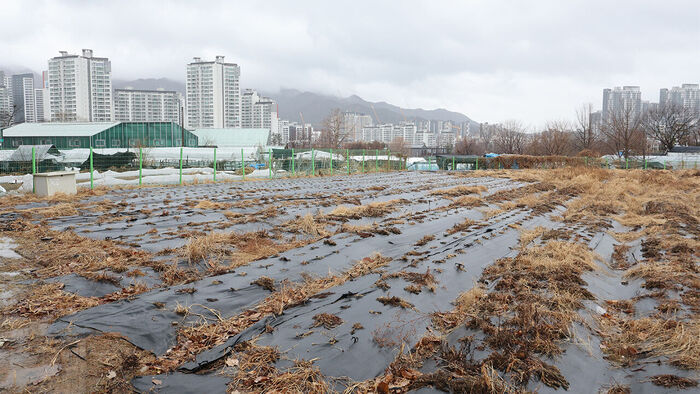
The cases clearly targeted for disposition by the party and government are: acquiring farmland by submitting a false farming plan in a land transaction permission zone and then leaving it uncultivated without permission or illegally leasing it; acquiring farmland through an agricultural corporation and engaging in the real estate business; and acquiring only farmland shares through an auction and then leaving them neglected without permission or illegally leasing them.
Serious illegal conversions that changed farmland in agricultural promotion zones into non-agricultural facilities such as storage yards or campsites will also face legal actions such as orders for restoration to their original state.
Since agricultural promotion zones are areas where the state has invested resources in field arrangement and infrastructure installation for food security, acts damaging farmland in these areas will be handled strictly, unlike general rural practices, according to the policy.
Yoon Won-seub, Director General for Agricultural Policy at the Ministry of Agriculture, Food and Rural Affairs, pointed out, "Although institutional improvements to strengthen farmland acquisition and management were made following the public institution employees' farmland speculation incident in 2021, speculative acts of acquiring farmland in shares by establishing false farming plans aiming for development benefits have not been eradicated recently. Such speculation hinders farmers' access to farmland and stable farming, and causes price distortion."
On the other hand, inherited farmland, farmland owned by elderly farmers, and farmland that is difficult to cultivate directly due to moving out of farming will be excluded from the uniform disposition targets if they are not for speculative purposes.
First, even if suspension of farming or lease violations are confirmed through this comprehensive survey, a "voluntary reorganization period" will be granted during which violations can be resolved by direct cultivation or leasing in a manner permitted by the Farmland Bank Act.
Owners who have difficulty with voluntary reorganization can be granted a postponement of the obligation to dispose by consigning the lease or management of their farmland to the Farmland Bank.
This prevents farmland from being neglected and manages it within the institutional system while allowing existing actual cultivators to continue farming.
Conventional practices such as farmers exchanging and cultivating each other's farmland for convenience or a single tenant farmer gathering and cultivating village farmland are also included in the targets for disposition postponement.
For unregistered inherited farmland, it was decided to review allowing administrative agencies to designate proxy cultivators or allowing property taxpayers to entrust it to the Farmland Bank as representatives.
Co-owned farmland is also planned to be allowed to be consigned with the consent of co-owners holding a majority of shares, provided it is not for speculative purposes.
The special reorganization period for lease agreements to protect tenant farmers will be extended until November 15.
Farmland owned for more than three years will be excluded from supplementary investigation targets if it is entrusted and leased to the Farmland Bank during the survey period, and measures not to view it as a lease violation under the Farmland Bank Act will also be promoted.
Even in cases where illegal farmland conversion is confirmed through this comprehensive survey, an opportunity for retroactive legalization will be granted unless it is a serious matter such as damage to farmland within an agricultural promotion zone.
Specifically, if facilities that could have been installed if conversion reporting or permission had been previously undergone remain in an illegal state without going through those procedures, an opportunity to apply for retroactive conversion will be created.
Once an application is filed, it is a retroactive endorsement method in which requirements are reviewed, a farmland preservation charge is imposed, and the status is converted to legal.
However, cases where the intent to violate the law is clear, such as operating a restaurant or using it solely for solar power generation after disguising it as a vinyl greenhouse or mushroom cultivation house, will be excluded from the targets, and a voluntary reorganization period will be granted to correct such facilities to their original purposes.
For land whose land category is a field or paddy but has turned into forest land for a long time so that the actual state and land category do not match and the utility of restoring it to farmland is low, changing the land category to fit the actual current status and excluding it from the application of the Farmland Bank Act will also be reviewed.
The party and government decided to promote the enactment of a special act to secure legal grounds for disposition postponement and retroactive endorsement of illegal conversions.
The bill is expected to contain targets and procedures for normalization and legalization, as well as requirements for disposition postponement.
Director General Yoon emphasized, "The current Farmland Bank Act has no grounds to mitigate dispositions for violations confirmed during the investigation process. Therefore, the enactment of a special act is absolutely necessary. We will complete up to the National Assembly vote within this year."
In addition, the party and government plan to concurrently promote amendments to the Farmland Bank Act to resolve the gap between agricultural and rural realities confirmed in the comprehensive survey and the farmland system.
They also decided to review increasing the budget for farmland acquisition and pension projects at the National Assembly stage for agricultural structural reform and stabilization of the farmland market.
Minister of Agriculture, Food and Rural Affairs Song Mi-ryung emphasized, "The comprehensive farmland survey is a starting point to accurately grasp the reality of our farmland, change the farmland system to fit reality, and revitalize agriculture and rural areas. Measures will be taken so that there are no disadvantages or inconveniences for well-meaning farmers and citizens."
(Photo: Yonhap News)
※ Please note: This article was translated by AI and may contain errors.
Copyright Ⓒ SBS. All rights reserved. Unauthorized reproduction, redistribution, and use for AI training are prohibited.