SBS NEWS
Korea Forest Service Claims 'National Interest'—Will It Just Walk Away if Deals Fall Through?
Published : Sep 20, 2026 9:07 AM
Stumbling Heavy-Lift Helicopter Project ⑤

(Part 1) Wildfire Helicopter Bought for 38 Billion Won Was Actually a Used US Military Aircraft?
(Part 2) Blind Faith in the Contractor's Word? Was the Contract Modification Justified?
(Part 3) The Core of the Stumbling 320 Billion Won Contract Is 'Certification'… Can It Be Obtained?
(Part 4) Unclear Military Accident History… Is It Really Okay to Proceed With the Project?
As mentioned in previous reports, the key argument emphasized by the Forest Aviation Headquarters was that "there was no alternative." The justification they put forward was "national interest." Their rationale was that if they terminated the contract, there were no other options available, and considering legal issues and economic viability, they had no choice but to modify the contract in pursuit of national interest. Detailed explanations appear in an internal report drafted by the Forest Aviation Headquarters in July 2025, titled "Review Report of the Deliberation Committee on the Introduction of Heavy Helicopters (M234SP)." The following summarizes the main points of the report in accessible terms.
"Modifying the contract enables the prompt acquisition of helicopters, allowing immediate deployment from the spring wildfire caution period of 2026 and establishing an immediate response framework. In contrast, terminating the contract and signing a new one would result in deliveries only by 2028, creating a two-year vacuum in wildfire response capabilities → Promptly securing helicopters is the paramount factor in serving the public interest to protect citizens' lives and safety."
"If the contract is terminated, overseas leasing of helicopters to secure water-dropping capacity becomes inevitable, which is expected to impose an additional financial burden. Modifying the contract (from new helicopters to remanufactured military models) allows purchase at a price 27% cheaper than the existing procurement cost. Securing an alternative asset capable of performing the same mission at a lower cost is desirable from the perspectives of fiscal soundness and public accountability."
"A gap in helicopter operational capability resulting from contract termination could degrade wildfire response capacity and erode social trust. Maintaining continuity through the existing contract will contribute to policy consistency and public confidence. → The stable performance of public functions is essential to building the foundation of trust in national disaster response."
This same logic was reiterated when SBS reporters met with officials from the Forest Aviation Headquarters. Key remarks included the following:
"Because an issue arose in the production of the new aircraft originally contracted, and given that we were already continuously purchasing remanufactured aircraft anyway, we judged that switching to a remanufactured model rather than canceling the contract would better serve economic efficiency and various public interest objectives. That is why we modified the contract. Before altering the terms, we reviewed legal issues, economics, performance, safety, and public value from multiple angles, ultimately determining that this served the national interest."
- Lee Seong-gwan, Head of the Aviation Maintenance Division, Forest Aviation Headquarters
Let us scrutinize these claims made by the Forest Aviation Headquarters.
First, as noted several times in previous reports, changing the contract from new helicopters to remanufactured military aircraft pushed the delivery deadline back to June 2027—a delay of one year and six months compared to the initial delivery date of late December 2025. Yet, certification issues remain unresolved, and there is no guarantee as to when they might be resolved. In the meantime, the helicopter temporarily deployed during the spring wildfire caution period was, as well known, owned by the U.S. company.
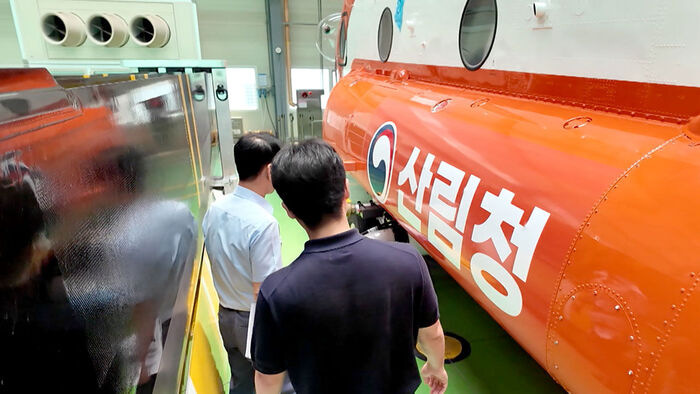
Next is the issue of economic viability. The Forest Aviation Headquarters swapped the aircraft model upon the U.S. contractor's request and agreed to accept remanufactured military aircraft built more than 40 years ago at a price 10% lower than the initial contract sum. To assess economic viability, one must verify whether the remanufactured military helicopters deliver performance and safety commensurate with that price tag. Only then can it be determined whether paying 10% less than the price of a brand-new helicopter is reasonable or grossly overpriced.
While the Forest Aviation Headquarters claimed that "modifying the contract allows purchase at a price 27% lower than the existing purchase cost," the basis for this calculation was that the revised price offered by the contractor ($25,398,000, reduced by 10%) was 27% lower than the average contract price of large helicopters procured by the agency over the two years from 2022 to 2024. Rather than conducting a comparative analysis of models sharing identical performance and conditions, they simply benchmarked it against the average contract amount of past heavy helicopter procurement projects.
What is critical when evaluating economic viability is the safety and certification feasibility of the remanufactured military helicopters that the U.S. contractor is supposed to deliver. The Forest Aviation Headquarters failed to secure concrete records from the past military service of Units 1 through 3—whose airframes have already been designated—such as accident histories and maintenance logs. On certification issues, the agency relied almost entirely on the contractor's optimistic outlook. The certification process remains stalled and is unlikely to be resolved in the short term. Even when the agency sought legal reviews from the Board of Audit and Inspection and the Ministry of Economy and Finance at the time, it did not disclose these certification risks.
The Forest Aviation Headquarters maintains that "canceling the contract would create a gap in wildfire response and damage public trust, whereas maintaining the existing contract through modifications contributes to policy consistency and public confidence." However, with even the U.S. company acknowledging that "meeting the delivery deadline will be difficult," it is questionable whether the agency has truly contributed to securing public trust.
Experts in government contracting and aviation certification, along with the relevant parliamentary standing committee, point out that regardless of the agency's intentions, the fact remains that contract execution has broken down. They insist on investigating why this happened and whether the Forest Aviation Headquarters bears responsibility.
"If the contract price was cut by 10% without an objective, rigorous analysis, that in itself could be problematic. Granting a 1.5-year delivery extension at the contractor's request effectively produced the exact same result as waiving the full 30% liquidated damages cap for failing to meet the initial deadline. Compared to how domestic contractors are treated, or even considering policy necessity, this clearly appears excessive."
- Kang Doo-won, Attorney (Government Contracts and Aviation Industry)
"A comprehensive assessment is required—whether the documents (obtained by the Forest Aviation Headquarters) were issued by an authority recognized by our domestic airworthiness authorities, whether that institution possesses a reliable system, and whether all such data is properly managed. While it is hard to speak definitively at this stage, with only the level of documentation currently obtained, it seems challenging for the airworthiness authorities to approve it. Moreover, this does not involve only civil airworthiness authorities, but also military airworthiness authorities, which makes it even more challenging."
- Choi Yong-hoon, Head of Aviation Certification Division, Korea Institute of Aviation Safety Technology (KIAST)
"The biggest problem is that contract terms were relaxed without thoroughly verifying deliverability and domestic or international certification feasibility. Once building new aircraft became impossible, they switched to remanufactured units, extended the delivery deadline by 18 months, and prepaid 70% of the contract amount before acceptance. Under the pretext of wildfire response urgency, they ended up wasting taxpayer money and inviting an operational void. The Korea Forest Service must clearly disclose what actual national benefit was gained from modifying the contract."
- Interview with Rep. Yoon Joon-byeong, Member of the National Assembly Agriculture, Food, Rural Affairs, Oceans, and Fisheries Committee (Democratic Party of Korea)
If certification issues are not resolved and the U.S. company fails to meet the delivery deadline, the Forest Aviation Headquarters maintains that it will "proceed strictly according to the contract." This means levying liquidated damages for late delivery as stipulated in the contract terms and sequentially considering contract termination. Inside the agency, there is also an apparent sentiment questioning why the agency should shoulder responsibility for the contractor's failings: "Why is it our fault if the contractor fails to meet contract terms?" In fact, officials from the Forest Aviation Headquarters repeatedly told SBS reporters, "If the contractor fails to properly perform the contract, we will simply terminate it."
This is a project backed by more than 326 billion won in national budget. Above all, it is an endeavor undertaken to safeguard citizens' lives, safety, and property. The scale and nature of the project are far too consequential to simply dismiss with claims that there was no alternative or that any failure to perform rests solely on the contractor. If the agency had put even a fraction of the effort it used to lobby the National Assembly for funding following major wildfires into verifying and ensuring that these massive funds were spent properly, the current situation could have been avoided.
Nearly four years have passed since the heavy-lift helicopter project began in 2022. A total of seven helicopters are scheduled for delivery by February 2029, yet it remains uncertain whether even a single unit can arrive on schedule. Rather than deflecting all blame onto the U.S. contractor, the Forest Aviation Headquarters must look inward and examine its own accountability. Since July, the Anti-Corruption and Civil Rights Commission has been investigating corruption reports involving the Forest Aviation Headquarters. The Board of Audit and Inspection has also included the heavy-lift helicopter procurement project in its regular audit of the Korea Forest Service. The central questions are whether switching from brand-new aircraft to remanufactured military helicopters that operated for 40 to 60 years was appropriate, whether the purchase price was reasonable, and whether undue preferential treatment or benefits were granted to the contractor.
In the next installment, we will examine effective measures to respond to increasingly severe and large-scale wildfires.
※ Please note: This article was translated by AI and may contain errors.
Copyright Ⓒ SBS. All rights reserved. Unauthorized reproduction, redistribution, and use for AI training are prohibited.