SBS NEWS
One Ministry Says Strip Labels, Another Says Keep Them: Two Conflicting Rules on Bottled Water Shelves
Published : Sep 19, 2026 9:02 AM
Same Shelf, Different Rules
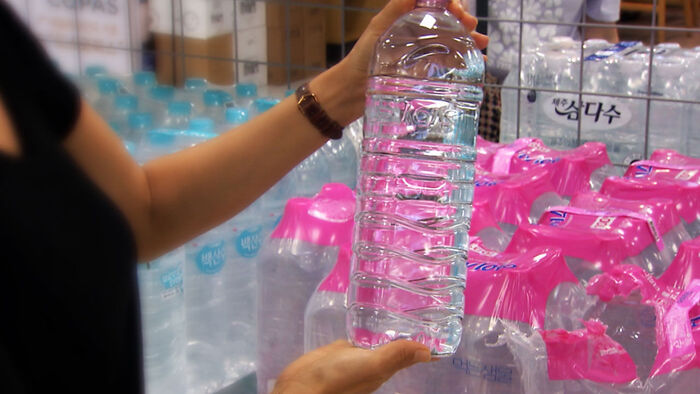
On September 9, at a hypermarket in Eunpyeong-gu, Seoul. Bottled water packages were piled up in a spacious area next to the checkout counters. At a glance, there were nearly ten varieties. Transparent PET bottles without labels and bottles wrapped in brand packaging were mixed together.
Here is what Yoo In-hyeok, who came to buy bottled water, had to say.
"Some have labels and some don't. It feels like they are attached even though they aren't really necessary. Nowadays, consumers already know what they're buying. While some people peel off the labels before throwing them away, most people just throw them out as they are. So I think going label-free is a really great change."
The Samdasoo bottle he picked up had no label, while the product right next to it did. He did not know what standard determined the difference.
Business Suspension vs. No Regulation
Starting January 1 of this year, labels are prohibited on drinking spring water sold online and on bundled packages sold offline. This is based on a public notice from the Ministry of Climate, Energy and Environment. Instead of labels, product information must be displayed on the bottle neck, bottle cap, or via a QR code.
The policy has been implemented in phases. In 2020, label-free packaging was allowed for bundled products, and in 2022, it was expanded to individual single bottles. This year, it became mandatory for bundled products. For individual bottles sold offline, a one-year transition and guidance period was established in consideration of retail infrastructure such as QR code recognition and POS system updates, with full enforcement scheduled for January 1 next year. The ministry stated that it is not considering an extension or re-deferral. Violations result in a warning for the first offense, followed by a 15-day business suspension for the second. A third violation brings a one-month suspension, and a fourth brings two months.
Domestic beverage companies have already completed the transition. Jeju Samdasoo switched its entire production for domestic sale to label-free bottles starting in May, and Kwangdong Pharmaceutical, its distributor, saw the proportion of label-free shipments to retail partners reach 97.2% as of July.
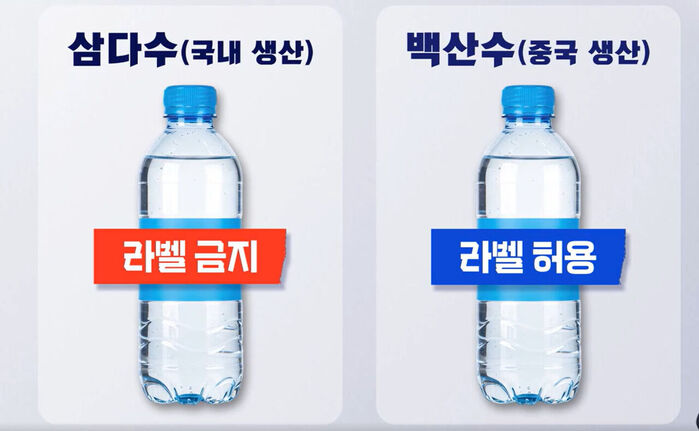
Yet, parts of the same shelf remain entirely unaffected by this regulation. Nongshim's Baeksansoo is sourced and produced in China, categorizing it as an imported product, which exempts it from the rule.
Orion's Jeju Lava Water uses Jeju lava seawater as its raw source. Per 2 liters, it contains 132 milligrams of calcium, 44 milligrams of potassium, and 18 milligrams of magnesium. Because this product is classified as a "mixed beverage" rather than drinking spring water, it is exempt from the mandatory label-free requirement. On the store shelf, it is virtually indistinguishable from the regular bottled water sitting right beside it.
Imported drinking spring water accounts for 4.4% of domestic distribution volume by bottle count. This is a three-year average from 2022 to 2024, and the figure stood at 4.3% in the first half of this year, according to numbers verified by the Ministry of Climate, Energy and Environment through an industry association. Mixed beverages are not even included in this calculation, as they are not drinking spring water and thus fall outside drinking spring water statistics.
Why They Are Not in Convenience Stores
However, selling label-free single bottles at convenience stores is impossible. This is because the Act on Labeling and Advertising of Foods mandates that required information must be displayed on the minimum retail sales unit offered to consumers.
An official from the Ministry of Food and Drug Safety (MFDS) explained the situation as follows:
"It depends on what constitutes the minimum sales unit. If an item is sold to the final consumer as a bundle, it is sufficient to print the required labels on the outer bundle packaging, meaning the individual products inside are not subject to mandatory labeling. That is why internal packaging can go label-free."
Single bottles, however, are a different story.
"Because mandatory details must be marked on the minimum sales unit, it is difficult to sell individual products without labeling information directly to final consumers."
Labels Won't Disappear
Originally, only food type, container and packaging materials, and storage instructions could be provided electronically. On August 29 last year, the ministry amended the Enforcement Rules of the Act on Labeling and Advertising of Foods and the Labeling Standards for Food, expanding the scope to include certain nutritional information, raw ingredient names, and business addresses. This system is known by the MFDS as "e-labels," and industry implementation guidelines have already been distributed.
However, this does not mean physical labels will disappear. The product name, expiration date, 22 types of allergens, and storage methods must still be printed directly on the packaging. Ingredients cannot all be moved to a QR code either, requiring the top three most used ingredients to remain, along with nutritional components such as calories, sodium, sugars, and trans fat.
The policy is designed to reduce labeling space, not eliminate it entirely. Moreover, it is a voluntary measure rather than a mandatory regulation. An MFDS official noted that the program is still in the phase of gradually gaining public and industry awareness.
The MFDS made its stance on expanding label-free requirements clear:
"Unlike bottled water, standard food products generally use multiple raw ingredients, and because there is a concern over spoilage and deterioration, providing and managing key information such as expiration dates is crucial. Therefore, our position is that physical label markings must be maintained."
That rationale seems reasonable for carbonated beverages or fruit juices. But does the same apply to products that are essentially water with added minerals?
"Those products also contain added ingredients, and because they constitute a distinct food category, we believe careful review is needed when considering consumers' right to know, potential confusion, and regulatory fairness across other food types."
The Ministry of Climate, Energy and Environment stated that it plans to consider phased expansion starting with imported products once domestic regulations take root. Mixed beverages would only follow after that.
Yet, the two ministries have never met to discuss the matter. The MFDS confirmed that there is no record of official communication with the Climate Ministry regarding the label-free policy.
Same Ministry, Different Scopes
Starting this January, manufacturers using more than 5,000 tons of PET bottles annually became obligated to use recycled plastic raw materials. The mandatory target rate for this year is 10%, and the government is pushing to expand the scope to companies using more than 1,000 tons per year and raise the quota to 30% by 2030.
Both drinking spring water and non-alcoholic beverages are subject to this policy. The regulation requiring recycled plastic inside bottles applies to beverages, while the rule mandating the removal of labels from bottles stops short at drinking spring water.
On January 1 next year, labels will also disappear from single bottles of drinking spring water.
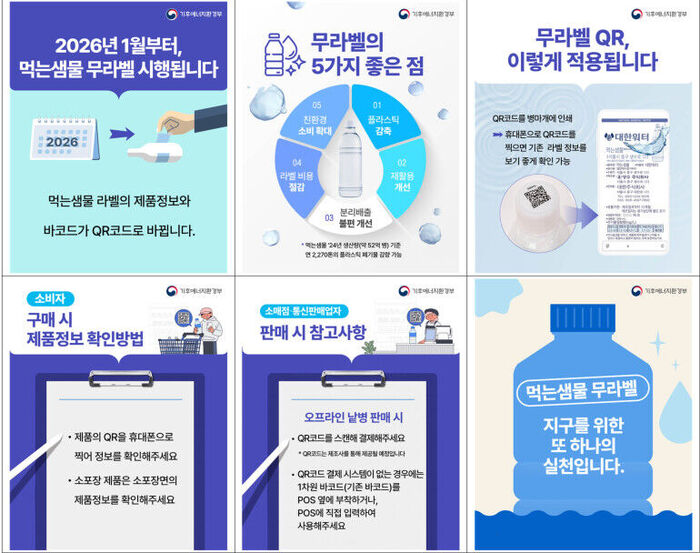
The annual plastic reduction target set by the government is 2,270 tons. This figure was calculated based on the 5.2 billion bottles of drinking spring water produced domestically in 2024. A single label measures an average of 20 centimeters; strung together, labels from 5.2 billion bottles would stretch 1.04 million kilometers. Labels from imported bottled water and mixed beverages are not included in that calculation.
※ Please note: This article was translated by AI and may contain errors.
Copyright Ⓒ SBS. All rights reserved. Unauthorized reproduction, redistribution, and use for AI training are prohibited.