SBS NEWS
Treasury Yields Mixed, Short-Term Up Limitedly Amid Hawkish FOMC; 3-Year Yield at 4.063%
Published : Sep 17, 2026 5:23 PM

▲ File Photo
Treasury bond yields showed mixed movements on September 17, with short-term yields rising slightly and long-term yields declining.
Following the hawkish assessment of the U.S. Federal Open Market Committee (FOMC) meeting overnight, Korean treasury yields traded weak centered on short-term tenors in the morning. However, they pared some of their losses as international oil prices and U.S. Treasury yields fell during Asian trading hours.
In particular, the drop in oil prices helped ease inflation concerns, acting as a downward catalyst for long-term yields.
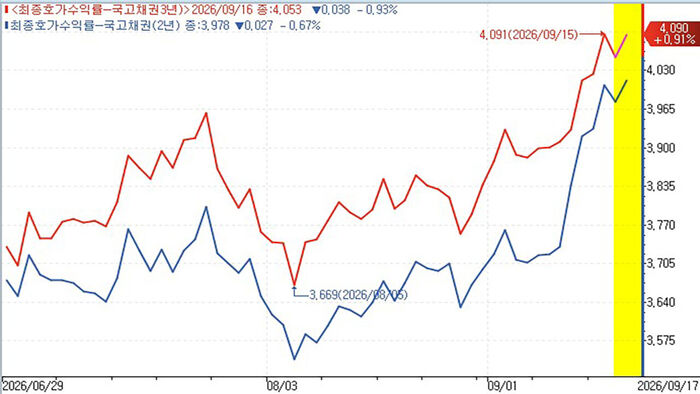
▲ Trends of 2-Year and 3-Year Treasury Yields
In the Seoul bond market today, the yield on three-year treasury bonds closed up 1.0 bp (1 bp = 0.01 percentage points) from the previous trading day at 4.063% per annum.
The 10-year yield fell 4.1 bps to 4.506% per annum.
The 5-year and 2-year yields dropped 2.6 bps and rose 1.6 bps, respectively, finishing at 4.262% and 3.994% per annum.
The 20-year yield dropped 4.6 bps to 4.496% per annum.
The 30-year and 50-year yields declined 8.5 bps and 5.7 bps, respectively, registering at 4.607% and 4.577% per annum.
Three-year treasury futures rose 2 ticks to 102.21, while 10-year futures gained 38 ticks to close at 103.66.
Foreign investors net sold 2,593 contracts of three-year futures and 4,972 contracts of 10-year futures.
Overnight, the Federal Reserve raised its benchmark interest rate by 25 bps to 3.75–4.00% at the September FOMC regular meeting, signaling the possibility of additional rate hikes within the year.
Consequently, treasury yields rose primarily across short-term tenors.
This reflected concerns that prolonged Fed rate hikes could lead to a higher terminal rate for the Bank of Korea.
However, entering the afternoon, domestic bonds rebounded as international oil prices and U.S. Treasury yields turned downward in Asian markets.
Brent crude futures for September delivery fell about 2.7% during the session, and West Texas Intermediate (WTI) crude futures for September delivery also dropped 1.3%.
The yield on the 10-year U.S. Treasury note fell 4.9 bps during Asian trading, and the 2-year yield also dropped 4.6 bps.
Ahn Ye-ha, a researcher at Kiwoom Securities, explained, "Domestic yields had risen due to concerns over additional Fed hikes and prolonged high interest rates, with expectations that the Bank of Korea could implement further hikes in the fourth quarter of this year and the first quarter of next year." She added, "However, in the afternoon, long-term yields fell as international oil prices declined and expectations grew that rapid rate hikes could actually lower inflation expectations."
(Photo: Provided by Korea Financial Investment Association and Yonhap Infomax, Yonhap News)
※ Please note: This article was translated by AI and may contain errors.
Copyright Ⓒ SBS. All rights reserved. Unauthorized reproduction, redistribution, and use for AI training are prohibited.