SBS NEWS
Global Water Resources on Red Alert... River Flow Dries Up to Lowest Level in 35 Years
Published : Sep 17, 2026 4:00 PM

▲ Drought on the Danube River in Bucharest, Romania, this summer
Diagnostics indicate that river flows around the world are drying up and the Earth's freshwater reserves are being depleted.
Because stable water storage reservoirs such as groundwater and glaciers serve as buffers against drought that sustain human survival, this analysis is interpreted as another catastrophic warning of climate change.
According to the State of Global Water Resources report released by the World Meteorological Organization (WMO) on the 17th, global river discharge in 2025 ranked among the driest in the past 35 years.
The past seven years were found to be the period with the smallest proportion of rivers maintaining normal discharge levels since 1991.
Analyzing 13 global hydrological model simulations and meteorological observation data, 36% of the global river basin area experienced below-normal discharge in 2025.
The proportion of river basins maintaining normal discharge stood at only 34% to 38%, significantly falling short of the past average of 46%.
The WMO drew attention to the decrease in terrestrial water storage and the frequent occurrence of disasters tied to this trend.
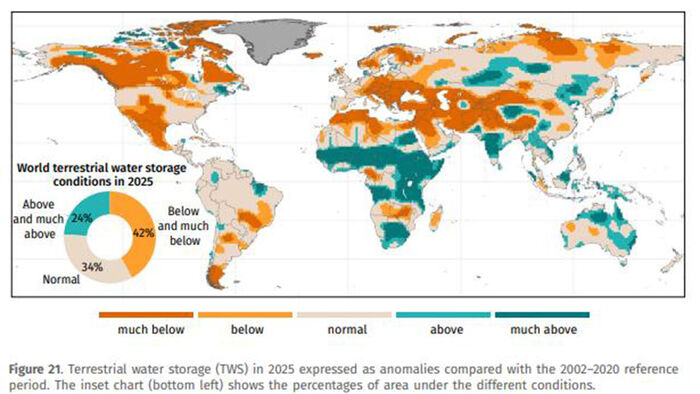
Water stored in groundwater, lakes, rivers, soil moisture, vegetation, glaciers, and snow has shown a continuous declining trend since the mid-2010s.
In particular, glaciers continued to lose mass from 2023 to 2025, with cumulative losses reaching 1,400 gigatons (Gt), equivalent to one-third of global annual freshwater withdrawals.
Amid extreme and erratic water cycles, unprecedented floods and droughts have been observed worldwide.
The WMO warned that disasters could become even more fatal due to the declining trend of slowly changing water resources such as groundwater, glaciers, and snow cover.
WMO Secretary-General Celeste Saulo explained, "Slowly changing water reserves have acted like savings," adding, "They are buffers that prevent a single drought or dry season from directly leading to a water crisis."
"That savings is now being depleted," Saulo interpreted, noting, "Global terrestrial water storage has been declining for 10 consecutive years since 2014–2016, and this phenomenon serves as a clear warning."
The WMO emphasized that this water crisis is inflicting cascading blows across borders around the world.
This means situations could arise where the reduction of glaciers in one country threatens the livelihood of residents in another country hundreds of kilometers downstream.
"Water knows no borders," Saulo urged, calling for a joint response to disasters through the sharing of data, regulations, and early warning systems.
(Photo: Captured from WMO report, Yonhap News)
※ Please note: This article was translated by AI and may contain errors.
Copyright Ⓒ SBS. All rights reserved. Unauthorized reproduction, redistribution, and use for AI training are prohibited.