SBS NEWS
Koreans Face Lifelong Deficits: Education Costs in Youth, Medical Expenses in Old Age
Published : Sep 17, 2026 12:59 PM

▲ Daechi-dong private academy district in Gangnam-gu, Seoul
South Koreans peak in labor income compared to consumption at age 45, recording their largest surplus, according to data.
Conversely, the largest deficit was recorded at age 16 when educational expenditures surge due to college entrance preparations, while aging leads people back into a deficit life driven by medical spending.
As the spending capacity of the elderly demographic grows and the population ages, the size of the elderly deficit surpassed that of the youth for the first time.
Statistics Korea released these findings on September 17 through the 2024 National Transfer Accounts.
The National Transfer Accounts are statistics designed to analyze the relationship between consumption and labor income across different age groups to understand the flow of economic resources between generations.
Looking at the per capita lifecycle, the structure consists of a three-stage cycle of deficit, surplus, and deficit as age increases.
From ages 0 to 27, consumption exceeds labor income, resulting in a deficit, with age 16 recording the largest deficit at 46.04 million won.
People enter a surplus phase at age 28.
From this point until age 60, labor income remains higher than consumption.
In particular, age 45 posted the largest surplus at 19.32 million won.
This appears to be driven largely by per capita labor income peaking at 46.51 million won during this period.
However, starting at age 61, which marks the onset of retirement, labor income shrinks, shifting back into a deficit period, with the scale of the deficit growing as age increases.
This is due to rising medical expenditures associated with population aging.
Since 2010, the age of entering the surplus phase has generally remained constant at ages 27 to 28.
However, the point of re-entering a deficit was delayed by 5 years, moving from age 56 in 2010 to age 61 in 2024.
This is interpreted as the effect of an increasing number of elderly individuals continuing to work even after retirement.
Lifecycle deficits are shown to be supplemented by government public transfers and private inter-household and intra-household transfers.
In fact, 344.9 trillion won net-outflowed from the working-age population (ages 15 to 64), with 185.9 trillion won and 148.3 trillion won transferred to the young (aged 14 and under) and elderly (aged 65 and older) populations, respectively.
Looking at public transfers, which show the flow of taxes, the working-age population recorded a net outflow of 216.3 trillion won, while the young and elderly populations recorded net inflows of 93.3 trillion won and 123 trillion won, respectively.
Private transfers, such as inheritances and gifts, also saw a net outflow of 128.6 trillion won from the working-age population, while the young and elderly populations recorded net inflows of 92.6 trillion won and 25.3 trillion won, respectively.
The total lifecycle deficit in South Korea for 2024, calculated as total consumption minus labor income, was tallied at 220.1 trillion won, down 7.3 trillion won from the previous year.
The scale of the lifecycle deficit shrank because the growth rate of consumption was lower than that of labor income.
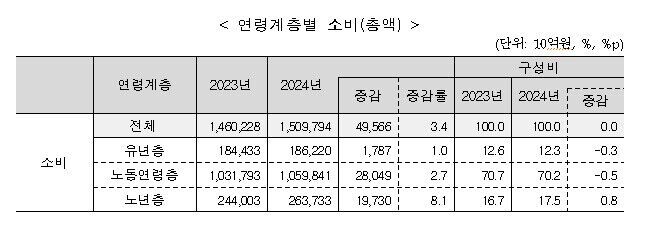
Consumption rose 3.4% from a year earlier to reach 1,509.8 trillion won.
Among this, public consumption increased by 4.5% and private consumption by 2.9%.
Within public consumption, public health consumption saw a notable growth rate of 6.2%, while in private consumption, private health and other consumption grew relatively large at 3.0%.
By age group, elderly consumption showed the sharpest increase at 8.1%, followed by the working-age population at 2.7% and the youth at 1.0%.
The proportion of elderly consumption out of total consumption expanded by 0.8 percentage points (p) to 17.5%.
This is the highest since relevant statistics began in 2010.
An official from Statistics Korea explained, "The labor income of the elderly has increased, and asset income such as savings has also risen, expanding their spending capacity," adding, "The increase in the elderly population due to aging has also had an impact."
Conversely, this proportion contracted by 0.3 percentage points and 0.5 percentage points for the youth (12.3%) and working-age population (70.2%), respectively.
Labor income rose 4.6% to 1,289.7 trillion won.
Specifically, wage income grew 4.7% and self-employed labor income increased 2.6%.
By age group, the youth deficit increased 1.0% from a year earlier to 186.2 trillion won, while the elderly deficit rose 5.3% to 188.9 trillion won.
This marks the first time since the compilation of related statistics that the elderly deficit has surpassed the youth deficit.
The working-age population posted a surplus of 150 trillion won.
The scale of the surplus expanded by 13.7% compared to the previous year.
(Photo provided by Statistics Korea, Yonhap News)
※ Please note: This article was translated by AI and may contain errors.
Copyright Ⓒ SBS. All rights reserved. Unauthorized reproduction, redistribution, and use for AI training are prohibited.