SBS NEWS
Artificial Nerve Conduit Resembling Peripheral Nerves Restores Hand Function in Monkeys
Published : Sep 16, 2026 3:06 PM

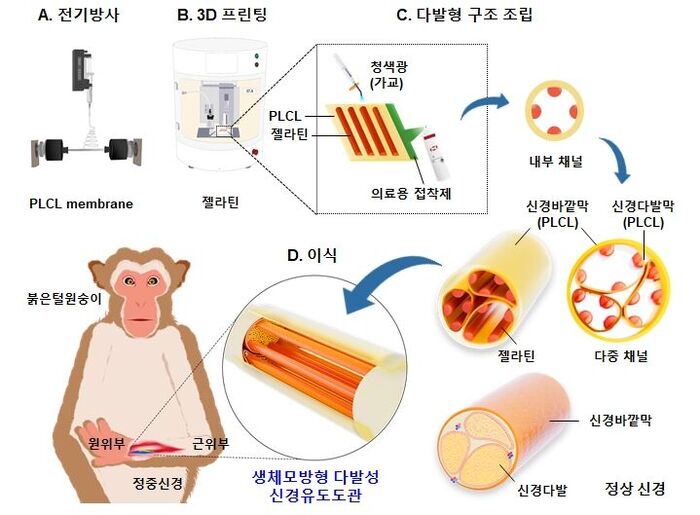
▲ Fabrication and transplantation of the bioinspired multi-channel nerve conduit
An artificial nerve pathway featuring an internal structure remarkably similar to peripheral nerves, which consist of multiple bundles of thin nerve fibers, has been developed by a South Korean research team.
The Korea Institute of Science and Technology (KIST) announced today (September 16) that, alongside research teams from Korea University and the Korea Research Institute of Bioscience and Biotechnology, it has developed a "multi-channel artificial nerve conduit" containing three small internal pathways, unlike conventional hollow artificial nerve conduits.
Additionally, the research team stated that they have successfully transplanted this multi-channel artificial nerve conduit—previously validated only in rats and rabbits—into the damaged wrist areas of monkeys, which are primates, for the first time, confirming the potential for nerve regeneration and recovery of hand function.
A nerve guidance conduit refers to an implantable material that bridges both ends of a severed nerve.
It serves to guide the path for regenerating nerve fibers to grow and prevents surrounding scar tissue from invading.
The domestic research team analyzed the wrist nerve structure of rhesus macaques, whose hand structures are similar to those of humans, to create the multi-channel artificial nerve conduit.
The outer layer was made of a polymer material that gradually degrades inside the body, and three pathways were arranged inside, followed by the formation of a gelatin hydrogel guidance channel.
The research team explained that a key feature of the multi-channel artificial nerve conduit is that its structure alone induces nerve regeneration without the addition of cells or separate growth factors.
The researchers created a 15 mm long defect in the wrist nerve associated with finger movement in rhesus macaques, transplanted the multi-channel artificial nerve conduit, and tracked changes in hand function and nerve regeneration for 12 months.
The research team explained, "As time passed, the time required to pick up small food items with fingers decreased, and motor disability scores also improved." They added that in tests measuring muscle responses by applying electrical signals to the nerves, signals mostly reappeared starting 6 months after surgery.
They further noted that after 12 months, the nerves newly grown inside the nerve conduit were organized into multiple bundles like real nerves, and the myelin sheath—the protective covering around nerve fibers—was also re-formed.
The research team also stated, "The molecular weight of the nerve conduit's polymer material decreased by approximately 94 percent compared to before transplantation, and no clear chronic inflammatory response was observed."
KIST evaluated that the multi-channel artificial nerve conduit holds potential for development as a medical device, given that it creates a pathway for nerve growth and then gradually decomposes and disappears within the body.
Furthermore, KIST expressed expectations that while harvesting a normal nerve from another part of a patient's body and transplanting it has hitherto been recognized as the standard treatment when peripheral nerves are damaged, the multi-channel artificial nerve conduit could become an alternative in the future.
KIST emphasized regarding the nerve conduit developed by the domestic research team that "it does not require cell culture or cryopreservation, making it advantageous for commercialization."
Jeong Young-mi, a principal researcher at KIST, stated, "We will expand the scale of verification in the future to lead to the clinical application of domestically developed nerve regeneration medical devices."
(Photo: Provided by KIST, Yonhap News)
※ Please note: This article was translated by AI and may contain errors.
Copyright Ⓒ SBS. All rights reserved. Unauthorized reproduction, redistribution, and use for AI training are prohibited.