SBS NEWS
Government Pushes to Officially Introduce Abortion Pills... Prescription and Dispensing at Medical Institutions for First Two Years
Published : Sep 16, 2026 12:26 PM

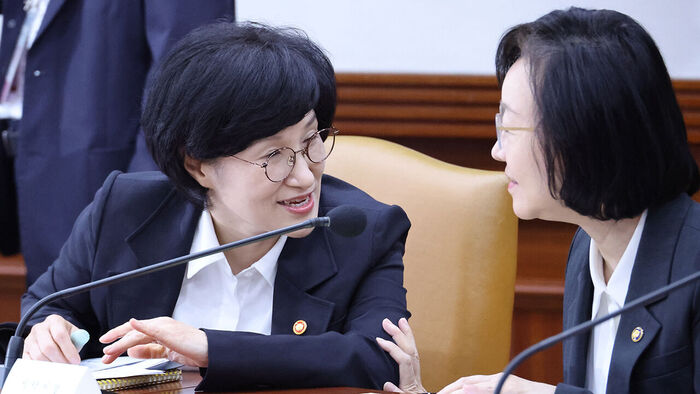
▲ Minister of Gender Equality and Family Won Min-kyung is briefing on plans to introduce abortion pills at the Government Complex-Seoul in Jongno-gu, Seoul, on the 16th.
Seven years after the Constitutional Court's decision of non-conformity to the Constitution regarding the crime of abortion in 2019, the government is pushing to officially introduce abortion pills into the institutional framework.
The initiative aims to introduce and manage abortion pills within the national medical system, thereby eliminating factors that threaten women's safety and health rights caused by illicit drug distribution.
The Ministry of Gender Equality and Family, the Ministry of Health and Welfare, and the Ministry of Food and Drug Safety reported these plans regarding the introduction of abortion pills at the 14th National Policy Coordination Meeting held at the Government Complex-Seoul today (the 16th).
The introduction of abortion pills is one of the national policy tasks of the Lee Jae-myung administration, serving as a follow-up measure to President Lee Jae-myung's directive in July of this year to review the feasibility of permitting abortion pills.
At today's meeting, the Ministry of Gender Equality and Family pointed out that a legislative vacuum has persisted despite the Constitutional Court's decision of non-conformity in April 2019, and that delays in introducing abortion pills have led to women's health and safety issues.
Accordingly, the ministry emphasized that institutional improvement is urgent and reported the expected benefits of the official introduction of abortion pills.
The ministry highlighted the urgency of introducing abortion pills, citing socio-economic burdens such as the illegal distribution of safety-unverified drugs, the prevalence of substitutes, restrictions on the right to choose between surgery or medication depending on a woman's health condition, and increased costs of abortion due to delayed timing.
It also expressed expectations that allowing abortion pills would enable tracking of usage trends, safe medication use, and proper follow-up care in accordance with institutionalization.
The Ministry of Food and Drug Safety reported its review and approval plans for the introduction of abortion pills.
The abortion pills currently undergoing import product approval and review by the Ministry of Food and Drug Safety have been applied for under the condition that they are used within 63 days (9 weeks) of pregnancy, based on clinical trial data and other evidence.
The ministry decided to proceed with related procedures by ensuring the safety, efficacy, and quality of abortion pills, and thoroughly reviewing application data, including the drug's Risk Management Plan.
The Risk Management Plan refers to collecting and evaluating adverse events after the drug goes on sale, investigating safety information, and establishing educational materials for patients and professionals.
The Ministry of Health and Welfare also reported its plan for the phased introduction of abortion pills today.
The plan dictates that for the first two years following the introduction of abortion pills, management will be based on direct prescription and dispensing by doctors within medical institutions, with gradual expansion after reviewing side effects and safety.
Minister of Gender Equality and Family Won Min-kyung stated, "Pregnancy and childbirth have a significant impact on an entire woman's life, yet due to institutional shortcomings, individuals' rights to safely access the medical system have not been guaranteed."
She added, "Now that the government has officially announced the plan to introduce abortion pills, we expect that abortions will be carried out more safely under the national medical system, thereby alleviating the burden on women who find themselves in socio-economic circumstances where they have no choice but to undergo an abortion."
(Photo: Yonhap News)
※ Please note: This article was translated by AI and may contain errors.
Copyright Ⓒ SBS. All rights reserved. Unauthorized reproduction, redistribution, and use for AI training are prohibited.