SBS NEWS
Household Debt-to-GDP Ratio Hits 10-Year Low, Nearing Government's Target Early
Published : Sep 16, 2026 9:20 AM

▲ The interior of a bank where promotional posters for the Buteummok Jeonse loan and Naejip Mareun Didimdol loan are displayed
South Korea's household debt-to-nominal GDP ratio as of the end of the second quarter of this year is estimated to have fallen to its lowest level in 10 years, bringing the early achievement of the government's target within reach.
While household debt has continued to grow, nominal GDP has expanded at a faster pace, which is analyzed to have driven a stair-step decline in the ratio.
According to statistics from the Bank of Korea (BOK) and the Bank for International Settlements (BIS) on September 16, the household debt-to-GDP ratio at the end of the second quarter is estimated to be around 81.3%.
This is the result of applying the BOK's second-quarter household credit growth rate to the BIS's first-quarter household and nonprofit institution debt balance—which was compiled based on BOK fund flow statistics—and dividing it by the sum of nominal GDP for the most recent four quarters.
This is an internal estimate based on the assumption that second-quarter household debt, which has not yet been officially announced, increased at the same rate as second-quarter household credit, a similar statistic that has already been published.
If this estimate is confirmed by actual figures, it will mark the lowest level in 10 years since the second quarter of 2016 (80.2%), based on past BIS statistics.
The government has set a target to lower the household debt-to-GDP ratio to the 80% range by 2030.
The gap between the estimated ratio for the end of the second quarter of this year and the target level is approximately 1.3 percentage points (p), significantly narrowing the margin about four years ahead of the target deadline.
The starting point is South Korea's household and nonprofit institution debt balance of 2,374.1 trillion won at the end of the first quarter of this year, as presented by the BIS on September 14 (local time).
Applying the quarter-on-quarter growth rate (1.3%) of the second-quarter household credit balance (2,019.8 trillion won) announced by the BOK on August 19 to this figure, the debt at the end of the second quarter is estimated at approximately 2,404.9 trillion won.
The sum of nominal GDP for the four quarters from the third quarter of last year to the second quarter of this year stands at 2,958.6 trillion won, and dividing the estimated debt by this amount yields a ratio of 81.3%.
The sum of nominal GDP for the most recent four quarters increased by about 6.2% compared to the end of the first quarter.
This significantly outpaced the debt growth rate (1.3%) used in the estimation, driving down the overall ratio.
According to the BOK's preliminary national income statistics for the second quarter, nominal GDP in the second quarter of this year rose 26.4% from a year earlier.
This marked the highest growth rate in 47 years since the third quarter of 1979 (27.7%).
Regarding this, BOK Governor Rhee Chang-yong noted during a press conference on August 27, "Nominal GDP is expected to come out quite high," adding, "Since nominal GDP is placed as the denominator when calculating all debt ratios, the debt ratios and soundness indicators will improve significantly."
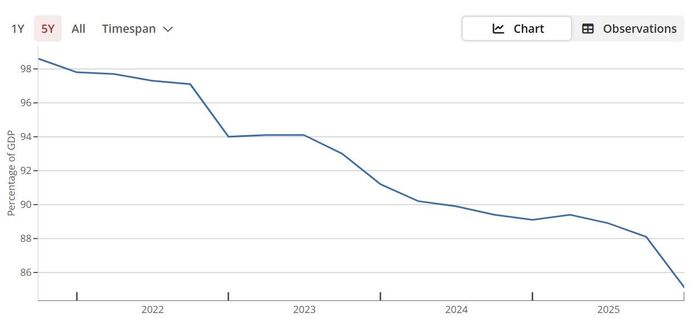
The downward trend in South Korea's household debt ratio was also confirmed by official BIS statistics.
According to the BIS, South Korea's household debt-to-GDP ratio at the end of the first quarter of this year was 85.1%.
This is a sharp drop of 3.0 percentage points from the end of last year (88.1%).
It has already recorded the lowest level in eight years since the first quarter of 2018 (85.1%).
This ratio peaked at the end of the third quarter of 2021 (99.1%) and has generally shown a downward trajectory since then.
The BOK's fund flow statistics for the second quarter are scheduled to be released on October 7, while the BIS's debt statistics for the second quarter will be published on December 7.
However, a decline in the household debt-to-GDP ratio does not necessarily mean an easing of households' principal and interest repayment burdens.
In its monetary and credit policy report released on September 10, the BOK also evaluated, "Although the household debt-to-GDP ratio will decline, it remains at a high level compared to major advanced economies."
It further stated, "Considering the possibility of increased housing purchase demand driven by improving income conditions, there is a strong need to continue managing household debt."
(Photo: Provided by BIS, Yonhap News)
※ Please note: This article was translated by AI and may contain errors.
Copyright Ⓒ SBS. All rights reserved. Unauthorized reproduction, redistribution, and use for AI training are prohibited.