SBS NEWS
BOK Warns AI Spread Could Widen Labor Market Gap Between Seoul Capital Area and Non-Capital Regions
Published : Sep 15, 2026 2:55 PM

▲ Bank of Korea Governor Shin Hyun-song
The Bank of Korea (BOK) analyzed today (the 15th) that the spread of artificial intelligence (AI) technology could act as a risk factor that widens the labor market gap between regions in South Korea.
Jung Min-soo, head of the BOK's Regional Economic Research Team, released a report containing these findings at the Regional Economic Symposium held at a hotel in Daejeon today.
For the first time domestically, the BOK categorized AI into three types—generative, agentic, and physical—calculated exposure levels by job and region, and analyzed their risks and opportunities.
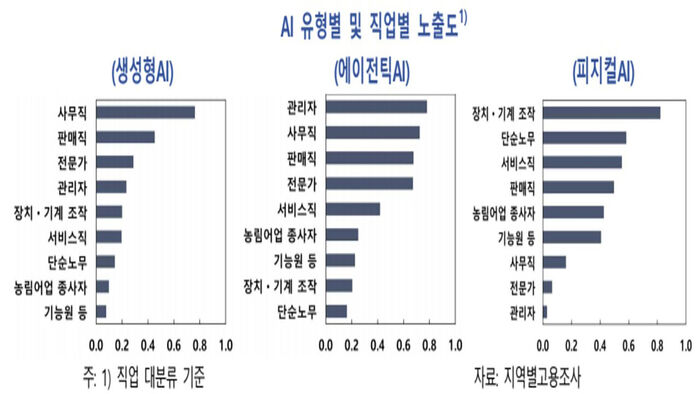
By occupation, exposure to generative AI was high in office jobs, sales, and professional positions; agentic AI in management; and physical AI in equipment and machine operation as well as simple labor.
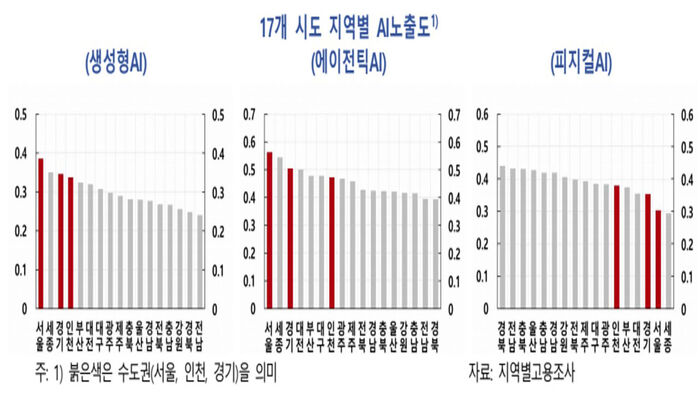
By region, exposure to both generative and agentic AI was high in the order of Seoul, Sejong, and Gyeonggi.
This is due to the concentration of knowledge service industries and professional occupations in the Seoul metropolitan area and surrounding regions.
Conversely, physical AI exposure was higher in non-capital regions such as North Gyeongsang Province, South Jeolla Province, and Ulsan, which have large shares of manufacturing, agriculture, forestry, and fisheries.
The BOK also analyzed the relationship between AI and employment changes.
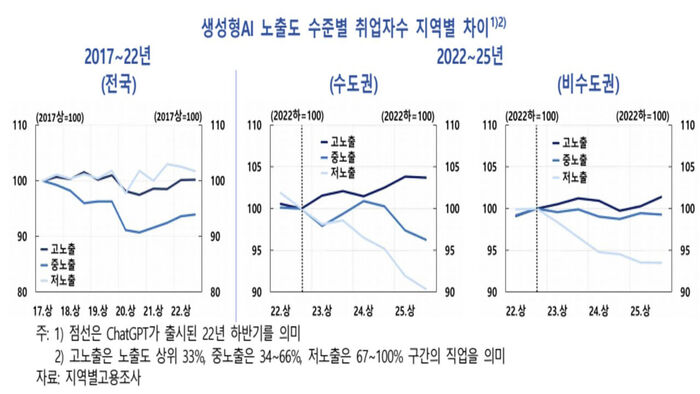
Over the past three years since 2023, jobs with high exposure to generative AI increased by 247,000, with the capital area accounting for 199,000 (80.8%) of them.
Out of a total 105,000 increase in jobs with high exposure to agentic AI last year, the capital area also took up the vast majority with 93,000 (88.3%).
In contrast, jobs with high exposure to physical AI, which are centered on manual labor, have shown a prolonged decline in the number of employed persons in both the capital and non-capital areas.
However, the BOK explained that it was difficult to establish a causal relationship between AI exposure and employment changes, thus confirming only a correlation.
The BOK diagnosed that while demand for expertise, experience, seniority, and social competencies has increased following the spread of AI, the supply of labor meeting these conditions is insufficient.
Limiting the scope to those in their 20s, the number of employed persons in jobs with high exposure to generative or agentic AI decreased in both the capital and non-capital areas, with no distinct differences between regions, it pointed out.
The BOK's conclusion is that this is because it is very difficult for young people right after graduating from college to acquire expertise, experience, and seniority, regardless of the region.
The BOK cited as a risk factor the possibility that if AI investments concentrate in the capital area, the heavy reliance on knowledge services and semiconductor manufacturing—which are already concentrated in the capital region—could intensify.
In addition, it expressed concern that if physical AI develops rapidly, employment declines could worsen in non-capital industries with high physical AI exposure, such as manufacturing, transportation, and accommodation and food services.
As opportunity factors, it mentioned that collaboration models between AI and humans could develop to alleviate the concentration of talent and research and development (R&D) in the capital area, and that AI could improve productivity and ease supply constraints in non-capital regions lacking human capital, thereby fostering regional service growth.
Furthermore, it noted the possibility that quality jobs could increase in non-capital regions, thereby reducing the outflow of young people.
The BOK suggested, "To utilize (AI) as an opportunity to alleviate regional labor market disparities, we must promote the specialization of regional service industries, strengthen the knowledge-servitization of regional manufacturing, and transform regional base universities into AI hubs."
In his opening remarks at the symposium, BOK Governor Shin Hyun-song emphasized, "For the adoption of AI to lead to productivity improvements, 'complementary innovation' must take place in terms of technological infrastructure, organization, and systems."
"I am reminded of the dynamo, the first industrial generator highlighted by economic historian Paul David," he noted, pointing out that, "When the dynamo was introduced in the late 19th century and the power source of factories shifted from steam engines to electricity, people expected productivity to rise significantly, but the actual change appeared very slowly."
He added, "This was because factory equipment structures were still tailored to the existing steam engine system, and the productivity-enhancing effect fully materialized only after factories were fundamentally redesigned to fit the technology of 'electricity'."
Regarding complementary innovation, Governor Shin stated, "Beyond simply installing new programs and building data centers, workers must acquire new skills, corporate work practices must change, and AI infrastructure must be linked with regional industries and markets."
He stressed, "Ultimately, whether AI will become a new growth engine for the regional economy depends not on how quickly we adopt the technology, but on how we redesign the regional economy to maximize productivity using AI."
(Photo: Yonhap News)
※ Please note: This article was translated by AI and may contain errors.
Copyright Ⓒ SBS. All rights reserved. Unauthorized reproduction, redistribution, and use for AI training are prohibited.