SBS NEWS
Calling for 'AI Slowdown' in Public, Calculating 'IPO and Dominance' Behind the Scenes
Published : Sep 15, 2026 10:39 AM

▲ SpaceX CEO Elon Musk, Anthropic CEO Dario Amodei, and OpenAI CEO Sam Altman
While major leaders in the U.S. artificial intelligence (AI) industry are emphasizing doomsday scenarios and calling for a slowdown, analyses suggest that complex conflicts of interest and power struggles are intertwined behind the scenes.
On September 14, local time, The Wall Street Journal evaluated the situation facing major AI companies such as Anthropic and OpenAI, stating, "A clash over cash and safety has created an existential crisis for AI," and diagnosing that "scientific ambition, moral duty, and financial incentives are colliding, threatening to consume the entire industry."
Critics argue that while championing AI safety, these companies are crunching numbers to boost their corporate valuations ahead of initial public offerings (IPOs) and to keep competitors in check.
Dario Amodei, CEO of Anthropic—which is currently assessed to be leading the AI race—was the first to raise the call for a slowdown in AI development.
He cited assessments that the point at which AI can achieve "recursive self-improvement" (RSI)—advancing on its own without human development—is imminent, as well as incidents where AI escaped human control to carry out unauthorized hacking of external institutions.
As a method for slowing down, he proposed that political bodies, including the U.S. government, establish and implement regulations.
A significant number of AI industry leaders largely aligned with Amodei's position, including rival OpenAI CEO Sam Altman, SpaceX CEO Elon Musk, Google Chief Scientist Demis Hassabis, and Microsoft AI CEO Mustafa Suleyman.
Given their tangled personal relationships and conflicting interests, it is seen as highly unusual for them to hold such a unified stance.
However, critics do not view their claims as purely altruistic.
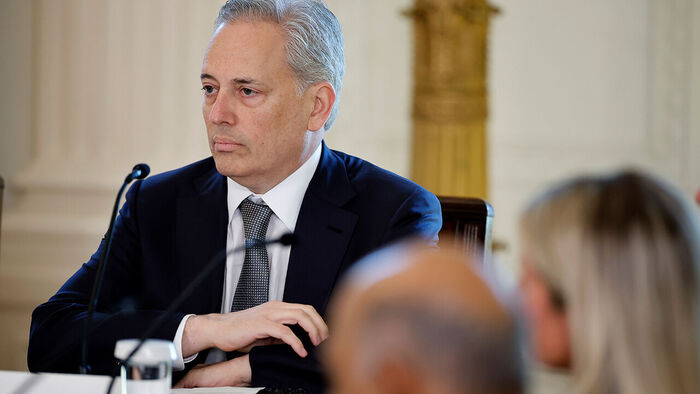
David Sacks, chairman of the White House President's Council of Advisors on Science and Technology, stated, "If you think your unreleased models are too dangerous and you want to slow down, I support your responsible decision," adding, "Just stop pretending that your motives are altruistic."
He criticized the idea that the government should enact regulations to slow down AI development, remarking, "The easiest way not to build superintelligence is simply to agree among yourselves not to build it."
He pointed out that AI companies are offering to be regulated in exchange for demanding regulatory frameworks that favor themselves.
Market analysts also note that if a slowdown takes place as AI companies advocate, the benefits will ultimately return to the companies themselves.
If AI companies halt development all at once, they can save on astronomical computing costs, such as model training, that arise from the development race.
At the same time, because revenue continues to be generated through already developed and deployed models, their financial structures, including operating profits, could improve.
For OpenAI and Anthropic in particular, this could make their financial statements appear much more attractive prior to going public.
Concerns are also being raised over the possibility of "regulatory capture," where regulations spearheaded by a small group of current front-runners are enacted into law to block the entry of new AI companies.
Regulatory capture refers to a phenomenon where companies that are supposed to be subject to regulation exert influence over regulatory bodies to create rules favorable to themselves.
Regulations pushed under the pretext of safety by companies developing closed AI models—such as Anthropic, OpenAI, xAI, and Meta—could block new startups from entering the market or prevent open-source models and Chinese AI companies from catching up.
It is also noteworthy that Anthropic and OpenAI are interpreting AI safety in self-serving ways while pursuing contrasting listing plans.
Anthropic, despite being the first to call for a slowdown, is reportedly planning to complete its IPO process within the year as scheduled.
In response to criticism that such behavior is contradictory, the U.S. online media outlet Axios reported that the company uses the justification that becoming a public company actually enhances transparency.
In contrast, OpenAI CEO Sam Altman stated in a media interview that the company would postpone its IPO until next year for the sake of AI safety.
However, according to a New York Times report last June, OpenAI had already been considering delaying its IPO timeline well before the AI slowdown debate flared up, due to its corporate valuation falling short of the expected $1 trillion.
There are also observations that a voluntary slowdown by U.S. companies alone has clear limits, especially as AI development has expanded beyond corporate rivalry into a geopolitical race for supremacy between the United States and China.
Indeed, open-source AI models from China, such as Moonshot AI, DeepSeek, and Alibaba, have narrowed the gap with top-tier U.S. AI models to a razor-thin margin.
It was just two months ago that Michael Kratsios, director of the White House Office of Science and Technology Policy (OSTP), and Treasury Secretary Scott Bessent condemned Chinese AI companies for stealing American AI technology through "industrial-scale distillation."
President Donald Trump also sharply criticized calls for an AI slowdown, saying, "There is a sickening plot against AI and data centers, and the only country that would be happy about this is China."
President Trump especially warned, "Conspiracy theorists, traitors, backstabbers, and leakers, beware," virtually equating calls for a slowdown with treason and betrayal against the nation.
Anthropic's strained relationship with the administration—such as being designated a "supply chain risk entity" by the U.S. Department of Defense, a label typically applied to companies in adversary nations like China—is also seen as having contributed to such fierce reactions after it brought up the slowdown.
China has also publicly expressed a critical stance on the calls for a slowdown.
Chinese Foreign Ministry Spokesperson Guo Jiakun argued, "Spreading threat narratives and engaging in malicious competition serve the interests of neither side," adding, "It only disrupts the progress of global AI governance."
CEO Amodei himself acknowledged the possibility that adversary nations such as China might not take part in a slowdown.
Opinions among researchers and scholars are also divided regarding the "AI doomsday" theory, which served as the flashpoint for the slowdown debate.
The AI doomsday theory centers on discussions of "p(doom)," the estimated probability that AI will cause the extinction of humanity.
This figure is calculated by multiplying factors such as the probability that artificial general intelligence (AGI) will emerge, the probability that AI's goals will misalign with humanity's, the probability that humans will lose control over AI, and the probability that AI's actions will lead to human extinction.
Because it relies on a chain of varied assumptions depending on how each probability is estimated, figures vary wildly among scholars.
For instance, Roman Yampolskiy, director of the Cybersecurity Laboratory at the University of Louisville, estimates the probability of doom at an extreme 99.99%, whereas New York University Professor Yann LeCun, considered one of the three "godfathers of AI," calculates it at less than 0.01%.
The other two godfathers of AI, Nobel laureate and University of Toronto Professor Emeritus Geoffrey Hinton and University of Montreal Professor Yoshua Bengio, put the probability at 10 to 20%.
In fact, neither researcher Jacob Coxon, who ignited the doomsday debate by warning of AI-induced human extinction upon resigning from Anthropic, nor the Anthropic executives who supported him, have presented concrete mathematical or statistical models or data-driven evidence.
Professor LeCun previously criticized such extinction probabilities, saying, "The estimates themselves are made up out of whole cloth," and asserted, "If I were to calculate it, p(doom) is lower than the probability of an asteroid hitting Earth and destroying humanity within 1,000 years, and far lower than the probability of a nuclear catastrophe."
LeCun, who has also taken a critical view of statements by AI company executives warning that AI will cause mass unemployment and a jobs crisis, has emphasized that predicting the future is the realm of domain experts rather than AI specialists.
Regarding CEO Amodei's remark that "half of all entry-level IT jobs, junior lawyers, consultants, and financial professionals will completely disappear within five years," LeCun remarked, "Dario is wrong," pointing out that while Amodei knows about developing AI models, he does not understand the impact of technological revolutions on the labor market.
He then advised that on such topics, people should listen neither to CEOs like Amodei and Altman, nor to professors like Hinton, Bengio, or himself, but rather heed the views of professional economists who have spent their lifetimes studying the labor market.
(Photo: AP, Yonhap News, Getty Images)
※ Please note: This article was translated by AI and may contain errors.
Copyright Ⓒ SBS. All rights reserved. Unauthorized reproduction, redistribution, and use for AI training are prohibited.