SBS NEWS
140,000-Won Table Tennis Racket Controversy... Does a "No Refunds" Policy Mean You Can't Get Your Money Back?
Published : Sep 15, 2026 8:13 AM

▲ A table tennis racket and receipt that a middle school student reportedly purchased for 140,000 won at a stationery store.
Recently, a case in Hwaseong, Gyeonggi Province, where a stationery store sold a pair of table tennis rackets to a middle school student for 140,000 won and then refused a refund, has become a hot topic online.
The student's parents stated that the product price was more expensive than other stores and requested a refund less than an hour after the purchase, but the stationery store refused, citing the phrase "Sports goods cannot be exchanged or returned" printed on the receipt.
In a post uploaded online, the student's parents wrote that they inquired with a consumer organization about the issue, but were informed that there is no way to get a refund for items purchased at an offline store unless there is an agreement between the seller and the buyer.
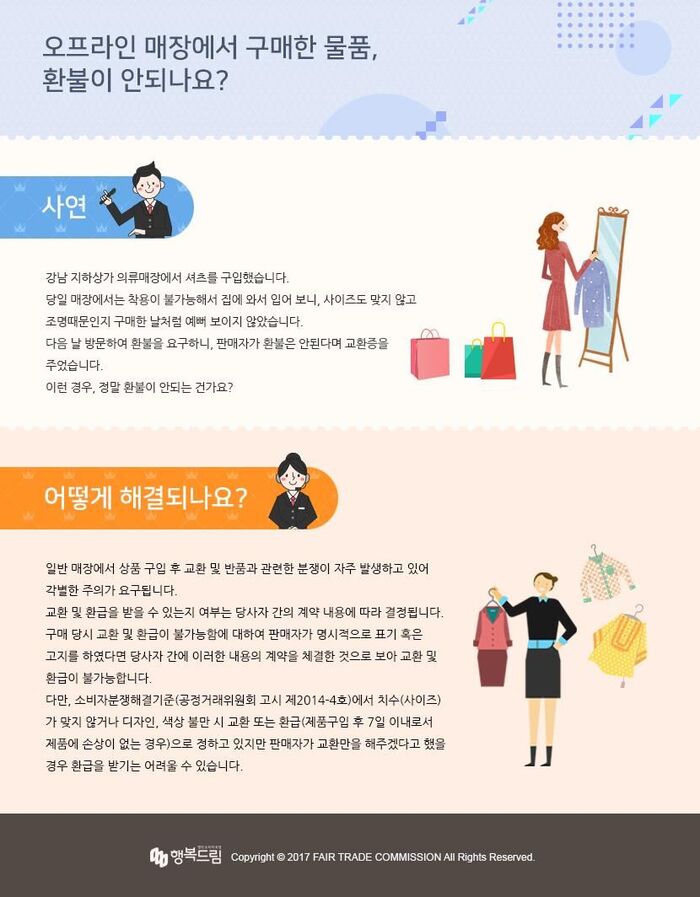
If "no exchange or refund" is specified on the receipt as in this case, is it really difficult to get an exchange or refund? Also, is there truly no way to get a refund for items bought at an offline store without an agreement? As with this case, if a "no refund" policy is notified, is there really no way to get your money back? Whether a product can be refunded depends on whether the place of purchase was online or offline, regardless of the type of item.
It is easy to assume that a refund is naturally possible within a certain period if you have the purchase receipt, but unlike online shopping, offline purchases do not have a uniform statutory right of withdrawal.
Article 17 of the E-Commerce Act clearly stipulates that a refund can be requested within 7 days for online purchases.
This right of withdrawal is guaranteed in online shopping considering the fact that consumers cannot directly check and purchase products in person.
Furthermore, Article 35 of the E-Commerce Act prohibits contracts disadvantageous to consumers, meaning that even if an online seller specifies "no refunds," it has no legal effect.
However, offline purchases are not subject to the E-Commerce Act.
An official from the Korea Consumer Agency explained, "This is because offline purchases are fundamentally considered to involve checking the item and seeing if there are any defects."
Offline purchases are legally regarded as contracts, and another background making refunds difficult is that, in accordance with the principle of freedom of contract—a fundamental principle of the Civil Act—contracts between parties are deemed valid.
Cho Shin-young, a managing attorney at Law Firm Yakso, explained this, saying, "Whether it is a sale, lease, or employment, the Civil Act views contracts between parties as valid as long as they do not violate social norms."
While the Consumer Agency recommends that offline stores also process exchanges and refunds according to the "Consumer Dispute Resolution Standards," these serve only as reference criteria for mediation when disputes arise and carry no legal binding force.
In effect, when department stores or supermarkets grant refunds within a certain period if you have a receipt, it is a service provided voluntarily by the companies.
That does not mean refunds are impossible in all cases.
Article 109 of the Civil Act stipulates that "a manifestation of intention may be cancelled if there is a mistake in an essential element of the juristic act."
This means that if you purchased a product after receiving incorrect information regarding an important aspect at the time of purchase, the transaction can be cancelled.
In this case, the fact that the buyer was a minor also became a point of contention regarding the refund.
According to Article 5 of the Civil Act, when a minor performs a juristic act, the consent of a legal representative is required.
Accordingly, as a rule, a middle school student needs parental consent when purchasing items.
In 2013, posting a warning on its website regarding sales tactics targeting underage college freshmen involving language textbooks and magazines, the Consumer Agency advised, "Since contracts made by minors without parental consent can be cancelled by the minor or their legal representative, you should express your intent to cancel the contract as soon as possible."
However, these rules do not apply in every single case.
An official from the Consumer Agency explained, "In principle, the cancellation of a contract for a purchase made by a minor is possible, but looking at relevant precedents, outcomes vary depending on individual cases, making it difficult to state a blanket standard."
For instance, even if purchases were made by minors under identical circumstances, there have been conclusions where the seller was not required to provide a refund depending on the type of item, the amount of money, or the source of funds used for the purchase.
Attorney Cho Shin-young stated, "It depends on the extent to which a minor is deemed to possess capacity to act," adding, "If a minor bought a car, it would naturally be void, but we need to examine whether a table tennis racket falls within this scope."
Attorney Cho also added, "It is also subject to review whether the act falls within a range where parents could reasonably consent to their child entering into such a contract."
In this incident, it is reported that when the child handed over a credit card, the store owner signed and proceeded with the payment.
In response, online comments suggested requesting a payment suspension from the credit card company, pointing out that this could be a case of the cardholder failing to sign the card or the merchant's representative signing on their behalf.
Indeed, looking at the standard personal member terms and conditions of major credit card companies, it is stipulated that "when a member purchases goods with a card, they must present the card and sign the sales slip with a signature identical to the one on the card."
However, unless it is unauthorized card usage due to loss or theft, it is unlikely that a credit card company would accept a payment cancellation request solely based on a child's card usage or a merchant's proxy signature, as seen in this case.
An official from a credit card company explained, "Because this is a problem arising from the contractual relationship between the customer and the credit card merchant (store), the cancellation of the contract between the customer and the merchant must take place first (rather than a payment cancellation by the card company)," adding, "Payment suspension or withholding is only possible when a customer suffers unilateral damage due to reasons where a contract cannot be properly performed—such as loss or theft of a card, or the suspension of a merchant's business after installment payment."
It was revealed that the stationery store in question sold the table tennis rackets without displaying prices, leading to criticism that failing to display prices in this manner might be illegal.
According to the "Guidelines for Price Display Implementation" by the Ministry of Trade, Industry and Energy, retail stores with a floor space of 33 square meters (approx. 10 pyeong) or larger—including stationery, athletic, and sporting goods retailers—must display selling prices on individual items using labels, stamps, tags, or price lists.
If prices are not displayed, local governments can issue corrective recommendations and subsequently impose fines.
When caught failing to display prices, penalties are applied sequentially: a 1st violation incurs a corrective recommendation, followed by a fine of 300,000 won for the 2nd violation, 500,000 won for the 3rd, 2 million won for the 4th, and 5 million won or more for the 5th violation and beyond.
An official from Hwaseong, Gyeonggi Province, where the controversial stationery store is located, stated, "Ahead of the holidays, we focus our inspections on large-scale stores and traditional markets," adding, "This time, we plan to inspect related stores in the surrounding area, including the shop in question."
Taking administrative action solely based on setting prices higher than others is not straightforward.
This is because business operators are free to set product prices, and the criteria for "rip-off pricing" remain somewhat unclear.
Administrative authorities explain that while charging excessive amounts is a civil matter—and could potentially be handled under criminal law if interpreted as fraud—imposing administrative penalties presents certain difficulties.
However, under Article 7 ofayan the Price Stabilization Act, acts where the Minister of Economy and Finance designates hoarding activities out of concern that they may hinder price stabilization, or acts where a market-dominating enterprise unfairly determines or maintains product prices or service fees pursuant to Article 3-2 of the Fair Trade Act, are subject to punishment.
(Photo: Capture from Bobae Dream, Capture from Consumer 24 website, Yonhap News)
※ Please note: This article was translated by AI and may contain errors.
Copyright Ⓒ SBS. All rights reserved. Unauthorized reproduction, redistribution, and use for AI training are prohibited.