SBS NEWS
Applications for Seoul Land Transaction Permits Hit Lowest Since October Last Year in August
Published : Sep 14, 2026 11:42 AM

▲ Real estate agency offices are crowded with consultation notices and listing boards in Gangnam, Seoul, on the 10th, following data showing that the month-on-month growth rate of newly applied prices for Seoul apartment land transaction permits in July reached its highest level since the announcement of the October 15 measures last year.
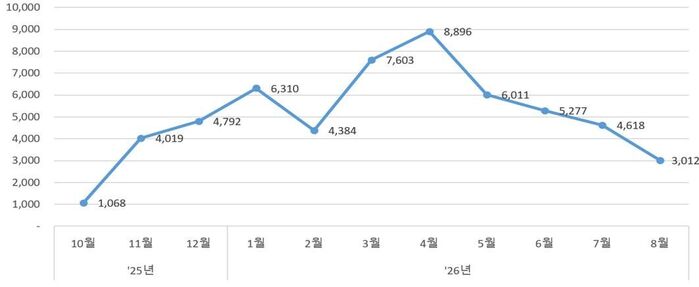
The Seoul Metropolitan Government announced that the number of new applications for land transaction permits for apartments in Seoul totaled 3,012 last month.
This is the lowest figure since all of Seoul was designated as a land transaction permit zone in October of last year.
The previous low before this was 4,019 applications recorded in November of last year.
The number of land transaction permit applications peaked at 8,896 in April as listings surged ahead of the expiration of the deferred heavy taxation on capital gains for multiple homeowners on May 9.
Since then, applications have continued to decline, recording 6,011 in May, 5,277 in June, and 4,618 in July.
The number of applications in August fell to about 34 percent of the peak seen in April.
The city government estimates that financing burdens driven by interest rate hikes and ongoing loan regulations have had an impact.
It is interpreted that buyers are continuing to take a wait-and-see approach as procedures such as parliamentary deliberation on the August 3 tax revision proposal still remain.
Breaking it down by region, applications decreased compared to the previous month across all districts. The decline rate was most pronounced at 38.6 percent in the seven districts along the Han River belt (Gwangjin, Seongdong, Mapo, Dongjak, Yangcheon, Yeongdeungpo, and Gangdong districts) and the four districts in the southwestern region (Gangseo, Gwanak, Guro, and Geumcheon districts).
The ten districts in the Gangbuk area (Gangbuk, Nowon, Dobong, Dongdaemun, Seongbuk, Jungnang, Seodaemun, Eunpyeong, Jongno, and Jung districts) saw a 31.4 percent decrease, showing a relatively smaller drop.
This is interpreted as the result of actual demand continuing in areas with lower price burdens.
Applications for the deferred obligation to actually reside in homes with tenants stood at 135, accounting for about 4.5 percent of all permit applications.
The city explained that the government's temporary policy to expand eligibility for deferred residency obligations in land transaction permit zones still does not appear to be producing clear results.
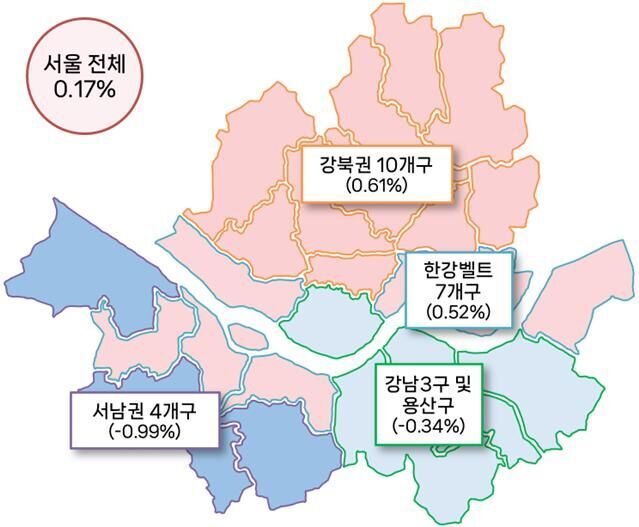
The applied prices for Seoul apartment land transaction permits rose 0.17 percent in August compared to the previous month.
The upward trend has cooled down compared to July (a 1.41 percent increase) and June (a 2.67 percent increase).
While the ten districts in the Gangbuk area (0.61 percent increase) and the seven districts along the Han River belt (0.52 percent increase) maintained an upward trajectory, the three Gangnam districts (Gangnam, Seocho, and Songpa districts), Yongsan District (-0.34 percent), and the four southwestern districts (-0.99 percent) experienced declines.
The city explained that uncertainty has expanded due to tax revision issues and other factors, leading to a contraction in buying sentiment in certain regions.
The Seoul Metropolitan Government analyzes and discloses the status of land transaction permit applications every month with the aim of minimizing information gaps in the real estate market.
(Photo: Yonhap News)
※ Please note: This article was translated by AI and may contain errors.
Copyright Ⓒ SBS. All rights reserved. Unauthorized reproduction, redistribution, and use for AI training are prohibited.