SBS News
Merciless Backlash of Global Warming: Mega Climate Disasters Unleashed
Published : Sep 14, 2026 9:05 AM

▲ Nuwakot, Nepal, Struck by Floods
People desperately fleeing from massive torrents of muddy water, villages turned into mudflats after fierce currents swept through, and thousands dead or missing.
The Great Flood that swept through the Himalayan mountain region along the border between Nepal and China in August served as a stark reminder that the merciless backlash of climate change is no longer a scene seen only in disaster movies, but a shocking reality unfolding before our eyes with lives on the line.
The mega-disaster, which began as summit glaciers—long considered an immutable part of the Himalayas, known as the "eaves of the world"—collapsed helplessly due to global warming,
swallowed up the daily lives and lifework of mountain villagers before they could even react.
Picturesque high peaks covered in perennial snow, which had drawn admiration by maintaining the same appearance for hundreds and thousands of years, have now become objects of fear and anxiety that could collapse at any moment because of the "ticking time bomb" of glaciers held within them.
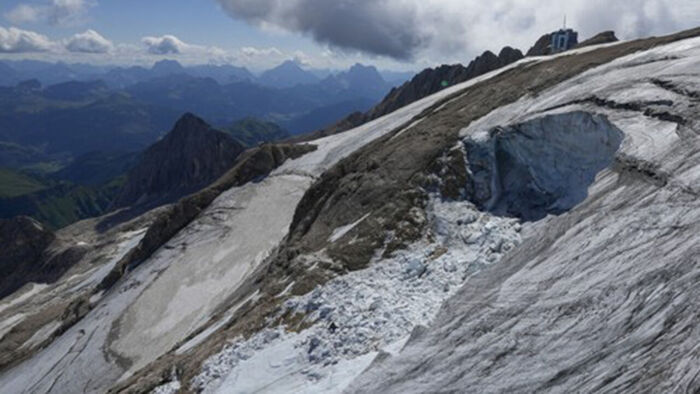
In Europe, the continent warming fastest on Earth, glaciers collapsing in the Alps have already killed climbers and buried villages, among a series of disasters large and small over the past few years.
The disasters caused by the climate crisis are not limited to glacier collapses, landslides, or mega-floods.
Amid warnings that accelerating warming has pushed the Earth's climate system to a tipping point, compounded by a strong El Niño, communities around the globe are suffering complex crises, including unprecedented extreme heat waves, severe droughts, and massive wildfires that rage for days.
From islands in the middle of the Pacific Ocean at risk of being completely submerged by rising sea levels to alpine regions thousands of meters above sea level, it is no exaggeration to say that there are now virtually no places on the map free from the repercussions of climate change.
The massive flood that struck the Himalayan mountainous region along the Nepal-China border on August 26 occurred after enormous volumes of glaciers and rocks collapsed, forming debris flows.
A glacier roughly 600 meters wide collapsed along with rocks at an altitude of 5,200 meters on Mount Langtang Lirung (7,234 meters above sea level) in Bagmati Province, north-central Nepal, generating an impact comparable to a magnitude 5.2 earthquake.
The glacier debris and flows swept downstream from the Lende River along the Trishuli River, causing major flooding in Nepal, while on the same day, a debris flow related to this Great Flood also occurred in Tibet.
So far, more than 7,000 people have been reported dead or missing in Nepal and Tibet.
While it is premature to conclude that this Great Flood was caused solely by climate change driven by global warming, there is no disagreement that it had at least an indirect impact.
This is because it is difficult to deny that warming is destabilizing Himalayan glaciers and amplifying fundamental risks.
Dan McGrath, a professor of geosciences at Colorado State University, noted that there are currently more than 95,000 glaciers in the mountains of Asia, covering a total area comparable to South Korea.
Professor McGrath explained, "These glaciers are losing mass at a very rapid rate," adding, "The water produced each year just from melting glaciers in this region would be enough to submerge New York's Empire State Building to its top (381 meters)."
Jason Gulley, a professor of geology at the University of South Florida who has explored Nepal's glacial regions six times over more than 20 years, also reported that "glacier collapses" have already occurred dozens of times along the China-Nepal border since the 1990s.
Glacier collapses manifest in various forms, including ice avalanches where glacial ice tumbles down like an avalanche, glacial calving where massive chunks of ice break off, and rock-ice avalanches where bedrock and glaciers collapse together.
As temperatures rise and meltwater from glaciers pools in depressions, vast glacial lakes can also form.
If the natural dams holding these lakes breach, catastrophic floods can occur downstream.
Although this tragedy was not caused by a glacial lake outburst flood, numerous warnings have already been issued that climate change is causing Himalayan glaciers to melt rapidly, heightening the risk of major floods.
In March this year, the International Centre for Integrated Mountain Development (ICIMOD), based in Kathmandu, Nepal, released research findings showing that the rate of glacier melt in the Himalayas—a major water source for around 2 billion people in Asia—has more than doubled in the 21st century due to warming.
The thickness of glaciers in this region decreased by an annual average of 34 cm before 2000, but since 2000, it has been shrinking by 73 cm per year.
Recently, fears have also been spreading in countries across South America's Andes Mountains that glacial lakes, which have formed in large numbers in unstable basins left by melting ice due to rising temperatures, might overflow.
In the Alps, the "roof of Europe," where temperatures are rising twice as fast as in other parts of the world in an "accelerated warming," glaciers atop the mountains are retreating rapidly, just like in the Himalayas.
Since the turn of the century, 40% of Alpine glaciers have already vanished, and heightened structural instability has led to frequent glacier collapses and rockfalls, fueling growing unease.
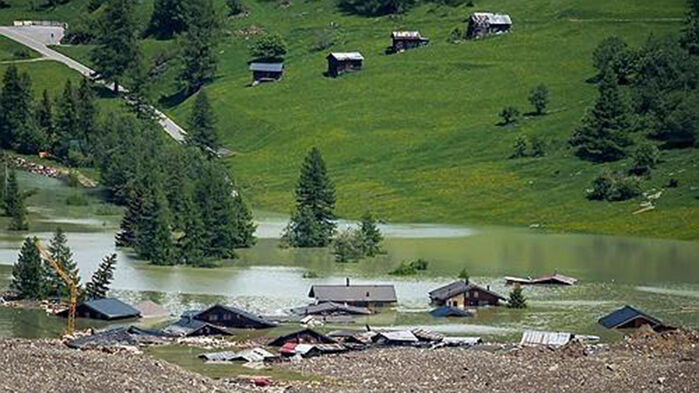
In the mountain village of Blatten in the southern Swiss canton of Valais, masses of ice and earth detached from the mountain summit swept through the village below in May last year, destroying or burying more than 90% of the village.
As the glaciers that had served as cement firmly anchoring rocks for thousands of years melted, loosened rocks collapsed along with chunks of ice.
Thanks to the advance evacuation of some 300 residents, the death toll was limited to one, but villagers were left devastated after losing the homes where they had lived all their lives.
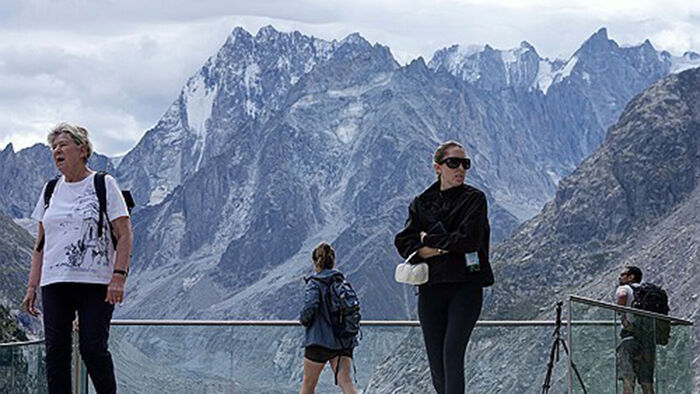
For residents living around Mont Blanc, the highest peak in the Alps on the border between France and Italy, the recent catastrophe in Nepal is by no means someone else's problem.
Residents of Chamonix, a French town nestled at the foot of Mont Blanc, express a sense of crisis over the summit glaciers retreating noticeably year after year.
This summer, as mercury levels across Europe soared to record highs, well exceeding 40°C (104°F), Mont Blanc alone has recorded over 450 rockfalls so far this year, forcing the closure of some climbing routes.
The annual number of rockfalls on Mont Blanc reportedly stood at just a few dozen only 10 to 20 years ago.
Europe, in particular, fought a fierce battle against a "triple whammy" this summer, as unprecedented droughts and wildfires coincided with the heat wave across the continent.
In effect, widespread climate disasters unfolded not only in mountainous regions but also across cities and rural communities.
Major European rivers, including the Rhine, Danube, and Po, dried up under extreme drought, dealing a blow to river shipping and disrupting nuclear power plant operations in countries such as France, Switzerland, Bulgaria, and Hungary due to a shortage of cooling water.
In countries like Spain, France, Greece, and Belgium, massive wildfires killed dozens of people and forced the evacuation of tens of thousands of residents and tourists, causing colossal casualties and property damage.
According to the European Forest Fire Information System (EFFIS), the area burned by wildfires in Europe from the beginning of this year through mid-August reached approximately 600,000 hectares, more than double the territory of Luxembourg.
Global warming often poses a fatal threat entirely on its own, even without triggering other extreme weather events.
A prime example is Spain, where heat-related deaths exceeded 5,000 this summer.
Unfortunately, damage from such warming is likely to worsen for the time being.
Such concerns are underpinned by projections that El Niño—an abnormal rise in sea surface temperatures in the eastern equatorial Pacific—will peak later this year and continue at least into early next year.
The World Meteorological Organization (WMO) forecast this scenario in its El Niño/La Niña update on September 3, stating, "A very strong El Niño will increase the likelihood of notable variations in temperature and precipitation patterns worldwide."
Experts believe this El Niño could become the "strongest El Niño on record."
This is because sea surface temperatures have already soared beyond the threshold for a "Super El Niño," where sea surface temperatures are 2.0°C (3.6°F) or more above average.
With drought damage triggered by El Niño already materializing primarily in Latin America, concerns are mounting worldwide over declining agricultural and fisheries production as well as increased wildfire damage.
Panama, which accounts for 5% of global maritime trade, declared a national emergency in August due to El Niño-induced drought and has been restricting the daily number of vessel transits through the Panama Canal starting this month because of dropping water levels.
The situation in nearby countries such as El Salvador, Honduras, and Peru is not much different.
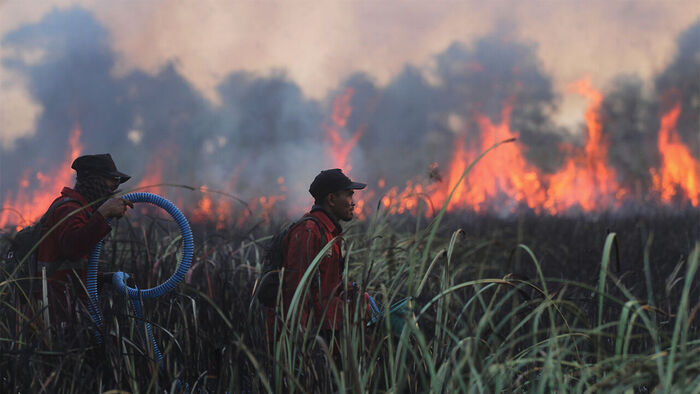
On the island of Borneo in Indonesia, massive wildfires broke out amid dry conditions caused by El Niño, while on the coast of California in the western United States, local researchers warned that sea levels could rise by as much as 30 cm by mid-October this year under the influence of the super-strong El Niño.
As the El Niño phenomenon intensifies, rising sea temperatures in the Pacific also increase the likelihood of tropical storms.
This also foreshadows that the threat of climate disasters will recur in even more varied forms.
(Photo: AP, Yonhap News)
※ Please note: This article was translated by AI and may contain errors.
Copyright Ⓒ SBS. All rights reserved. Unauthorized reproduction, redistribution, and use for AI training are prohibited.