SBS News
Global Temperatures in August This Year Tie Record High Since Observations Began
Published : Sep 10, 2026 3:36 PM
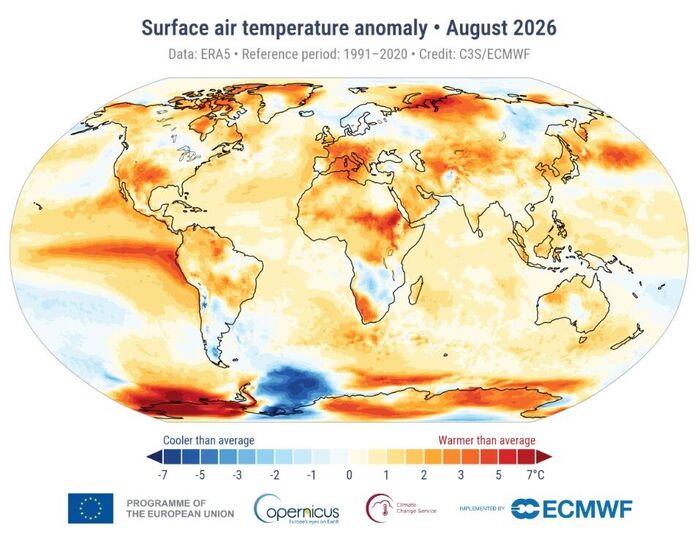
▲ Global Temperature Map for August 2026
The average global surface temperature for August of this year reached 16.96°C (63°F), tying the record for the highest monthly temperature since observations began, the European Union's Copernicus Climate Change Service (C3S) announced on the 10th (local time).
Expressed numerically, this is 0.01°C higher than the previous monthly record set in July 2023.
However, C3S scientists explained that because the difference falls within the margin of error, the two months are considered tied.
Comparing Augusts exclusively, August of this year was the hottest on record.
Previous records for August were 16.82°C (62°F) in 2023 and 2024.
The global average temperature for August of this year was 1.65°C higher than the average for the same month during the pre-industrial reference period (1850–1900), and 0.85°C higher than the average for the normal period (1991–2020).
The goal presented in the 2015 Paris Agreement was to keep the rise in global temperatures within 2°C compared to pre-industrial levels, and to strive to limit it to within 1.5°C.
According to Copernicus data, the top eight months with the highest temperatures on record all occurred in or after July 2023.
This year, the temperature in August was 0.06°C higher than in July, which is unusual.
Typically, July is the hottest month of the year.
According to observation records maintained by Copernicus since 1940, this is only the fifth time that August has been hotter than July, following 1945, 1951, 1955, and 1985.
The Northern Hemisphere summer (June, July, and August) of this year tied with 2024 as the hottest summer on record.
Compared to the same period in the normal years (1991–2020), it was 0.69°C higher.
The global average sea surface temperature for August tied with the record set in March 2024 as the highest ever.
August 22 of this year marked the day with the highest global average ocean temperature in observational history.
Comparing January to August each year, global temperatures ranked 2024 first, this year second, and 2023 third.
Experts note the possibility that El Niño may approach its peak around the end of the year, and expect high-temperature records to continue for the coming months.
Samantha Burgess, Deputy Director of C3S at the European Centre for Medium-Range Weather Forecasts (ECMWF), told AFP, "Humans have rarely experienced temperatures as high as these, for at least the past 100,000 years."
This conclusion was reached by scientists taking into account evidence of past temperatures preserved in glaciers, tree rings, and coral reefs.
Andrew Dessler, a climatologist at Texas A&M University, said in an email to AFP, "It is time to stop pretending to be surprised by the Earth continuing to get hotter," adding, "This is literally playing out exactly as scientists predicted decades ago."
He added, "The interesting question is not whether we will continue to break temperature records (of course we will), but whether we are going to do something about it, or just stand idly by while the climate train runs us over."
AFP analyzed C3S data and reported that 52 countries broke all-time high temperature records for the June–August period this year, with 1.3 billion people experiencing the highest temperatures on record for that time of year.
AFP pointed out that while weather agencies in countries such as France and the UK have published record high temperatures, quite a few countries do not disclose detailed climate data.
Copernicus stated that the average temperature in Western Europe from June to August this year also surpassed the previous record set in 2003, making it the highest on record.
Due to the prolonged heatwave that began in May of this year, droughts intensified in countries such as the UK, France, Hungary, Romania, and Serbia, while water levels in the Rhine, Danube, and Dnipro rivers dropped unusually low.
The U.S. National Oceanic and Atmospheric Administration (NOAA) also announced on the same day that the average temperature across the contiguous United States for June through August this year was 23.54°C (74°F), making it the highest summer temperature in 132 years of records.
This is about 0.2°C higher than the previous records set in 1936 and 2021.
The average temperature across the contiguous U.S. in August was 24.21°C (76°F), making it the hottest August since 1895.
The average daily high temperature also reached a record high of 31.42°C (89°F).
Zeke Hausfather, a researcher at Berkeley Earth, a non-profit research organization that analyzes climate science, pointed out that these records continue to be broken recently and that all-time highs were set in August rather than the traditionally hotter July, which is a sign that human-induced climate change is accelerating.
(Photo: C3S/ECMWF public data, Yonhap News)
※ Please note: This article was translated by AI and may contain errors.
Copyright Ⓒ SBS. All rights reserved. Unauthorized reproduction, redistribution, and use for AI training are prohibited.