SBS News
Gangnam 3 Districts See Apartment Prices Weaken… Seoul's Gain Narrows
Published : Sep 10, 2026 2:23 PM

▲ File image
Amid continuing uncertainties surrounding tax revisions that would increase the tax burden on high-priced homes and single-home owners who do not reside in them, apartment prices in all three districts of southern Seoul (Seocho, Gangnam, and Songpa) have turned downward.
According to the weekly apartment price trends for the first week of September (as of September 7) released by the Korea Real Estate Board today (the 10th), apartment sales prices in Seoul rose by an average of 0.20% compared to the previous week.
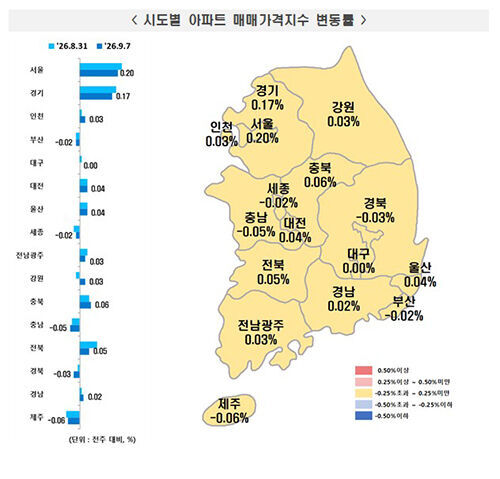
The gain narrowed by 0.02 percentage points.
The Korea Real Estate Board stated, "As properties with adjusted prices appeared in some areas, it led to lower-priced transactions, while sales prices rose mainly in major complexes such as large-scale complexes with high preference and areas near subway stations, resulting in an overall increase for Seoul as a whole."
The Gangnam 3 districts, where a high concentration of expensive homes is expected to face heavier tax burdens if future tax revisions are implemented, all shifted to a weak trend as Songpa District joined Gangnam and Seocho districts in declining this week.
Gangnam District (-0.35%) dropped mainly around large complexes in Apgujeong-dong and Daechi-dong, while Seocho District (-0.30%) expanded its decline by 0.07 percentage points compared to the previous week.
Songpa District (-0.02%) also turned downward for the first time in 21 weeks since the third week of April.
However, Seoul as a whole has maintained an upward trend for 83 consecutive weeks since the first week of February last year.
The record-longest rising period was from the second week of June 2020 to the third week of January 2022 (85 weeks).
Mid-to-lower tier areas where it is relatively easy to raise purchase funds through loans, such as Gangbuk District (0.46%), Dobong District (0.43%), Seodaemun District (0.43%), Seongbuk District (0.42%), Gwanak District (0.41%), and Jungnang District (0.40%), continued their upward trajectory.
In Gyeonggi Province (0.17%), Gwonseon-gu (0.48%) and Yeongtong-gu (0.47%) in Suwon, along with Hanam (0.47%), showed strong growth, and Incheon expanded its gain by 0.02 percentage points to 0.03%.
The greater Seoul area as a whole rose by 0.16%.
In non-metropolitan areas (0.01%), the four major metropolitan cities and seven provinces each rose by 0.01%, Jeonnam-Gwangju increased by 0.03%, and Sejong dropped by 0.02%.
Nationwide sales prices rose by an average of 0.08%.
Apt jeonse (lump-sum lease) prices nationwide rose by an average of 0.10% compared to the previous week.
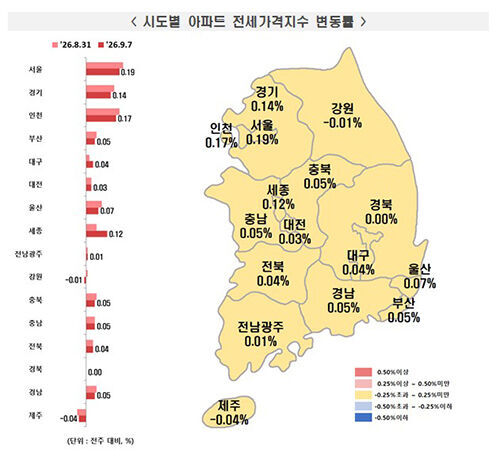
Seoul (0.19%) saw an overall increase as jeonse prices rose primarily in preferred complexes such as areas near subway stations and large-scale complexes, even as price-adjusted transactions were concluded in some complexes affected by new supply volumes or reconstruction.
However, the upward margin narrowed by 0.02 percentage points from the previous week.
Seocho District (-0.21%) widened its decline by 0.11 percentage points, falling for four consecutive weeks due to the impact of new move-ins at large complexes such as Raemian Trinione in Banpo-dong (2,091 households) and DH Bangbae in Bangbae-dong (3,064 households).
Gangnam District (-0.03%) saw its decline shrink by 0.1 percentage points compared to the previous week, but continued its weak trend for two consecutive weeks.
On the other hand, Nowon District (0.38%) maintained an upward trend focused on large complexes in Junggye and Sanggye dong, and Jungnang District (0.37%) around subway station areas in Junghwa and Sinnae dong. Seodaemun District (0.32%), Geumcheon District (0.32%), Seongdong District (0.31%), and Gangbuk District (0.31%) also posted large increases.
In Gyeonggi Province (0.14%), high growth rates were recorded in Gwangmyeong (0.37%), Jungwon-gu in Seongnam (0.33%), and Uiwang (0.33%), while Incheon rose by 0.17%.
The greater Seoul area as a whole rose by 0.16%.
In non-metropolitan areas (0.04%), the four major metropolitan cities rose by 0.04%, Sejong by 0.12%, Jeonnam-Gwangju by 0.01%, and the seven provinces by 0.03%.
(Photo: Provided by Korea Real Estate Board, Yonhap News)
※ Please note: This article was translated by AI and may contain errors.
Copyright Ⓒ SBS. All rights reserved. Unauthorized reproduction, redistribution, and use for AI training are prohibited.