SBS News
Hyundai Steel to Produce Low-Carbon Steel in US; Euisun Chung Says It Will Be Used for 'Atlas'
Published : Sep 5, 2026 1:22 PM

▲ Hyundai Motor Group Executive Chair Euisun Chung delivers a welcoming speech at the HPLS groundbreaking ceremony.
As Hyundai Steel embarks on constructing the United States' first electric arc furnace-based steel mill specialized for automotive sheets, steel produced here is projected to be utilized in various Hyundai Motor Group products, including the humanoid robot "Atlas."
Hyundai Motor Group Executive Chair Euisun Chung stated on September 4 (local time) at the groundbreaking ceremony for the "Hyundai Steel-POSCO Louisiana Electric Arc Furnace Steel Mill" (HPLS) held in Donaldsonville, Ascension Parish, Louisiana, in response to a reporter's question on whether the steel produced here could be applied to Atlas, "Naturally, I think it should be applied."
"I hope we can work harder in the future to supply steel for rockets such as SpaceX as well," Chair Chung added.
Hyundai Steel is building HPLS in Donaldsonville to produce a total of 2.7 million tons of hot-rolled, cold-rolled, and coated steel sheets annually, consisting of 1.8 million tons for automotive use and 900,000 tons for general use.
The investment cost stands at $5.8 billion (approximately 8 trillion KRW), with mass production targeted for 2029.
HPLS is an integrated steel mill that produces direct reduced iron (DRI)—a raw material for steelmaking—using iron ore and natural gas, and melts it in an electric arc furnace alongside high-grade steel scrap to produce final products.
Hyundai Steel explained that producing molten metal through this method can reduce carbon emissions by about 70% compared to the blast furnaces at Hyundai Steel's Dangjin Works.
Hyundai Steel plans to operate HPLS to alleviate burdens caused by U.S. steel tariffs while enhancing its accessibility to the North American market based on low-carbon steel products.
Having announced a multi-billion-dollar investment plan totaling $20 billion in the U.S., including the construction of the steel mill, at the White House in March of last year, Chair Chung assessed that HPLS taking its full-fledged first step is "proceeding on a normal track thanks to the concerted help of the state government and everyone involved."
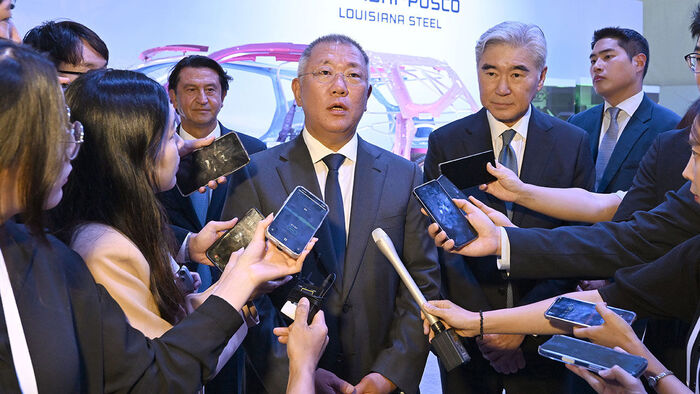
Mentioning that the U.S., which imports 20 million tons of steel annually, will be able to procure high-value-added special steel and low-carbon steel through HPLS, Chair Chung noted, "I think it will generate synergy as it benefits both sides (the U.S. and Hyundai Motor Group)."
José Muñoz, President and Global COO of Hyundai Motor Company, also met with reporters and said, "We want to use HPLS steel for the cars we produce in the United States." He added, "We plan to apply it to all vehicle models, as many as possible. We want to maximize the localization of steel used in our U.S. plants in Alabama and Georgia."
Highlighting that HPLS steel is produced locally in the U.S. and is a carbon-reduction product, President Muñoz conveyed, "Other automakers are also interested in [HPLS steel], and we will be able to produce and supply steel to them as well," adding, "We are actually in discussions with some companies."
(Photo provided by Hyundai Motor Group, Yonhap News)
※ Please note: This article was translated by AI and may contain errors.
Copyright Ⓒ SBS. All rights reserved. Unauthorized reproduction, redistribution, and use for AI training are prohibited.