SBS News
India Prepares for Nagoya Asian Games Without Athletes' Village by Living in Containers
Published : Sep 5, 2026 10:55 AM

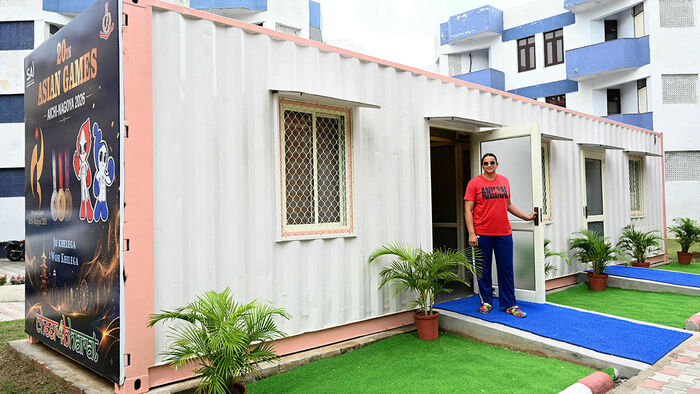
▲ Temporary container accommodation set up by India for local adaptation ahead of the Nagoya Asian Games
National athletes representing India at the 2026 Aichi-Nagoya Asian Games are undergoing adaptation training in temporary accommodations converted from shipping containers.
According to the Indian media outlet The Indian Express, the Sports Authority of India has converted 12-meter-long and 2.5-meter-wide shipping containers into accommodations at its training centers in Patiala, Punjab, and Bengaluru, providing them to national athletes. The report noted that this measure is due to the organizing committee's decision not to operate an athletes' village to cut costs, opting instead to use cruise ships, hotels, and containers as accommodations.
The Netaji Subhas National Institute of Sports (NIS) inspected the local sites in Japan and built accommodation facilities similar to the local environment by utilizing containers previously purchased for storing equipment during the COVID-19 pandemic.
Each container accommodation consists of two rooms and is equipped with air conditioning, a kitchenette, a bathroom, and beds.
Athletes who must stay in the container facilities during the games have been living there first for practice.
The NIS stated, "Currently, nine athletes have stayed in these containers, and more athletes will experience living here before departure."
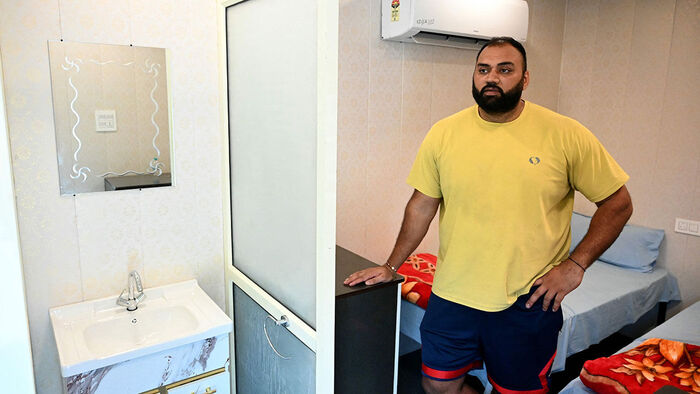
Indian national athletes who experienced living in the containers generally agreed that while it is inconvenient, it is something they must endure.
Seema Punia, an Indian national discus thrower, said, "The container was small so I couldn't sleep properly on the first night, but I soon got used to it. I was surprised to hear that we had to stay in containers because I naturally thought we would live in an athletes' village since the Asian Games is a major multi-sport international event."
She added, "However, we have to adapt because our most important goal is to win medals."
Tajinderpal Singh Toor, a national shot putter standing 193 cm tall, said, "When I was in college, I shared a room with four or five other teammates and laid out mattresses to save money. Staying here suddenly brought back memories of those days."
He continued, "It might be an issue for athletes with a large physique like me. Since I have mentally prepared myself, I will adapt well and achieve good results."
Indian authorities have adjusted not only the accommodations but also the training center's meal plans to match Japanese cuisine.
The media outlet reported, "Sushi is served almost once a day."
As the organizing committee is not operating an athletes' village cafeteria, this is part of the process of adapting to local Japanese diets.
At the 2022 Hangzhou Asian Games, India won 28 gold medals, 38 silver medals, and 41 bronze medals, finishing fourth in the overall rankings behind China, Japan, and South Korea.
For this tournament, India is dispatching 503 athletes, accompanied by 256 support staff and officials.
(Photo: AFP, Yonhap News)
※ Please note: This article was translated by AI and may contain errors.
Copyright Ⓒ SBS. All rights reserved. Unauthorized reproduction, redistribution, and use for AI training are prohibited.