SBS News

▲ Treasury Bonds, Government Bonds
Yields on South Korean Treasury bonds fell across the board today (the 3rd).
This marks the first decline in a week since the Bank of Korea's August Monetary Policy Committee meeting on Thursday of last week.
The downturn was influenced by a combination of factors, including foreign investors turning to a net buyers of treasury futures for the first time in six trading sessions, declines in long-term yields in major economies, and a stronger Korean won.
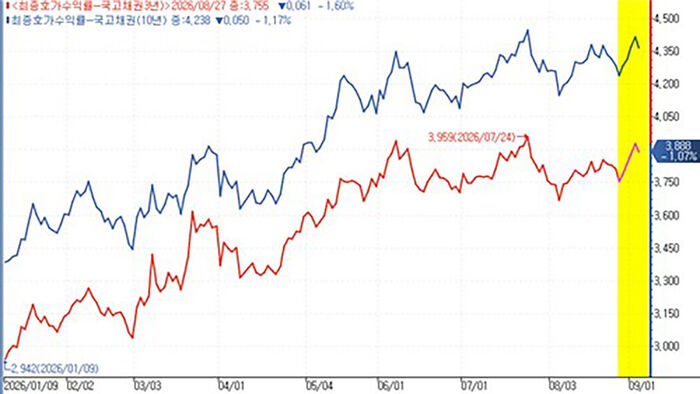
▲ Trends in 3-year and 10-year Treasury bond yields this year
In the Seoul bond market today, the yield on three-year Treasury bonds finished the session down 4.2 bps from the previous trading day at 3.888% per annum.
The 10-year yield fell 5.1 bps to 4.367% per annum.
The 5-year and 2-year yields dropped 4.9 bps and 5.0 bps, respectively, closing at 4.118% and 3.711% per annum.
The 20-year yield declined 2.1 bps to 4.593% per annum.
The 30-year and 50-year yields fell 2.2 bps and 2.1 bps, respectively, registering 4.635% and 4.542% per annum.
The three-year treasury futures rose 19 ticks from the previous day to close at 103.14, while the 10-year treasury futures increased 45 ticks to 105.20.
Foreign investors net-purchased 9,209 contracts of three-year futures and net-sold 74 contracts of 10-year futures.
Even though domestic monetary policy uncertainties were cleared following the Bank of Korea's consecutive base rate hikes last month, rising long-term yields in major countries such as the United States and Japan have been acting as a burden on the domestic bond market.
However, the decline in long-term yields in Asian markets such as Japan and Australia today served as a factor that somewhat alleviated that pressure.
In particular, the yield on Japan's 30-year government bonds plummeted by more than 10 bps during intraday trading.
The won-dollar exchange rate also fell to the mid-1,350 won range today, extending the appreciation of the Korean won against the dollar.
A fixed-income trader at a securities firm said, "The biggest factor seems to be that foreign investors, who had net-sold three-year treasury futures for five consecutive trading sessions, turned to buying. There was also a sense of burden regarding the yield levels that had risen following the Monetary Policy Committee meeting, along with several other contributing factors such as the continued stabilization of the won-dollar exchange rate."
(Photo courtesy of Korea Financial Investment Association and Yonhap Infomax, Yonhap News)
※ Please note: This article was translated by AI and may contain errors.
Copyright Ⓒ SBS. All rights reserved. Unauthorized reproduction, redistribution, and use for AI training are prohibited.