SBS News
"Could Young Generations Face a Crisis?"… Will Korea See a 'Lost Generation' Like Japan? The Real Reason Korea's Economy Is Unsettling
Published : Sep 3, 2026 9:03 AM
Cho Young-moo, Head of NH Financial Research Institute

Growth requires strength. The strength to remain unshakeable, the strength to reach higher. "Gyoyangi-reul Butakhae," the knowledge news program that makes you smarter the more you listen, provides you with the strength to grow into a cultured person alongside the best SPOT contributors.
Contributor Cho Young-moo
Head of NH Financial Research Institute
Former Research Fellow at LG Economic Research Institute
Macroeconomist
Head of NH Financial Research Institute
Former Research Fellow at LG Economic Research Institute
Macroeconomist
'Super-Polarization' Worse Than Expected... A Nation Leaning on Semiconductors Alone
Q. Late last year, you suggested that this year would see severe 'super-polarization' and an optical illusion. What do you think about the actual situation now?
This is a question I always get around this time of year, as economic players begin planning their business strategies for next year. That is why I previously shared keywords forecasting the South Korean economy in 2026.
"So when asked what next year's South Korean economy will look like, I offer two keywords: super-polarization and optical illusion."
▶ [Knowledge News] "Don't Be Fooled by the Optical Illusion"... Why Is the Current High Exchange Rate Dangerous? Revealing the Real South Korean Economy (feat. Cho Young-moo, Head of NH Financial Research Institute) / Gyoyangi-reul Butakhae (Dec. 28, 2025)
▶ [Knowledge News] "Don't Be Fooled by the Optical Illusion"... Why Is the Current High Exchange Rate Dangerous? Revealing the Real South Korean Economy (feat. Cho Young-moo, Head of NH Financial Research Institute) / Gyoyangi-reul Butakhae (Dec. 28, 2025)
'Super'-polarization refers to an extreme imbalance that cannot be explained by conventional polarization alone. And by optical illusion, I meant that while macroeconomic indicators would improve, a significant number of economic players would feel, "I don't really feel it," leading them to wonder, "Is this an optical illusion?"
To get straight to the conclusion, it has been even worse than expected. In terms of figures, South Korea's economic growth rate for 2025 was around 1%. However, regarding the 2026 growth outlook, many economic forecasting institutions have recently raised their forecasts for this year. Institutions that released their growth outlooks in August predict growth will exceed 3%. That is nearly triple compared to last year. Forecasts for the current account surplus—the amount earned through exports minus the amount spent on imports—are also continually being revised upward. Within this economy of ours, an extreme imbalance has emerged just as predicted by the keyword 'super-polarization', and it continues today.
To give a few examples, semiconductors accounted for over 40% of South Korea's total exports in July. If expanded to related ICT sectors, it exceeds 50%. While our economy has improved significantly compared to last year, semiconductors accounted for about 70% of that contribution to growth. Seventy percent of the incremental growth came from a single item.
Moreover, the scale of domestic facility investment in semiconductors alone announced by two companies—Samsung Electronics and SK Hynix—reached 43 trillion won in the first half of this year alone. That is a 35% increase compared to the same period last year. As mentioned earlier, our total economic growth rate this year might well exceed 3%. The growth rate of capital expenditures by these semiconductor companies is more than ten times that.
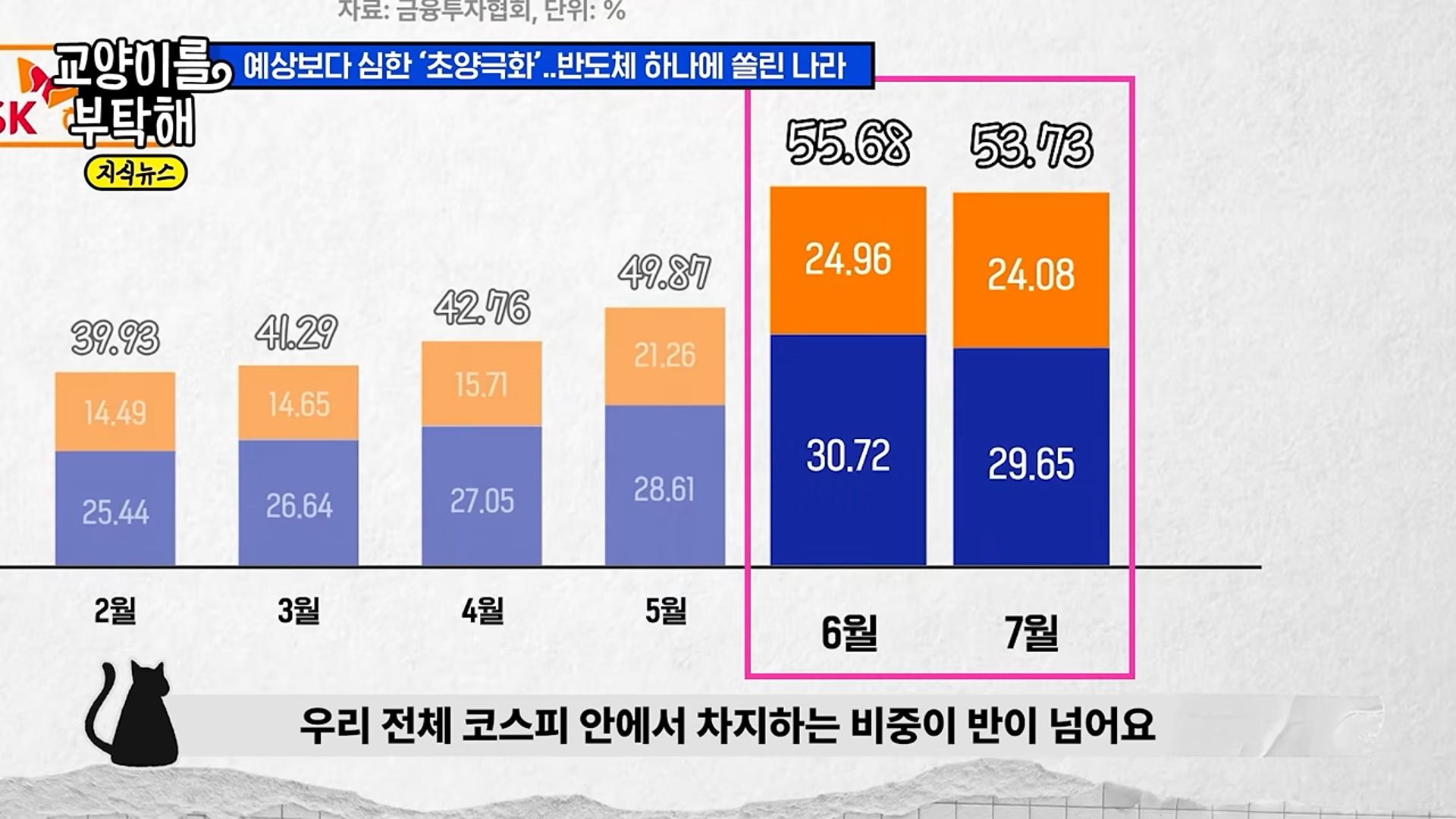
Profits are often evaluated in this manner as well. (Because financial sector companies earn money differently within the stock market,) Samsung Electronics and SK Hynix accounted for two-thirds of the total net profits earned by all non-financial KOSPI companies. Furthermore, as of the end of July, the combined market capitalization of Samsung Electronics and SK Hynix accounted for more than half of the total KOSPI. It has risen to a level similar to TSMC's share in the Taiwanese stock market. Our economy's growth, investment, production, corporate profits, and market capitalization are heavily skewed towards them.
South Korea's Economy: Headline Figures Improved, But the Warmth of Growth Is Skewed to One Side
Regarding the 'super-polarization' keyword I projected, some comments asked: 'Super-polarization? Is that a bad thing? It means semiconductors are doing well. It has been good since the second half of last year, so what is the problem? Isn't it actually remarkable? Shouldn't we praise them? Far more countries cannot do that, so what is the issue?'
However, things are not like they used to be. While there is talk that South Korea's economic growth rate could reach around 3% this year, we need to break down which sectors contribute how much to achieve that growth rate. How much did exports, private consumption, corporate facility investment, or construction investment contribute? When mapping this out, the picture is completely different from the 2017 semiconductor supercycle when we previously sold large volumes of semiconductors.
Back in 2017, our growth rate was quite good, and the contributions to growth from exports, private consumption, and facility investment were all evenly high. When we sold many semiconductors, the spillover effect led people to consume heavily and companies to invest substantially.
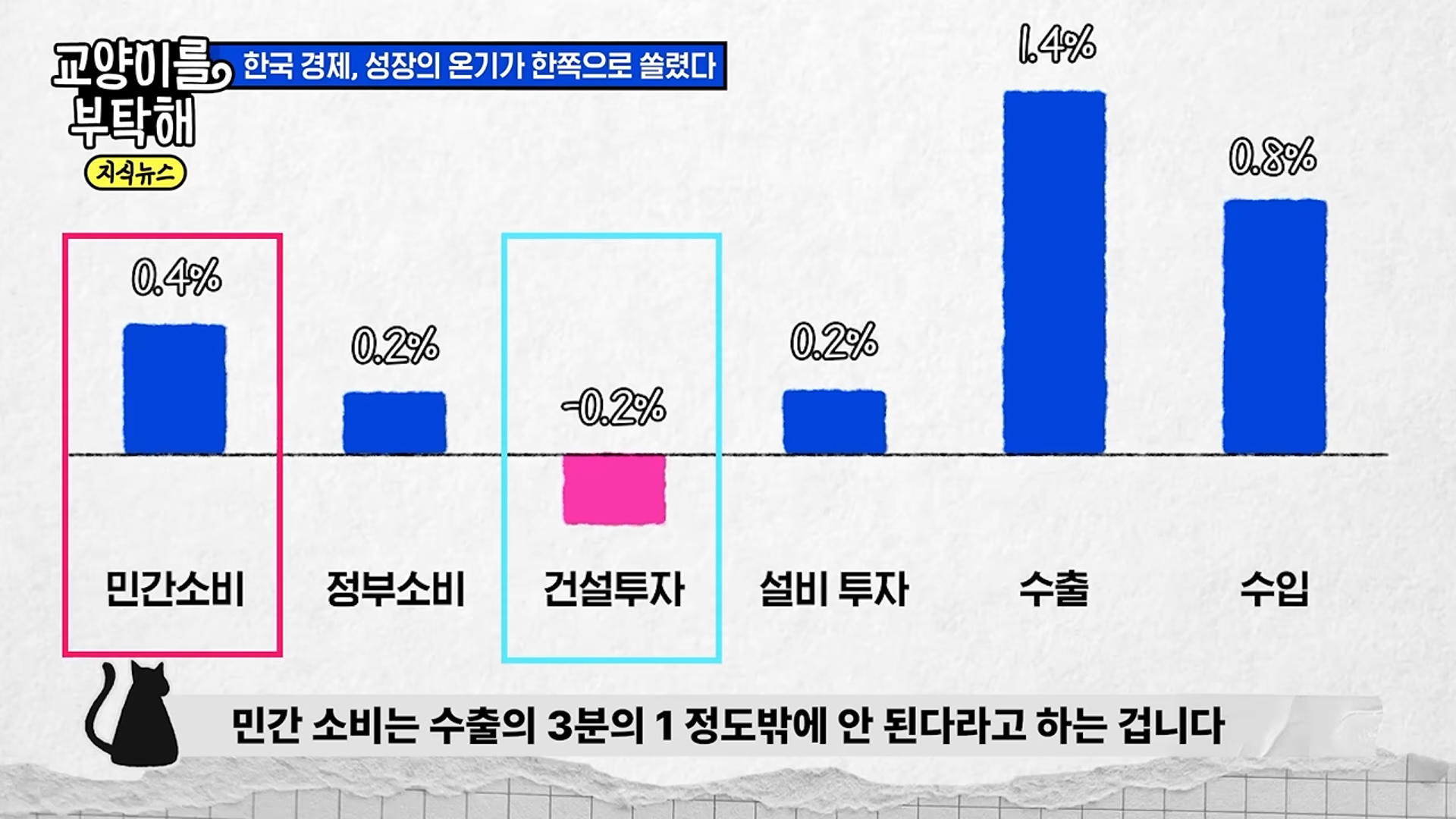
So what is different now? When breaking down either the economic growth rate or the contributions driving that growth, construction investment remains negative even as domestic demand has recently shown some recovery, while private consumption is only about one-third of exports.
What about ICT? It is manufacturing. Manufacturing looks strong on the surface. But let us break this down into large corporations and small and medium-sized enterprises (SMEs). The combined total figure for manufacturing looks positive. Yet, looking specifically at SME manufacturing, production in May this year fell by more than 3% compared to the same month last year. While large corporations are seeing significant growth, SME manufacturing recorded minus 3.7% year-on-year.
Consumption is also important. There are many small business owners and merchants. How do you feel? I feel polarization is exceptionally severe. Looking at retail sales growth by store type announced as of June, department store sales rose 14% compared to the same month last year. On the other hand, large discount marts, frequented by ordinary citizens, were not plus 14% but minus 14%. Spending by those with wealth posted large gains, while spending by others declined. Luxury department stores are reported to have grown by 40 to 60%. That is how severe the polarization is.
Why? Because earnings differ. As of the first quarter of this year, total employee wages grew by around 3% compared to the same period last year, which is close to this year's economic growth rate. However, through April, average wages at large electronics manufacturing firms rose by more than 60% year-on-year—20 times the total employee wage growth rate. Meanwhile, the average monthly wage in the construction sector fell by over 2% year-on-year. Some are earning more than 20 times more, while others cannot even earn what they did a year ago.
The conclusion is that macroeconomic indicators look positive. Aggregate economic indicators add everything up without distinction, whether coming from exports, consumption, or construction investment. Looking at the combined total figure, it has improved substantially compared to last year. That is why market capitalization and stock indices rose, and total exports grew. While the aggregate total looks favorable, examining the underlying details reveals an extreme imbalance.
Q. An extreme imbalance. The issue is that sectors other than ICT and semiconductors are seeing negative figures, right?
That is correct. The semiconductor industry neither hires large numbers of workers nor spreads its effects across diverse sectors. Large performance bonuses were distributed in the semiconductor industry, but what happens when employees receive those bonuses? With stock prices rising, they buy stocks. They buy homes. They spend on luxury goods at department stores. Consequently, despite vast sums of money being distributed, the warmth does not spread across the broader economy.
Within the stock market as well, share price gains were concentrated in a few companies, a few sectors, large-cap stocks, and expensive shares. To benefit, one needed surplus funds to trade stocks and buy Samsung Electronics and SK Hynix. Over the past year of the bull market, the age group that recorded the highest investment returns was, unusually, those in their 50s. Furthermore, in another unusual trend, larger capital allocations correlated with higher returns. Typically, investors with smaller capital trade more aggressively, but here, those deploying larger sums earned higher returns. Investors who had surplus capital and enough money to purchase expensive large-cap stocks achieved higher returns. It is highly likely that this was an asset market where only those individuals made meaningful gains.
As a result, the growth in exports, production, and market capitalization driven by semiconductors and ICT was not in a pattern that allowed many economic players to feel that the warmth was spreading evenly as it once did.
2027 South Korean Economy Keyword ① The Cost of Growth Focused on Chips... Why Korea Is Becoming a 'Volatile Economy'
Looking ahead to 2027, what keyword best describes South Korea's future economy? A 'Volatile Economy'—an economic state characterized by high volatility and instability, with sharp ups and downs and fluctuations.
While overall headline numbers are improving, there is heavy concentration. That concentration is happening in ICT, semiconductors, and AI-related fields. Because their share in production, investment, and market capitalization is exceedingly high, and because this involves a very small number of sectors and roughly two companies, any downturn in the semiconductor cycle would not simply be an issue for one or two firms like Samsung Electronics and SK Hynix. It would affect GDP production, total corporate investment, gross exports, total market capitalization, corporate earnings, and consumption by certain groups. Ultimately, it affects our economic growth rate, total exports, current account surplus, market cap, and stock indices overall, meaning the circumstances of just two companies can shake macroeconomic indicators.
Then, what characteristics does this sector have? That is why we examined business volatility. Sectors with high business volatility include shipbuilding, ICT, and semiconductors. Conversely, domestic demand, private consumption, and services do not exhibit high business volatility (since people must eat and live even in a downturn). How large is the difference? We calculated the business volatility—the standard deviation of operating profit margins—for electrical, electronics, and machinery industries, which include IT.
Business volatility in ICT and electrical/electronics is double the manufacturing average. Compared to service sectors such as dining, food service, and travel, volatility is five times greater. When that sector performs well, the entire economy thrives; when it stumbles, the whole economy is prone to distress. In short, South Korea's overall economic structure is becoming more volatile. That is why the keyword 'Volatile Economy' came to mind.
2027 South Korean Economy Keyword ② The Aftermath of a Sudden Boom... A Korean-Style 'Dutch Disease'
'Dutch Disease' (a phenomenon where the rapid development of one sector in a national economy harms the growth of other sectors). Around 1959, massive natural gas reserves were suddenly discovered in the Netherlands. Consequently, exports surged dramatically. Much like semiconductors booming in Korea's economy today, exports surged, foreign currency poured in, current account surpluses widened, and tax revenues climbed. Yet after that period passed, the Dutch economy experienced a sudden downturn. In short, it is the aftermath of an unexpected boom.
Why did that happen back then? As resource exports brought in foreign currency, the value of the Dutch currency appreciated. When that happens, the price competitiveness of a country's export goods deteriorates, and exports falter. Furthermore, because the natural gas sector was making substantial profits, wages were raised there, much like the recent large bonus payouts in semiconductors. As a result, talented and capable individuals across the Netherlands flocked to that sector. Other industries thought, 'Do we need to raise wages to retain our workforce?' so wages rose across the board. Because resources were absorbed there, overall costs rose and prices surged. Other manufacturing and export sectors suffered from rising costs and weakened competitiveness despite having done nothing wrong.
Additionally, because one sector was generating massive profits, corporate tax revenues naturally soared. With abundant tax revenue, the Dutch government expanded welfare and public spending. However, this resource boom did not last forever. Once it ended, what happened? Welfare and public expenditures are known as rigid expenditures. Once increased, they are difficult to cut. Consequently, while tax revenues no longer flowed in as before, expenditures had to continue, leading to deteriorating fiscal conditions.
South Korea shares both similarities and differences. What is similar? The sudden transformation. In the Netherlands, it was natural gas; in our case, it is semiconductors. The world needs semiconductors to advance into AI, and memory prices rose in that process. However, the sudden windfall of natural gas in the Netherlands was a discovery, not the result of deliberate effort; it had nothing to do with technological prowess. In contrast, our ability to capitalize on the semiconductor boom stems from Samsung Electronics and SK Hynix continuously advancing technology and developing products even under challenging circumstances. Because it is rooted in technological competence, this boom has the potential to contribute to future productivity, industry, and technological development. This is a difference from the Dutch experience, and a positive one.
Another difference has both positive and negative aspects. Although Samsung Electronics and SK Hynix paid out substantial performance bonuses, these bonuses are not being dispersed evenly. They are spent selectively on stocks, housing, or luxury consumer goods. Consequently, the effect of spreading warmth throughout the broader economy is limited. The semiconductor industry also has a relatively low employment inducement effect. Just because business is booming does not mean they are hiring indiscriminately. Therefore, side effects such as labor draining from other sectors and broadly driving up wages across other industries are not as severe as during the Dutch Disease era. In short, positive spillovers are limited, but negative spillover effects are also limited. This stems from the characteristics of the semiconductor industry.
Another difference is negative. When Dutch Disease occurred, financial markets were not as developed. Compared to the 1950s, financial and stock markets today are vastly more advanced and larger in scale. Over the past year, South Korea's stock market surged primarily around Samsung Electronics and SK Hynix, and then pulled back. The financial market channel is far more critical in today's Korean economy than during the historic Dutch Disease period. People took on debt to invest, only to get trapped or suffer losses, meaning this does not end simply as a concentration within financial markets—it can also impact the real economy. Capital intended for consumption or home purchases flowed in that direction. Compared to the past Dutch Disease era, the significantly heightened importance of this financial market channel in the recent South Korean economy is a concerning factor.
South Korea's Fluctuating Economy and Growing Volatility... Why the Role of 'Fiscal Policy' Is Crucial
What policy implications does this hold? A boom occurred intensively in a specific sector, which will generate substantial tax revenues. Back then, the Netherlands substantially expanded welfare and fiscal spending. South Korea is also collecting considerable tax revenue and expecting tax increases. In my view, the government is inclined to spend heavily. Semiconductors are strong, growth rates are high, and corporate tax receipts are substantial. If the government spends the heavily collected tax revenues, economic growth will rise further.
However, what if semiconductors face difficulties? Growth rates will drop, tax revenues will fall, and the government will lack funds to spend, causing fiscal expenditures to contract. Then negative trends turn even more negative. The economy's ups and downs will become more severe. This aligns with the concept of a Volatile Economy. That is why fiscal policy is critical. Depending on how it is managed, it can make booms even hotter and busts even deeper, or it can cool things down during booms and cushion downturns during busts. Managing fiscal policy going forward will be exceptionally important.
There is no single correct answer. It is ultimately a matter of judgment, and macroeconomists exist to assist policy decisions. Tax revenue will undeniably be abundant because semiconductor firms made massive profits, resulting in high corporate tax collections. The issue lies in how that abundant tax revenue is utilized.
For instance, with abundant tax revenue, one could say, 'National debt has grown significantly over time; let us pay down the debt.' The government could use the tax money collected from booming sectors to repay debt without increasing expenditures. While that might not directly stimulate the economy immediately, it could create response capacity for the future. However, current policy direction does not appear set in that direction. We likely have to take that as a given. Therefore, if the direction is set this way, my focus is on discussing how best to spend it.
Q. There are also concerns that this could manifest as strong volatility later on.
Inevitably so. In economics, collecting taxes during economic expansions to cool the economy down and holding onto those taxes to expand government spending during downturns—thereby dampening the amplitude of business cycles—is referred to as automatic fiscal stabilizers. An established principle in macroeconomics is that well-designed tax systems, maintained under consistent principles, can cool the economy when it overheats and cushion the fall when downturns deepen.
Youth Employment, a Problem Bigger Than the Numbers... "Polarization Surrounding Jobs Has Begun"
Q. In this situation, the worsening employment conditions for young people are particularly concerning. What aspects are you worried about, and why?
Unfortunately, from what I see, conditions are exceptionally difficult. Don't you feel it as well? The macroeconomic numbers macroeconomists look at are always lagging indicators. They are compiled and released one or two months late. Even so, looking at the data reveals clear insights, even without asking people directly.
As of June, the unemployment rate for people in their 20s stood at 7%. That is a 1.0 percentage point increase from a year earlier. A 1.0 percentage point rise is very large relative to South Korea's overall unemployment rate levels. Among all age groups, people in their 20s have the highest unemployment rate. Right now, 7 out of every 100 individuals are unable to work.
The labor force participation rate—the proportion of the population actively seeking work—for people in their 20s was 64.2% as of June this year. It dropped by 0.8 percentage points in a single year, the largest decline among all age groups. Out of 100 people, 64 are working or seeking work but unable to find a job. The remaining 36 did not engage in job-seeking activities. This ratio continues to decline. The number of young people giving up on job searching is increasing.
The cause connects directly to our economy's super-polarization phenomenon. Young people think, 'I need to be cautious when looking for a job.' Don't they feel that entering a large conglomerate will keep them secure, whereas entering a struggling sector might leave them facing persistent hardship?
Our economy shows positive growth rates and export growth rates, but they are concentrated in ICT and semiconductors. How does this reflect in jobs? From 2020 to 2025, the average wage growth rate in IT and manufacturing was 2.3 times higher than in health and social welfare services. Compounded over five years, that difference is enormous.
Yet semiconductors and IT do not hire many people. The employment inducement effect (the ability of a specific industry or economic activity to create new jobs) of the semiconductor industry is only one-fourth that of the service industry. As a result, the number of employed persons in manufacturing in June decreased by 100,000 compared to the same month last year, continuing a multi-year trend of declining by 100,000 workers annually.
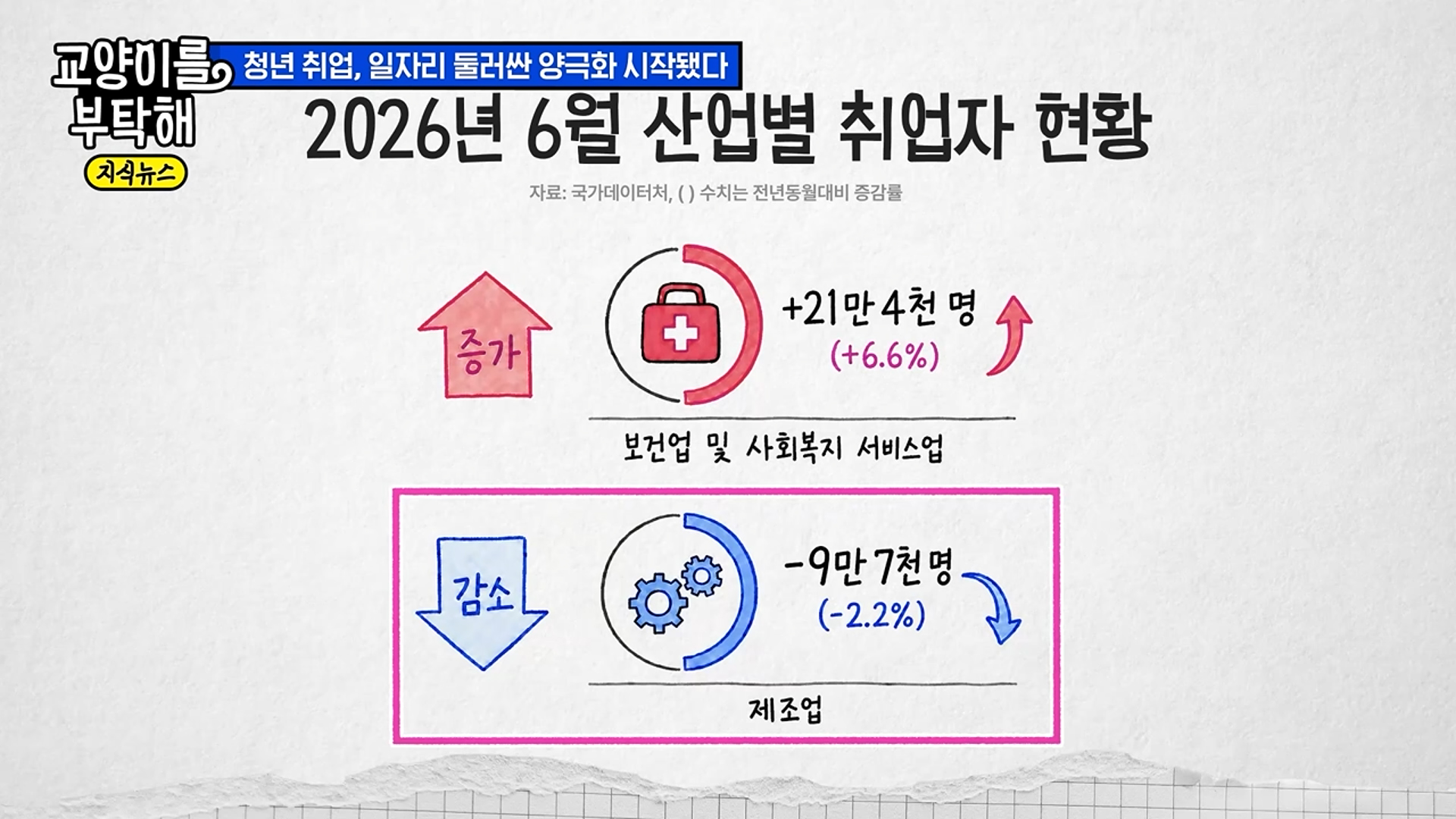
On the other hand, health and social welfare services saw employment increase by over 200,000 people in June compared to a year ago. In other words, sectors where young people find employment in large numbers offer lower average wages, while sectors they aspire to join are continually reducing recruitment numbers. Sectors where young people want to work are barely hiring, while sectors they are reluctant to enter are hiring extensively. In short, the overall quality of jobs is deteriorating.
Under these conditions, if someone is in a position to retry job preparation, hold out, and aim for a desirable position, they would want to hold out. Those whose parents have the financial capacity hold out; those who do not are forced to take whatever employment is available. The employment situation among youth is also becoming polarized.
What have been the hot topics in South Korea's economy? Stock market swings, real estate prices, related housing policies, tax systems, household debt, and Trump's tariff policies—all are important. But youth employment is also critical. Can we afford to leave this generation like this? They are not strangers. I hope more attention is directed toward this issue from that perspective.
https://youtu.be/BL7SSEWGkLQ
Subscribe to the <Gyoyangi-reul Butakhae> YouTube channel to watch more content.
※ Please note: This article was translated by AI and may contain errors.
Copyright Ⓒ SBS. All rights reserved. Unauthorized reproduction, redistribution, and use for AI training are prohibited.